

About the authors: Jim Krane is the Wallace S. Wilson Fellow for Energy Studies at Rice University’s Baker Institute and the author of the 2019 book Energy Kingdoms. Mark Finley is the fellow in energy and global oil at Rice University’s Baker Institute.
Until this week, Russian President Vladimir Putin’s isolation was acute. The uproar from his 2022 invasion of Ukraine limited his travel to “safe” destinations such as China, Iran, and former Soviet republics.
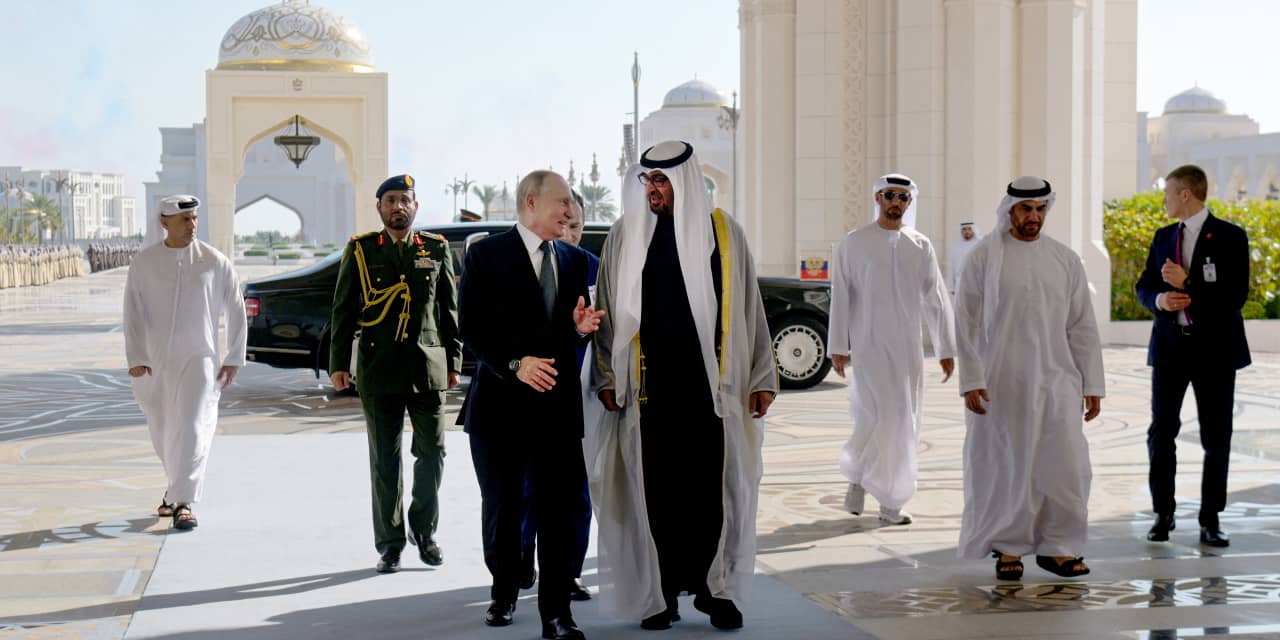
That period is over. Putin received warm embraces during his visits to two of Washington’s closest partners, Saudi Arabia and the United Arab Emirates. That diplomacy appears to have put Russia on a path to rehabilitation. Now the question is whether oil markets that shrugged off last month’s OPEC meeting will reverse their declines.
Whether it’s Putin’s newfound support for the Palestinian cause, common interests in higher oil prices, or the increasing appeal for Saudi Arabia and the UAE in breaking out of the U.S. orbit, Russia’s involvement is surprisingly welcome in the Middle East.
The consequence of Russia’s 2016 entry into the OPEC+ bloc has been underappreciated. Russian membership reinvigorated the cartel’s flagging geopolitical influence. OPEC’s global oil oversight went from 36% of the market to 53% by adding the “plus” countries, with Russia by far the biggest. That’s about the same share OPEC held when the Arab oil embargo was launched 50 years ago.
Putin has used OPEC to unwind the West’s attempts to isolate him after his Ukraine blunder. Now, another opening has emerged in the form of the Israeli onslaught on Gaza.
Israel has struck back aggressively after Hamas’s terror attack. The Russian president has repeatedly blamed Washington for the civilian carnage that has horrified the Arab world and much of the global South, pointing to U.S. military, diplomatic, and economic backing for Israel. Putin’s accusations of Western double standards have found sympathetic ears in Riyadh and Middle Eastern capitals already disdainful of the Biden administration.
Since Russia and Saudi Arabia control nearly a quarter of global oil supply, the meeting between Putin and Saudi Crown Prince Mohammed bin Salman in Riyadh this week should focus minds in Washington.
While OPEC+ leaders insist oil production decisions are based on market forces, Gaza provides a new rationale for price hawkishness. After all, protesters across the Muslim world are demanding a forceful response. Making American voters pay higher gasoline prices sends that message, just as it did in 1973 when another of Washington’s interventions in support of Israel triggered the infamous embargo.
Oil prices are a blunt political instrument, however. In a global marketplace, U.S. consumers aren’t the only ones hurt. So are drivers in China, India, and everywhere else.
Of course, the regimes of OPEC+ also need the money. Crude oil prices have sagged below the group’s unofficial $80 floor and Russia has a war on. In the Saudi case, Mohammed bin Salman’s “gigaprojects,” which have failed to attract much foreign direct investment, are pushing the state budget into deficit. The International Monetary Fund estimates that the kingdom needs at least $86 per barrel to balance its budget. In other words, higher oil prices help.
Now begins the work of enforcing cuts of some 2.2 million barrels a day agreed on Nov. 30. The biggest hurdle to a forceful oil market response is Russia’s reluctance to match production sacrifices made by the big Arab producers.
Quota parity between Russia and the kingdom has been a cornerstone of OPEC+. That represents a face-saving gesture from Riyadh, since Saudi capacity significantly exceeds that of Russia. But parity has become increasingly unrealistic as G7 sanctions bite into Russian output. Even so, Saudi Arabia continued to maintain the façade until recently. Even when Russia accepted a lower production quota than Saudi Arabia in June, the Saudi oil minister announced additional voluntary cuts.
That situation remains in effect today. Saudi voluntary cuts amount to 1.5 million barrels a day. (And this doesn’t count an additional 2 million barrels a day of capacity Saudi holds as a strategic buffer.) Russia’s cuts are just 0.5 million barrels a day. Even the much smaller UAE has been curtailing more than Russia, a whopping 1.6 million barrels a day or more than a third of its estimated 4.5 million barrels a day capacity. This imbalance surely came up during Putin’s brief stays in Abu Dhabi and Riyadh.
But the imbalance goes beyond burden-sharing. OPEC has become a vehicle for Putin to reverse his isolation and to insert himself into the nearly 80-year U.S.-Saudi friendship. It’s no coincidence that the new Russian-Saudi “strategic relationship” coincides with cooling U.S.-Saudi ties.
Putin is paying pennies on the dollar for these diplomatic, economic, and geopolitical gains. Saudi watchers can’t help but wonder what—besides modest support for oil prices—Riyadh is getting in return.
Finally, weakening oil prices suggest that markets have written off the potential for the Gaza war to bleed into the oil market. That may be premature. Israeli-Arab conflicts have a knack for playing out in multiple arenas.
One potential platform for extended conflict is in and around the Red Sea, where the Houthi—who control much of Yemen—have hijacked an Israeli-linked ship and launched missiles and drones toward southern Israel. Already, tanker owners are readying alternate routes that avoid the Red Sea.
More worrying would be a broadening of the conflict to include Iran, which bankrolls many of the anti-Israel paramilitaries in the Middle East. When Iran responds to the U.S. or Israel, it tends to do so in ways that raise costs for American motorists. This is a fairly simple matter in the target-rich environment of the Persian Gulf.
The disruptive Holy Grail is a closure of the Strait of Hormuz, which could devastate global oil and liquefied natural gas supply chains. The U.S. Energy Department estimates that fully one-fifth of the world’s oil production—21 million barrels a day—flows through the strait.
These are the sorts of reasons that the U.S. still maintains a Strategic Petroleum Reserve. Right now, that reserve is nearly half empty. When it comes to oil markets, especially heading into an election year, complacence is risk.
Guest commentaries like this one are written by authors outside the Barron’s and MarketWatch newsroom. They reflect the perspective and opinions of the authors. Submit commentary proposals and other feedback to [email protected].
Read the full article here