

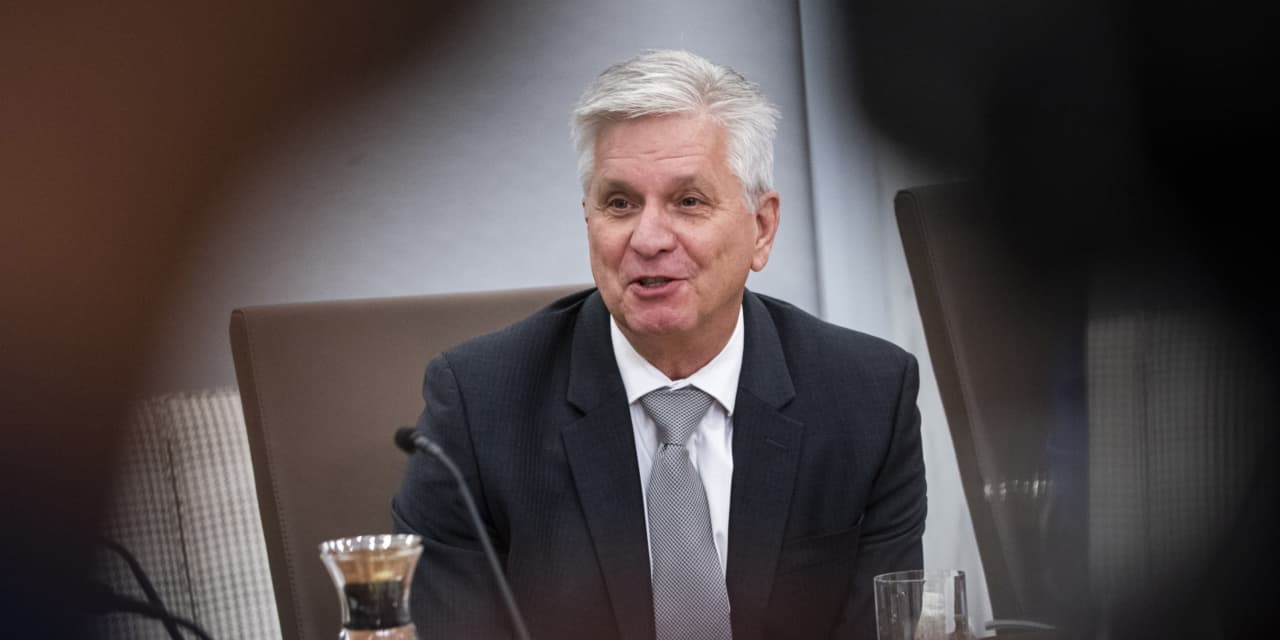
Federal Reserve Gov. Christopher Waller urged a slow and cautious approach to easing monetary policy this year, given a still-uncertain outlook for inflation and recent strong economic data. His comments on Thursday evening were the latest in a string of Fed officials talking down the likelihood of near-term interest-rate cuts.
“The data that we have received…has reinforced my view that we need to verify that the progress on inflation we saw in the last half of 2023 will continue and this means there is no rush to begin cutting interest rates to normalize monetary policy,” Waller said in prepared remarks for a Thursday evening event in Minneapolis, Minn. organized by the Notre Dame Club of Minnesota and University of St. Thomas. His speech was titled “What’s the Rush?”
Waller is a voting member of the Federal Open Market Committee, the Fed’s policymaking body, and has served on the Fed’s Board of Governors since December 2020.
Since the FOMC’s last meeting in late January, major U.S. economic data has come in stronger than expected. Fourth-quarter real gross domestic product grew at a 3.3% annualized rate, employers added 353,000 jobs in January, and measures of inflation for the month interrupted a multi-month trend of decelerating price increases. The core consumer price index, which excludes volatile food and energy components, rose 0.4% last month to stretch its 12-month gain to 3.9%.
“I am going to need to see at least another couple more months of inflation data before I can judge whether January was a speed bump or a pothole,” Waller said.
It’s simply too early to make a confident call that inflation is on a sustainable path toward the Fed’s 2% goal, Waller said, and the central bank doesn’t want to risk easing too soon and seeing inflation reaccelerate. At the same time, the healthy economy and labor market means that the Fed isn’t under pressure to lower interest rates to support demand and GDP.
“With most data indicating solid economic fundamentals, the risk of waiting a little longer to ease policy is lower than the risk of acting too soon and possibly halting or reversing the progress we’ve made on inflation,” Waller said.
Waller said he isn’t concerned about the other extreme: that by not lowering interest rates in the coming months the Fed risks waiting too long and pushing the U.S. economy into a recession. “In the absence of a major economic shock, delaying rate cuts by a few months should not have a substantial impact on the real economy in the near term,” he said.
Waller said he does expect economic growth to moderate in 2024, and said he was closely watching indicators of hiring and job openings and shifts in consumer demand for direction. He added that the tight labor market was pushing up wages, contributing to higher inflation. Waller said that he sees predominantly upside risks to the Fed 2% annual-inflation goal, again arguing for a wait-and-see approach to rate cuts.
“On the flip side, I see little reason to expect that inflation will run below 2% for an extended period given the strong economic fundamentals we are observing in GDP and employment,” Waller said. “For these reasons, I am going to need to see a couple more months of inflation data to be sure that January was a fluke and that we are still on track to price stability.”
Futures-market pricing implies about a 30% likelihood of a reduction in the federal-funds rate—currently at a target range of 5.25% to 5.50%—at the FOMC’s May meeting and 70% odds for a rate cut in June.
Write to Nicholas Jasinski at [email protected]
Read the full article here