

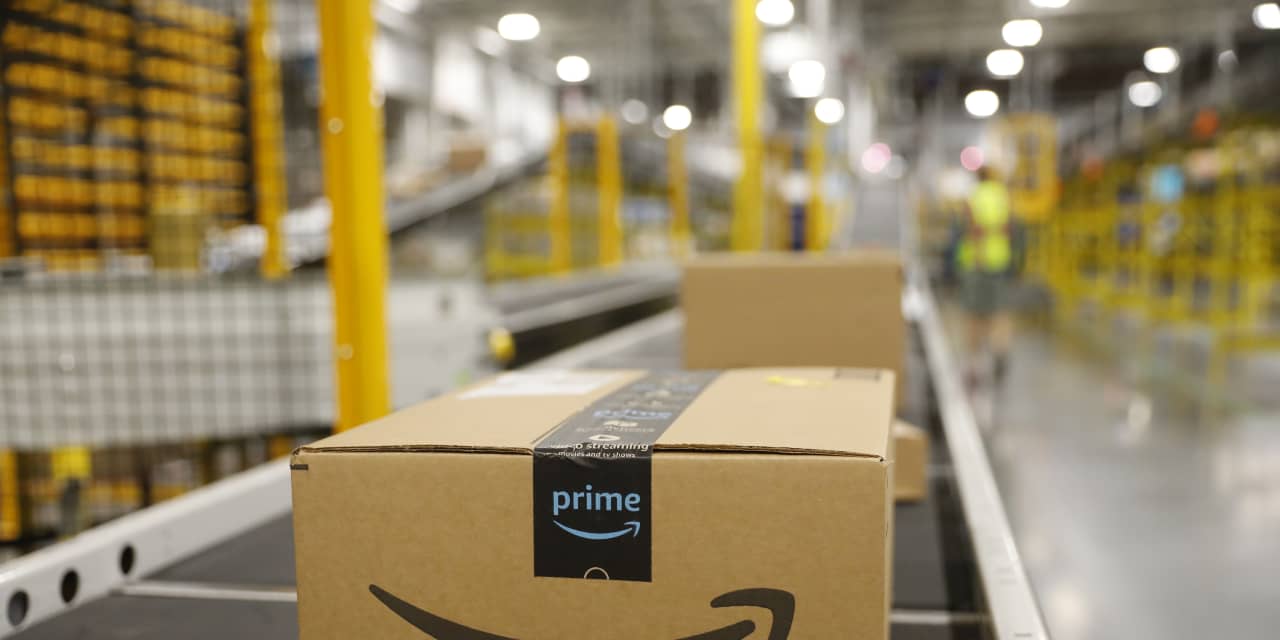
Just call me Top Gun Maverick, because I’ve got a boldly contrarian investment idea for 2024. Real defy-the-crowd stuff. It’s
Amazon.com
stock.
I’m not the first to notice it. Okay, it’s the world’s most recommended stock. Among 57 Wall Street forecasters who cover it, 56 say to buy. The lone Negative Ned says hold.
Also, Amazon has already had a teensy bit of a run. Shares have multiplied seven times in value over the past decade, including a 75% gain just this year. They’re not quite in the deep value bin, either, at 40 times this year’s projected free cash flow, versus 25 times for the
S&P 500.
But that’s just it. According to a consensus of old investment tropes, the stock must be headed for trouble. Avoid herd mentality, they say. Don’t chase past performance. Buy low.
That means that recommending Amazon at this point is so conformist that only a daredevil would attempt it. It’s a classic double-contrarian reverse. If you need me, I’ll be out here on this limb.
To see why Amazon could continue outperforming in 2024, let’s look at some recent financial estimates. There is relevance here to more than just those holding or considering the stock. The top 10 companies in the S&P 500 recently made up 35% of the index’s value, the most since the 2000 internet stock bubble. Index fundholders have thrived over the past decade, but returns from here could depend on how soon Amazon and some of its peers can grow into their share prices.
For a $1.5 trillion company, Amazon remains a peppy grower—and maybe a reaccelerating one. J.P. Morgan predicts 13% overall revenue growth next year, excluding the effect of currency swings. That’s two points faster than its estimate for this year. And it springs from both of Amazon’s biggest businesses.
In Amazon Web Services, the cloud computing business, revenue growth next year is pegged at 17%, up from 13% this year. And in retail, including Amazon’s online stores and its third-party services for other sellers, revenue could rise 11% next year, up from 9% this year. The growth surge will pad margins. JPM predicts $51 billion in operating profit next year, for a 7.9% margin, up two points.
This upshift didn’t come cheaply. Back in 2019, Amazon cleared more than $25 billion in free cash, which had ramped up from less than $2 billion in just five years. Then it set off on a massive investment spree. One goal was to improve its order fulfillment network to the point where much of its Prime shipping could be done in one day rather than two. Another was to build out its cloud infrastructure with artificial intelligence chips and software to allow ordinary tech departments to perform valuable new tricks with their data.
That investment push took capital expenditures from less than $13 billion in 2019 to $58 billion last year. It also turned free cash flow sharply negative for the past two years. But now the spending is bearing fruit. This year, the consensus puts free cash flow at $38 billion. JPM sees it hitting $53 billion next year and $74 billion in 2025. It calls Amazon its top large-cap internet pick. Its price target of $190 implies 29% upside from recent levels, and works out to 25 times projected 2025 free cash flow.
How expensive is that? Using year-after-next free cash projections for two other companies that are big in retail and cloud computing, Amazon at $190 would be only slightly more expensive than
Walmart,
and a bit cheaper than
Microsoft.
This assumes that Amazon won’t just find new ways to spend all of that incoming money. But already baked into those free cash estimates is the expectation that yearly capex will remain well north of $50 billion, leaving Amazon the biggest spender in the S&P 500 by far.
Opportunities abound for more revenue growth and margin improvement. Some 90% of information technology is still handled on-premises, leaving plenty of room for cloud migration. Of retail, Amazon CEO Andy Jassy recently said, “We have a long way before being out of ideas to improve cost and speed.”
In three years, Amazon could generate $100 billion in free cash, on its way to rivaling Microsoft,
Apple,
and, depending on the price of crude in any given year, Saudi Arabia’s oil monopoly for the title of most cash generative company on earth. I’m not clear on how Amazon would put all of that money to work, even if it wanted to.
For scale, the U.S. Navy’s shiny new nuclear supercarrier, the USS Gerald R. Ford, is the world’s largest and most expensive warship, costing 30% more than initial estimates. With $100 billion in free cash flow, Amazon could pay sticker price for seven of them a year. I’m guessing a dividend would make more sense than going into the strike-group-as-a-service business, but you get the idea. Amazon is cheaper than it looks, based on an approaching swell of free cash that appears both epic and inevitable.
Now a quick word on batteries. Higher interest rates haven’t been kind to the solar business, including the shares. The
Invesco Solar
ETF has lost 30% this year. But BofA Securities came away from hosting its yearly Energy Storage Conference, calling it “the single most upbeat in our history.”
Utilities still need help smoothing out power production from all those new solar and wind farms. Firing up natural gas when needed is an option, but so are utility-scale batteries, and demand for those is growing faster than for natural gas generation, not least because the price of lithium ion phosphate used to make batteries has plunged by nearly three-quarters this year.
BofA predicts a “step function increase in storage deployments”—a lot more, in other words, especially in California for policy reasons, and Texas for economic ones. To invest in the trend, the bank recommends shares of a $4 billion utility battery specialist called
Fluence Energy.
It’s threatening to turn to profitability this year, after which sales are seen doubling over three years, to $6 billion.
Write to Jack Hough at [email protected]
Read the full article here