
A breathtakingly racy La Calisto and a compellingly sung Louise at Aix-en-Provence Festival — review

Unlock the Editor’s Digest for free
Roula Khalaf, Editor of the FT, selects her favourite stories in this weekly newsletter.
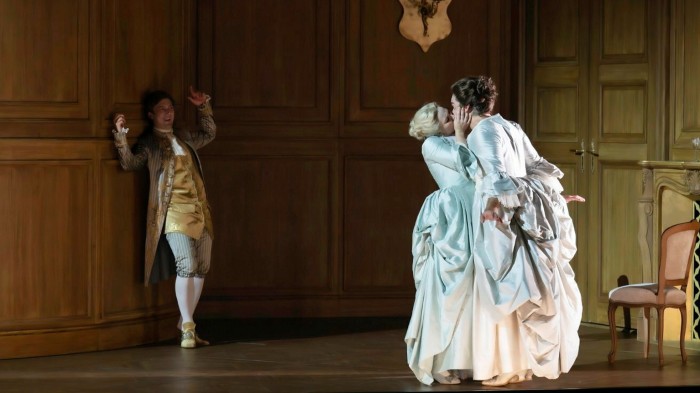
The nymph Calisto was decentring men for Venetian audiences back in 1651. Giovanni Faustini’s racy libretto for Francesco Cavalli’s opera La Calisto is breathtaking in its sexual openness: when Jupiter transforms himself into his own daughter, the huntress Diana, to seduce the nymph, the 17th-century queerometer must have been touching the far end of the red zone.
Though Calisto has vowed chastity, she is more than willing to “enter the grotto” with Diana; Jupiter gets what he wants, while his actual daughter — who also signed the purity pledge — is sneaking lovemaking with poet Endimione. It’s all there in Ovid’s Metamorphoses, which was so much more than Fifty Shades of Grey in Latin. In Faustini’s shockingly explicit retelling, with Cavalli’s equally bold music, this is an opera about sex and lust, desire and dominance, consent and its absence.
La Calisto is the second rarity to hit the beautiful open-air courtyard stage of Aix-en-Provence’s historic Théâtre de l’Archevêché this summer. The first, Gustave Charpentier’s 1900 Louise, was premiered two days earlier. Both are the legacy of Festival d’Aix-en-Provence director Pierre Audi, whose sudden death in May left the music world reeling. Ever since he took the helm of Dutch National Opera in 1988, at the age of 31, Audi’s programming consistently expanded the operatic repertoire, from high-carat stagings of neglected baroque gems to works where the ink was still wet on the page.
Death, wrote Goethe, is an impossibility which suddenly becomes reality. Audi would undoubtedly have mounted a robust defence of his 2025 programming choices, but any criticisms dwindle into insignificance in the face of a lifetime of artistic achievement so diverse and striking that eulogists at this year’s festival have struggled to find adequate words for it. And yet Audi’s hallmark of artistic risk-taking is still evident. For La Calisto, a work that few opera-goers know well, he assembled a line-up of newcomers and specialists, with no big-name stars to top the bill.
Alongside an outstanding cast of excellent young soloists, Audi’s choice of conductor Sébastien Daucé and his period-instrument Ensemble Correspondances proved perfect. Despite a sudden chill and the blustery gusting of the mistral winds, Daucé’s instrumentalists played with phenomenal polish and style, following his unerringly poised tempi through his lush, cheekily imaginative instrumentation. You cannot give a historically accurate rendition of a piece like this in a theatre this size, let alone outdoors; Daucé and his team have made a series of clever interventions to beef up Cavalli’s score for the setting.
Director Jetske Mijnssen, also barely known in France, sets the action in an aristocratic rococo palace, Dangerous Liaisons with a twist at the end. Though the opulence of frock coats and panniers will please many conservative audience members, the effect is of cynical detachment from the passions the work depicts; which makes Lauranne Oliva’s accomplishment all the greater in delivering such a profoundly moving account of the title role.
★★★☆☆
Much of the success of Louise also lies with its leading lady. Charpentier’s patriotic hymn to the glorious freedoms of Paris and the bohemian life made his opera a raging success with the French public for the first half of the 20th century, after which the piece sank into obscurity. Christof Loy’s new production is psychoanalytical, with more than a nod to neurologist Jean-Martin Charcot and his groundbreaking, if misguided, work on female hysteria. Charcot examined the maladies of his repressed and disempowered subjects as though they, and not society, were the problem; Loy picks up the threads to examine Louise’s icky relationship with her abusive father and distant mother.
As Loy tells it, Louise’s beau, the poet Julien (tenor Adam Smith, not on good form) is a figment of her imagination, and Paris a fever-dream; she can only escape her toxic family in her mind. It is a clever and earnest approach to a work that lacks both form and substance; the musical realism of verismo operas is challenging at the best of times, and Charpentier could have benefited from some of Puccini’s finesse.
The whole might fare better in stronger musical hands than those of conductor Giacomo Sagripanti. The piece demands a combination of experience and French levity that is conspicuously lacking, and while the Mediterranean Youth Orchestra proves plucky and competent, a professional ensemble could surely render the score more convincing.
Thank goodness, then, for Elsa Dreisig, whose account of the title role is utterly compelling. Dreisig is fragile, dreamy, emancipated and crushed in turn, always drawing us with her, making every note viscerally physical, with an awareness of phrasing and shading that flows seamlessly into her dramatic performance.
★★★☆☆
‘La Calisto’ to July 21, ‘Louise’ to July 13, festival-aix.com
Read the full article here