

In the pantheon of Swedish monarchs, King Oscar I (1844-1859) barely rates a mention. An early reformer, the second Bernadotte lost his nerve in the cross-currents of the era’s revolutionary uprisings. After he died, his widow Queen Josefina erected, in his honour, a home for poor elderly women of the upper class, often penniless widows. Designed by architect Per Ulrik Stenhammar and built between 1873 and 1875, the handsome three-storey structure with two wings facing a central courtyard was one of the first buildings in Stockholm to have rooms opening off long corridors lit by arched windows. Charitable but by no means miserable, the home in Stockholm’s edgy southern district of Södermalm provided solace for almost 80 years.
But after the elderly residents moved out in the early 1950s, the stately building suffered decades of vicissitudes. Situated directly on top of a new rail tunnel, it sat empty for years – not precisely unloved, but run down and seemingly stranded on a grid of steel girders protecting its foundations from the earthworks underneath. Eventually the works were completed, and the city was ready to sell the building – but on the proviso that it be converted into a public space.
So the landmark property has been reborn as a 32-room and suite hotel, its elaborate metal roof with characteristic rounded dormer windows again gleaming, and its plastered façade repainted in its original sandstone colour. On the tympanum above the elegant front entrance, original gilded letters spell out its former name: Konung Oscar I:s Minne (King Oscar I’s Memory). Below it is the building’s new one: Stockholm Stadshotell.
In English it means “city hotel”, but for a Swede, stadshotell conjures up something more romantic – a certain nostalgia, a bourgeois elegance. It also signals just what sort of establishment this is; so much so that when Södermalm’s fiercely local residents learnt the name, they were relieved. They had feared their cherished building would become an exclusive destination hotel largely closed to its neighbours; instead, they got a contemporary version of the family-run inns that dot the country – social hubs, or statts as they are colloquially known.
“The statt is where you go for your first date, where you take grandma for her 70th birthday. It’s the living room for the city,” says Fredrik Carlström, a creative director who is one of the hotel’s five founding partners. The New York-based Swede, who develops brands and real estate, is fascinated with the art of ambience. “In hotels and real estate there’s this trend of who designed it, who’s the architect, but I believe the people who really are great at creating a vibe are restaurateurs.” He’s long wondered what would happen if a hotel was run by a cohort of the best of them, applying all their knowledge of hospitality to the entire guest experience: “To put people first and let design follow as a backdrop,” as he says.
With this statt Carlström is putting that theory into practice, having teamed up with Johan Agrell, Jon Lacotte and Dan Källström, the trio behind much-vaunted neighbourhood haunts Babette, Café Nizza, Schmaltz and Tengu. They didn’t have to go far to find each other: Carlström had been hanging out in their restaurants for years, soaking up their special sauce. “I visit every time I come from New York. Babette especially feels like a higher-end cafeteria at an art college.” In 2020, when Agrell told him about a wonderful heritage building in the heart of Söder (as locals call it) that had come up for rent and would make the perfect hotel, Carlström was instantly sold. He recruited his friend and colleague Ian Nicholson, a veteran US hotel manager and developer whose CV includes The Standard, The Mercer, Chateau Marmont, Hudson and Soho Grand hotels. Their financial partner, Karl-Johan Persson, the third generation to head up Swedish retail behemoth H&M (and a Babette regular), likewise needed little persuasion.
The brief was succinct – a house where you can eat and sleep, but where the focus is flipped. “A restaurant with rooms rather than a hotel, that must provide somewhere to eat breakfast,” says Agrell, adding that opening the bistro before the hotel, as they did in December, underscored their particular difference. Although the hotel’s name may not mean anything to a non-Swede, he says it signals what they want to achieve. “It’s like anti-branding in a way. Stockholm Stadshotell is very institutional, which helps to send a message that it’s the product, it’s the food, it’s the wine, it’s the service, it’s the inclusiveness; that’s what we want.”
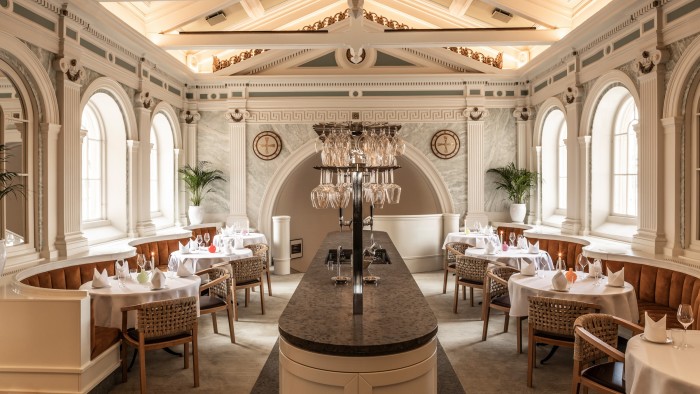
Everything follows from there. Even the nomenclature is straightforward, if not prosaic: there’s Bistro, with tiles up the walls, tables bolted to the floor and a daily handwritten blackboard menu; Salongen, with banquettes and Småland chairs; the Bar; and the high-end restaurant, Matsalen – “dining room” in Swedish. Just like home, where you eat in the kitchen every day and use the matsalen for special occasions. Quite special, in this case: Matsalen is in the former chapel, complete with vaulted ceilings, Ionic pilasters, golden angels and marbleised walls recently repainted by hand. The staff might riff on the formality of fine dining, folding napkins into bishop’s hats, for instance, but this is no hushed temple. The tasting menu is five generous courses, not 15, created under the stewardship of executive chef and Chez Panisse alum Olle Cellton, and served with neither fuss nor ego.
The hotel’s design – lobby, salons and rooms – was overseen by Elin Martin and Michaela Hemlin of Studio Escapist, and aligns with this mindset. A discerning luxury where nothing shouts, and everything is comfortable and beautiful without ever being overwrought; Carlström alternatingly calls it “Shaker Chic” and “Monastic Meets Palazzo”. There are discreet nods to Swedish design history, from Biedermeier-inflected and Swedish Grace to 1940s and ’50s functionalism. (The curved plywood bench seats in Bistro are a homage to those in the Faith Chapel of Gunnar Asplund’s Woodland Cemetery, widely acknowledged as being Stockholm’s most photogenic bench.) Vintage finds are combined with custom-furniture in richly grained wood, such as burr birch, and upholstered in dense velvet.
Thanks to the building itself, there’s a great deal of inherent character, an old energy and humanity that’s still very perceptible even if much of the current interior was built from scratch. There are 150 years of tread marks on the limestone steps on two original curved staircases, and the gracious heritage-protected corridors, with their sightlines to large windows, which in many such projects would have been absorbed into larger hotel rooms. A sense of artistry and craft pervades, from the intarsia marquetry capturing Stockholm motifs in the lift to the traditional Insjöns Väveri woven napkins.
Södermalm is itself a special place; by now gentrified, but still with a hard-working grit, the self-styled creative locus of the city – the Brooklyn of Stockholm, so to speak, whose residents prefer to socialise in their ’hood, says Agrell. He’s not presumptuous enough to suggest he and his partners have created a much-needed social hub, but he’s “super-proud” if others are saying it. (They are.) It’s early days, but there is a sense of a life beyond the insularity of a luxury hotel, a neighbourhood spirit in which an outsider can share. Lacotte, a proud Söder local who grew up in the utilitarian station precinct nearby, can’t wait for summer, when he and his crew will turn the courtyard into an Italian-style piazza with wicker chairs and umbrellas, and really throw open the doors.
stockholmstadshotell.com, from SKr3,500 (about €325)
Read the full article here