

Unlock the Editor’s Digest for free
Roula Khalaf, Editor of the FT, selects her favourite stories in this weekly newsletter.
The tale of the Sycamore Gap tree hit a nerve. Earlier this month, Daniel Graham and Adam Carruthers were found guilty of chopping down the tree in Northumberland’s national park, which had been growing alongside Hadrian’s Wall for over 150 years. They had no apparent motive save wanton destruction. The night-time felling caused such a public outcry that American outlet CNN gave the verdict top billing, leading the defendants themselves, according to their prosecutor, to fear becoming “public enemy number one”.
Sycamore Gap may be the tree that’s top of mind but others have suffered a similar fate. The Cubbington Pear, a 250-year-old wild pear tree in Warwickshire — and which stood in the way of the HS2 railway development — was cut down in 2020, while the Happy Man Tree in Hackney, a 150-year-old London plane, was removed as part of the redevelopment of a housing estate in 2021. Last month, The Whitewebbs Oak, a 450-year-old tree in the London borough of Enfield, was felled by Mitchells & Butlers, the pub and restaurant chain that owns Toby Carvery. And that’s just in England.
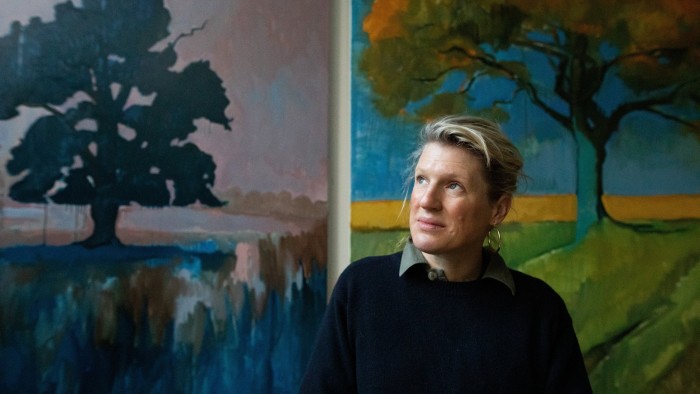
These are trees that have “united communities in their desire to save them”, says the artist Nancy Cadogan, who has painted them all as part of The Lost Trees, an exhibition that opens at the Garden Museum in London on June 10. It features 20 large-scale paintings of both well-known trees and unnamed ones that have triggered a more personal sense of loss; together they are “a memorial”, says Cadogan.
The 46-year-old, British-American painter who has previously shown at London’s Saatchi Gallery and Rome’s Keats-Shelley House, works figuratively, from landscape to portraiture, exploring themes of time and stillness. Creating this new series, however, has been “a completely different process”, says Cadogan. “It’s the most collaborative project I have ever done.”
The idea for the show began to take seed in 2022 when one of Cadogan’s friends sent her a photograph of a stately oak. The tree held particular meaning to the family and was located close to theirs and Cadogan’s homes on the Oxfordshire and Northamptonshire border — an area, says Cadogan, made up mostly of “smaller farms and plots of land”. It is also on the controversial HS2 rail route, which aims to cut train times from London to Birmingham by 29 minutes and has now cost nearly three times its original £32bn budget. While HS2 Ltd does not keep records of the number of trees it has felled, in 2024 it reported it had cut down 20.4 hectares of ancient woodland. Cadogan’s friend’s ancient oak was one of its casualties.
Cadogan says she watched the area she loved change “from a small pocket of a little known rural world to a carved-up landscape”, making her feel “completely powerless”. In an effort to mark what these lost trees meant to her, Cadogan took to the canvas. As word spread, people began to send her images of trees that held meaning for them, whose losses felt like grief. She began painting those too.
Trees are “landmarks in our lives, a way of putting our short human existence into perspective”, says Cadogan. They connect us to history. “Colonel Careless hid in an oak tree with Charles II during the civil war,” she says. “The Senlac Yew saw William the Conqueror come ashore at Hastings.”
Cadogan insists, “I’m not political, I’m not an environmentalist, I’m not a botanical artist, I’m just really interested in human connections with the natural world.” But there is an edge to her exhibition. With the exception of the famous sycamore, this arboreal memorial is not for trees that were felled at the hands of vandals; it is for those chopped down with official approval.
Political environmental art has a rich legacy. In 1982, artist Agnes Denes planted wheat on a $4.5bn 2-acre plot of Manhattan, two blocks from Wall Street. It represented, Denes said, “mismanagement, waste, world hunger”. More recently, in 2024, Brian Eno founded Hard Art, a collective drawing attention to the climate crisis.
Many who have attempted to stop the felling of trees have found themselves behind bars. Some who tried to prevent Sheffield City Council’s cull of half of its street trees between 2014 and 2018 were later paid a total of £24,000 in compensation for wrongful arrest. A 2023 inquiry found that of the 17,500 trees targeted by the council, only a thousand actually required removal.
The defendants in the Sycamore Gap trial will find out their fate on July 15 at Newcastle Crown Court. For those behind the other “lost trees” hanging in the Garden Museum the same month, there will be no judicial consequence. But now, at least, the trees’ stories will not be lost too.
“Nancy Cadogan: The Lost Trees”, Garden Museum, London, June 10-July 20; gardenmuseum.org.uk
Find out about our latest stories first — follow @FTProperty on X or @ft_houseandhome on Instagram
Read the full article here