

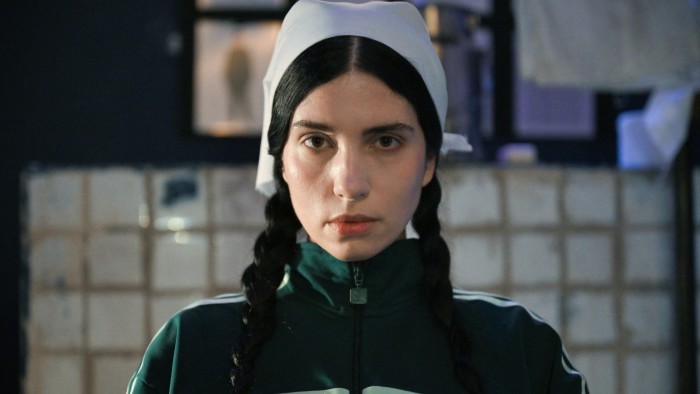
When Nadya Tolokonnikova entered a mock prison cell at Los Angeles’ Museum of Contemporary Art last Thursday, she sought to illuminate for her audience the dangers of authoritarianism. Tolokonnikova, a founding member of the Russian feminist art collective Pussy Riot, could not have known that in the course of her 10-day performance “Police State”, something of a police state would be unfolding right outside the museum walls.
On day three, Saturday, Tolokonnikova is wearing a green track suit pinned with an identification tag, the same one she wore during the two years she spent at a penal colony in Russia. Nearby is a sewing machine. During her prison sentence, punishment for gatecrashing Moscow’s largest Orthodox church to perform a 40-second “Punk Prayer” criticising Vladimir Putin, Tolokonnikova spent up to 16 hours a day sewing. Since 2023, she has been on Russia’s most wanted list.
“In these regimes they always pick the scapegoat. In Russia it’s people who speak out against the regime,” the 35-year-old says in a soft-spoken, unwavering voice. “In America and Los Angeles, it’s migrants.”
On Friday, a day before our meeting, federal officers had conducted raids on LA’s garment district, seeking to detain people suspected of being undocumented migrants. By the end of the day, 44 people were being held at Los Angeles Metropolitan Detention Centre, just blocks away from Moca’s Geffen Contemporary building (itself a former police car warehouse, renovated by Frank Gehry) where Tolokonnikova was performing. Protests had started, and over the weekend some 2,000 National Guard troops would be called into the city by President Donald Trump, against the wishes of the city’s mayor and the state’s governor.
“I walked out of the gallery into a Trump-created war zone, into a police state,” Tolokonnikova says. Leaving Moca on Friday, she was met with circling helicopters, rows of military vehicles, and police officers with batons and tear gas standing outside the museum’s parking lot. Behind the officers loomed Moca Geffen’s striking Barbara Kruger mural, whose text poses questions about power: “Who is beyond the law? Who is bought and sold? Who is free to choose?”
“When political art is good it starts to be really interwoven with reality,” Tolokonnikova says. “The thing about that now in a time of grim politics, is it just ends up being devastating.”
One of her aims is for people to take abuses of power seriously. “There is this idea in society of ‘oh, it will never happen to me’, but I can tell you it can happen to anyone and it does happen slowly, an arrest here and there, a few changes to some laws, and then quickly it can all change,” she says. “We all need to hold governments and power to account, we cannot just sit around and hope someone else does. We all have to be brave.”
As for what is happening in the US right now, her views are plain: “This isn’t the land of the free like many Americans believe it to be, you just look at the incarceration rates, you just look out on the street right now,” Tolokonnikova says. “No society is perfect but as an activist, you need to be objective about what is happening.”
On Sunday, Moca closed the Geffen gallery. Despite the absence of an audience, Tolokonnikova still performed. Her reproduced cell contains all the hallmarks of a detention facility: security cameras, an uncomfortable bunk bed, a toilet. It also includes some anomalies, chiefly black and white sketches from Russian, Belarusian and US prisoners, including drawings by the brother of the late Russian dissident Alexei Navalny, whom Tolokonnikova credits as the inspiration behind Pussy Riot. There is also a sound mixing station where the artist creates unique soundscapes.
Viewers are invited to observe Tolokonnikova through small gaps in the cell wall as she goes about her day, eating, drinking, sewing and creating. During the first few performances, audience members rushed to view her, sticking their smartphones through the slits. One viewer whispered “how can we save you?” into the cell. “I feel that energy and I want it to be directed towards the people who are in jails, the people just a few hundred metres from here or those who are being locked up by ICE,” Tolokonnikova says.
The peepholes and smartphones make the audience, in a sense, stand-ins for prison guards, part of the surveillance apparatus that Tolokonnikova sees as a hallmark of authoritarian regimes. “We’re kind of forcing people to participate in a process,” she says. In authoritarian regimes “people are forced into things they don’t necessarily want to do.”
The setting prompted the question of whether it triggered any post-traumatic stress or anxiety. “When I was in jail I dreamt of what I would like to do with my time. I’d wish for art or music equipment but I wasn’t allowed anything,” Tolokonnikova says. “I’d just sew police uniforms and do labour. This time I’m working on a project that makes sense to me. When I’m in here I am reclaiming my experience.
“I’m not one that is too into analysing my feelings. My friend Slavoj Zizek likes to say, if you keep digging internally then eventually you’re just going to encounter a lot of shit. I’d rather use that time and energy to create.”
In the Moca cell, Tolokonnikova is working on mixing a soundtrack to the performance, layering lullabies and church music with real recordings from inside prisons and her own screams. As the riots escalated, Tolokonnikova announced she would be weaving in live sounds from the streets with the help of her husband, John Caldwell, who was outside capturing protesters’ speeches, and a police scanner that captured LAPD dispatches.
Despite its subject matter, there are elements of playfulness here, like the installation of a gumball-type machine that has colourful spheres named after poisons such as novichok. “You have to be a little childish and naive in order to effectively fight the system of oppression,” Tolokonnikova says.
Before her performance started, Tolokonnikova had been nervous that the 10-day “durational” performance would not provide the same “intensity” that her much shorter street performances did. “I’ve been learning from Marina [Abramović]” — whom she describes as a friend, role-model and godmother-like figure — “to bring the intensity into the institution,” she says.
She need not have worried about that. As I leave the gallery, distant police sirens ring out and two helicopters circle overhead. Raids and riots were happening elsewhere.
To June 14, moca.org
Read the full article here