
A Room of Her Own review — the Clark Institute’s show goes from the sublime to the sentimental

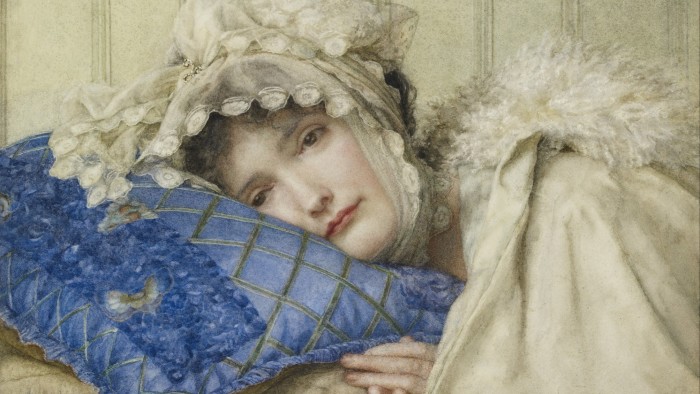
I approach my annual visit to the Clark Institute with great expectations. The idyllic Massachusetts campus, tucked into a hollow of the Berkshires, is one of the most soothing yet stimulating spots I know, and it lives up to its location and architecture with distinctive, high-grade exhibitions. I recall the excitement of encountering the Norwegian painter Nikolai Astrup, Ida O’Keeffe (Georgia’s younger sister) and Guillaume Lethière, a plantation slave’s son who rose to dizzying, if temporary, fame as a painter in post-Revolutionary France.
One especially bracing 2018 show ignited my hopes for the current episode of feminist revisionism. Women Artists in Paris, 1850-1900 celebrated under-recognised talents who made the pilgrimage to Paris in the late 19th century, only to have their careers stall and their contributions forgotten. This summer’s sequel, A Room of Her Own: Women Artist-Activists in Britain, 1875-1945, promised to redirect the same energy, sensitivity and discriminating focus across the Channel. Instead, after a strong and purposeful start, it gets drawn into digressions, trapped in self-contradictions and seduced by mediocrity. As an argument for a submerged current of female talent bursting through the surface of a sexist society, it quickly runs aground.
The show gets its title from Virginia Woolf’s essay arguing that the artistic soul has physical needs, and that creative women have always had to stake out their own preserves of solitude and freedom, usually in the home. That’s where the first, and best, gallery dwells. In a 1912 portrait by her sister Vanessa Bell, Woolf lounges in an oversized wing chair, her violet, green-trimmed dress jangling against the orange upholstery. Her famously melancholy face is blurred into a blank mask, and the elongated arm droops at the wrist, expressing a profound fatigue.
Next to the painting, a quotation from Woolf’s 1938 essay “Three Guineas” explains that for a woman of her class and generation, the hearth was a soft prison. “It was with a view to marriage that her mind was taught . . . that she . . . sketched innocent domestic scenes, but was not allowed to study from the nude; read this book, but was not allowed to read that . . . It was with a view to marriage that her body was educated; a maid was provided for her; that the streets were shut to her; that the fields were shut to her; that solitude was denied her.”
In 1917, Woolf and her husband Leonard founded the Hogarth Press, hand-printing new literary works on the dining room table of their house in Richmond, south-west London. Suddenly, the home became a workplace, an incubator, a tool of liberation. “I’m the only woman in England free to write what I like,” she crowed. “The others must be thinking of series and editors.”
That quiet exultation is missing from the show, but we do see women compensating for their exclusion from power by building — and recording — their own indoor empires of one. In Nina Hamnett’s “Portrait of a Woman” (1917), the subject sits at a table reading a book, holding it open with one splayed hand while the other cradles her chin. Self-contained and secure, she has everything she needs: a well-stocked bookshelf, a bottle of red, an expectant wine glass. A flask of ink intimates that she has literary aspirations of her own. Equally important, she’s not tending to anyone else’s desires.
Woolf lusted after genuine solitude, the kind you don’t share with another body or another pair of eyes. Two humbly titled paintings of inanimate objects in apparently empty spaces illustrate what she had in mind. Ethel Sands’ “The Chintz Couch”, (c1910-11) a vast, plush, ostentatiously comfortable piece of furniture illuminated by a single shaft of daylight, glows gold against the watery wall. A vase of carefully delineated calla lilies shows off a burst of vanilla petals.
Nearby, Gwen John’s 1915 “The Brown Teapot” is a monochrome symphony in shades of caramel, coffee, pecan and cocoa. Tea for one and an open newspaper sit on a rustic table. A plain stool looks like it’s sliding from the foreground out of the picture. And up on the mantel, near the top of the frame, sits a plain jug bristling with paintbrushes. Sands’ cosy retreat and John’s austere studio are not vacant at all. Each room is occupied by exactly one creative woman: the painter of the scene.
Unfortunately, no sooner does the exhibition break out of the domestic confines than it runs into trouble, largely because the curator, Alexis Goodin, extends the metaphor of a room of one’s own beyond what it can bear. She shifts her focus from the home to studios, art schools and exhibition spaces. Very few women wangled access to these male preserves, and Goodin is right to point out how hard they had to fight for their perks.
I sympathise with her desire to broaden the subject matter to anti-war protests, wartime industry, allegorical scenes and religious revelation. But in her urge towards comprehensiveness, she neglects to be discriminating, and trots out paintings that could have been spared the voyage to Massachusetts. Women at the turn of the 20th century were grudgingly allowed to study female (and only female) models in the nude, and Annie Swynnerton’s “Mater Triumphalis” (1892) represents an achievement of sorts. An unclothed figure reminiscent of Ingres raises her arms in a strange gesture that might be rapture or somnolence, ignoring the large bruise (or is it just a shadow?) on her right hip and the bowl of what looks uncannily like dog food at her feet. Whatever triumph she’s enjoying, it’s not the victory of good taste.
By now we’re looking at stuff that is almost mesmerisingly awful. “Love’s Messenger”, a Burne-Jones knock-off by Marie Spartali Stillman, gives us a medieval maiden standing in profile, clutching a letter that has arrived via pre-industrial air mail: the dove perched on her palm. A cloying Pre-Raphaelitic scent of death pervades Evelyn De Morgan’s tacky anti-war propaganda, with its winged angels, rainbows and clusters of severed heads.
But it’s Eleanor Fortescue-Brickdale who wins the atrociousness prize for “The Posthumous Child” (1904), in which a weeping, black-clad woman kneels in prayer, as an angel presents her with a phosphorescent baby. It’s not clear whether the infant is a revenant or a flesh-and-blood kid a few seconds away from demanding a nappy and a meal. Either way, when a show inspired by a feminist pioneer culminates in this teary ode to maternity, you know it has lost its way.
To September 14, clarkart.edu
Find out about our latest stories first — follow FT Weekend on Instagram, Bluesky and X, and sign up to receive the FT Weekend newsletter every Saturday morning
Read the full article here