

Unlock the Editor’s Digest for free
Roula Khalaf, Editor of the FT, selects her favourite stories in this weekly newsletter.
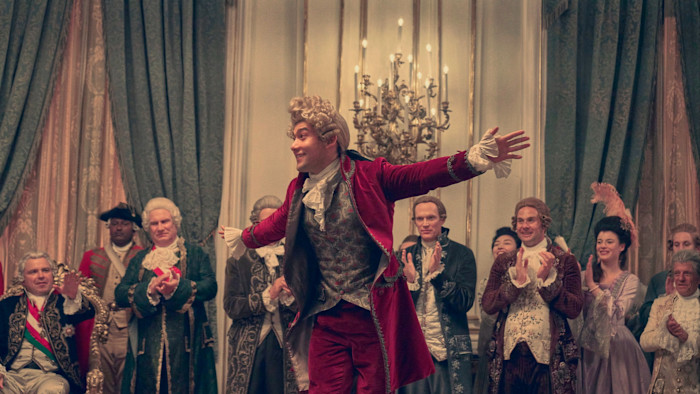
The synopsis: The tale of the rivalry between Viennese court composer Antonio Salieri and the upstart Amadeus Mozart is as familiar as it is historically inaccurate. Peter Shaffer’s Tony Award-winning 1979 play was already a hit when Miloš Forman’s Amadeus film won the Best Picture Oscar in 1985. This much-loved story has now been given a lavish TV adaptation by screenwriter Joe Barton (Black Doves, Giri/Haji), with Will Sharpe (White Lotus) as a reckless Mozart and Paul Bettany as the brooding Salieri.
Location, location, location: This is a show of high drama and big tunes (including the first performance of The Marriage of Figaro), and the backdrop of imperial late 18th-century Vienna had to be suitably opulent. Step forward . . . Hungary, where Budapest especially has become a global hub for location filming, with its grand yet eclectic architecture able to stand in for everything from Belle Époque Paris (Bel Ami) to late ’80s Berlin (Atomic Blonde) and mid-century Buenos Aires (Evita). Numerous Amadeus scenes were filmed in the capital — from the Castle Quarter, with its ornate baroque townhouses, to the imposing neoclassical St Stephen’s Basilica (bazilikabudapest.hu; entry from Ft2,600/£5.85) and a handful of extravagantly chandeliered theatres, including the Hungarian State Opera (opera.hu; hour-long guided tours from Ft10,500) and the Operetta Theatre (operett.hu).
Many more scenes were filmed outside the city. Emperor Joseph’s Palace in the show was filmed at the Esterházy castle in Fertőd, two hours’ drive west of Budapest, often referred to as the “Hungarian Versailles” (eszterhaza.hu; whole castle tickets from Ft5,000). Many of the street and outdoor scenes were shot in Sopron, further west towards the Austrian border, one of the best-preserved medieval old towns in Hungary; and at arty Szentendre, a town of cobbled streets and colourful 18th-century houses 20km north of Budapest. Salieri’s house in Amadeus was represented by the Ráday Palace in Pécel (nof.hu; tickets Ft1,600), 20km east of the city, where the main hall is covered in intricate monochromatic frescoes depicting everything from the Greek mythological death of Phaeton to scenes from Ovid’s Metamorphoses.
Behind the scenes: According to Budapest-based supervising location manager Zsolt Molnar, a veteran of productions from Blade Runner 2049 to Homeland, the team initially considered shooting in Vienna itself. “But it wasn’t just that shooting in Hungary is quicker, cheaper and easier, with a system that means you can get permits in days,” he says. “In Vienna, the team found fewer places to shoot without something modern in the frame.” The choice of locations was also driven by availability. Whereas shots at the neo-Renaissance Hungarian State Opera had to be done through the night to avoid its hectic schedule, the team had six days of shooting at Eszterházy. They also managed to close down the whole centre of Sopron, a place that Molnar describes as “a jewel box of a town, which really makes you feel like you’re walking around 200 years ago.”
While you’re there: Szentendre and Sopron are worth a visit in their own right, with the train from Budapest taking 40 minutes to the former and a little over two hours to the latter (jegy.mav.hu). In Sopron, Florand Rooms and Wine (florand.hu; doubles from Ft38,000) makes for a smart base, with its whitewashed, wood-beamed rooms around a courtyard on the edge of the medieval old town. But, away from the filming locations themselves, Budapest offers ample opportunity to live out baroque fantasies. With its oversized pillars and domes, swims don’t come much grander than the Széchenyi Thermal Bath (from Ft12,500; szechenyibath.hu). And while the big luxury hotels tend towards the later Belle Époque era, they’re similarly maximalist — including the Anantara New York Palace hotel (anantara-hotels.com; rooms from around €240) that’s home to the neo-Renaissance New York Café (newyorkcafe.hu), with its columns and gilded frescoes creating a visual sugar rush to match the layered buttercream Esterházy cake and the “24-carat gold hot chocolate”.
‘Amadeus’ is available on Sky and Now TV
Find out about our latest stories first — follow FT Weekend on Instagram, Bluesky and X, and sign up to receive the FT Weekend newsletter every Saturday morning
Read the full article here