

Unlock the Editor’s Digest for free
Roula Khalaf, Editor of the FT, selects her favourite stories in this weekly newsletter.
Jonathan Watkins’s A Single Man takes as its text Christopher Isherwood’s 1964 novel, which captures a day in the life of George, a 58-year-old English professor at a Californian university, whose partner of 16 years, Jim, has recently been killed in a road traffic accident. The usual stages of grief are compounded by his inability to attend the family funeral and the impossibility of sharing his loss with neighbours and colleagues, none of whom knows the well-kept secret of his sexuality.
The narrative was freely adapted into a film by Tom Ford in 2009 but the result felt self-indulgently arty despite a terrific Oscar-nominated, Bafta-winning performance by Colin Firth. Watkins was convinced that this was a story that could be told in dance, particularly if you signed up Edward Watson and Jonathan Goddard, two of the finest dance actors of their generation, as George and his dear departed.
At Aviva Studios, Jasmin Kent Rodgman’s jazzy commissioned score is played live behind a downstage screen by a quintet from the Manchester Collective. Their music is supplemented by doomy ballads written and sung by John Grant, who sits upstage at his keyboard inside a neon outline of the hero’s head, the personification of George’s internal monologue. Grant’s mellifluous, Scott Walker-y baritone was clearly a highlight for many in the packed house and his previous hit “Glacier”, from the 2013 album Pale Green Ghosts, provides George’s story with an inauthentic but undeniably uplifting ending.
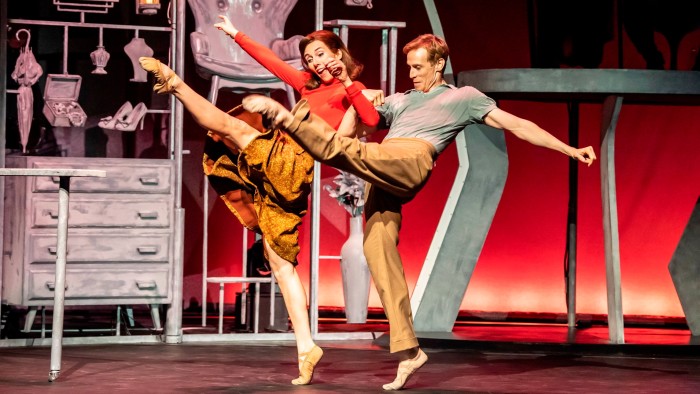
Chiara Stephenson’s set is an ingenious Wunderkammer of George’s possessions, suspended from shelving on little sprues like an unmade Airfix model of his life. Simisola Majekodunmi’s lighting helpfully picks out individual components — cans and cartons for the supermarket scene; bottles and glasses for the beachside bar. No-nonsense colour coding also distinguishes flashback and fantasy from reality.
Watkins gives the 13-strong ensemble a twofold role, either acting en masse to amplify George’s moods or peeling away to become the characters in his 24-hour psychodrama. For their more abstract dances they wear flesh-toned unitards adorned with Twombly-ish splodges of colour. As friends, students and colleagues, they cover these with 1960s smart casuals, a nerdy mix of polo shirts and Sta-Prest trousering all conceived and designed by Holly Waddington and Eleanor Bull.
The Royal Ballet’s Kristen McNally gives a fine tragicomic turn as the limpet-like Charley. Her Covent Garden colleague James Hay plays Kenny, George’s student-turned-drinking-companion, with enormous warmth, helping restore his professor’s zest for life.
Goddard’s Jim flits in and out of the action, forever reminding George of what he has lost. Their big love scene is tenderly written and danced. Isherwood tells us that his hero “looks — and doesn’t he know it! — better than nearly all of his age-mates at this gym . . . He is still a contender; and they aren’t.” Watson is a miracle of nervy misery as George. At 49, he remains in remarkable shape, still able to surprise with a speedy, lizard-lick extension or an easy pirouette à la seconde. Advances in sports science? Or just a picture in the attic?
★★★☆☆
To July 6, Aviva Studios, Manchester International Festival; September 8-20, Linbury Studio Theatre, Royal Opera House
Read the full article here