

There is a perfectly golden gruyère puff pastry sitting on Adwoa Aboah’s plate, its buttery scent wafting temptingly in the air. When we first arrived at Don’t Tell Dad, a buzzy bakery-restaurant in north-west London, Aboah announced to no one in particular, “I’m starving.” Yet 20 minutes later her food remains untouched.
For a model, the image might conjure a familiar fashion-world tableau: the artful performance of eating without actually indulging. Aboah, who has worked for Burberry, Miu Miu, Dior and Fendi, is also the founder of the hit podcast Gurls Talk – which advocates for female mental health – and an actor, seen first in Top Boy and, this summer, Netflix’s romcom series Too Much. She has 1.8mn Instagram followers. So you’d be forgiven for assuming she has fallen victim to the pressure of keeping up (physical) appearances. But that would be a misread. Aboah isn’t avoiding food – she simply hasn’t paused long enough to take a bite.
She has returned to modelling following the birth of her first child. “I’m self-employed and I’ve got bills to pay,” she chuckles in a low throaty voice that lends her an unexpected gravitas. She is also in the midst of launching another venture, a fashion line. There is no time to stop.
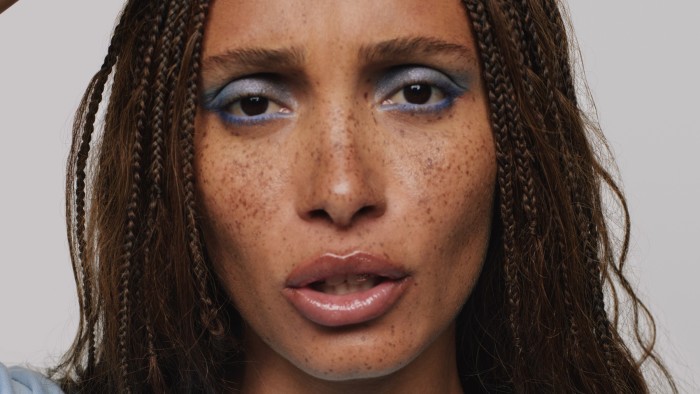
Tall and athletic-lean, she has a smattering of freckles across her face and long auburn single braids twisted into two playful pigtails. Her eyes are hidden behind Kendrick Lamar x Chanel sunglasses, but Aboah is unmistakable – even though she later jokes that there are people who think she and the author Zadie Smith (also a north Londoner) are the same person. She is dressed off-duty: long basketball-style mesh shorts, white trainers and a vintage Flintstones T-shirt. “It’s good, isn’t it?” she says, tugging at the hem. “My friend got it for me because Shy [her one-year-old daughter] looks just like Pebbles. She has the red hair and everything.” On her wrist a delicate tattoo of a bone mirrors the one worn in the cartoon character’s hair.
Aboah is preparing to step back into the spotlight as brand founder of The Veil, a meticulously crafted collection of handbags created in collaboration with head designer and creative director Georgie Wright, her long-time friend. Inspired by the decorative functionality of the châtelaine, the idea was born, says Wright, out of their shared frustrations “of never having the right bag for the right occasion and not having enough money to buy hundreds of bags”. Says Aboah: “We wanted to create something timeless and everlasting, something that wasn’t going to be restricted by trends.”
The brand launches with two elements: a slick, modern design called the Snap Bag; and a series of beaded “veils” – detachable sleeves that transform each bag from understated to ornate. The concept, says Wright, is that you “basically have one very beautiful timeless bag that you can dress up or down, and it can transform with your many moods.”
“It feels like, with accessories, women always have to choose,” says Aboah. “It’s always either-or. And, in this case, it’s simplicity or extravagance. With the Snap Bag you can be that woman as well as that woman. You don’t need to choose.” The ethos of The Veil – particularly the balancing act between creative vision and commercial reality – mirrors how she feels in herself right now. “Being postpartum, I’m confused about my identity. Actually…” She corrects herself. “No. Not confused. I’m mourning an old identity. But,” she quickly adds, “I’m very open to a new one. You do change.”
Born in London – to an English mother, Camilla Lowther, one of the world’s most successful creative talent agents, and a Ghanaian father, Charles Aboah, who runs an app for creatives – Aboah was privately educated at Millfield. In the 2010s, she became one of her generation’s best-known models. She walked for Chanel, Versace and Marc Jacobs, and starred in campaigns for Burberry, Rimowa, Calvin Klein, Dior and Nike. She was named Model of the Year at 2017’s Fashion Awards, was the cover of Time magazine’s “Next Generation Leaders” issue in 2018 and, a year later, earned a nod from Forbes’ “30 Under 30”.
“I didn’t plan to be a model,” she says. “I was scouted while still in school. Katie Grand [the stylist and magazine editor] had always been supportive of me – so I was in Pop magazine when I was 12,” she recalls with a laugh. “But my first catwalk show came much later with Giles Deacon”, at the age of 16. Her first major cover, meanwhile, was for Vogue Italia in 2015, photographed by Tim Walker. Yet her early years were also tough. She has spoken openly about her teenage struggle with addiction, depression and bipolar disorder, which culminated in a near-fatal overdose in 2015. After falling into a four-day coma and receiving psychiatric care, she emerged determined to kick-start her life and the conversation around mental health. It led to her founding Gurls Talk – a global, community-led organisation dedicated to the mental health and wellbeing of women and girls – in 2015.
Her sister, model and painter Kesewa Aboah, says that her older sister has had to be “uncompromising and relentless for the right to be herself”. “I’ve known Adwoa since she was a young girl,” adds Edward Enninful, co-founder and chief creative officer at EE72, who put her on his very first cover of British Vogue in 2017. “And I noticed her smarts, resolve and strength of character right from the start. She’s never been afraid to be herself, or to stand up for what she and others believe in. She represents the girl of today.”
“I’m in a lucky position where, to a certain extent, I get to choose the people I work with,” says Aboah. “But, yeah, coming back to work… It has been different. I’m having to re-establish myself. It’s a weird energy. I’m sure lots of women who’ve come back to work after having a child can relate. Yes, I am different. But I’ve simply had a child.”
She now spends long stretches of the year in LA with her boyfriend and the father of her child, Daniel Wheatley, the American skateboarder. Motherhood has offered her a new stability. “I feel like it’s chilled me out so much. I’ve had my journey and it’s been a rocky one. So I think one of the things that has come with it is an element of control. Sobriety lends itself to that – but also willpower and perseverance. As someone who has been quite controlled in life, whether it be with my own image or just being quite OCD about everything and quite neurotic, I think my friends worried that having a child could’ve made it worse. But actually I’ve gone completely the other way.”
Having a child has also made her reflect on her own relationship with style and clothes. “I feel I wasted so much time before. Being so anxious about what to wear and what was suitable and what my body looked like. And then it changes and you’re like, fuck. What a waste of time!” She gestures dramatically with her tattooed hands. “What was I doing not finally walking around in booty shorts and not wearing any clothes?”
On the day we meet, Too Much has just launched on Netflix. Aboah plays Linnea, Will Sharpe’s abandoned wannabe-dominatrix lover. She took on the role while she was pregnant, but didn’t tell anyone. “I didn’t trust the system,” she says flatly. “There’s this idea that if a woman is pregnant she won’t want to work, she’ll be distracted, her priorities will be somewhere else…” So she kept schtum. “And I had a ball,” she grins. Her sex scene with Sharpe in the second episode? “Oh my goodness,” she says. “I’m like doing some weird, soft sex scene and I’ve got someone else’s child in me.”
Its creator and writer, Lena Dunham, was impressed by Aboah. “I knew in less skilled hands this character’s vulnerability would be lost, and she really highlighted the humour, hope and complexity,” says the director-screenwriter. “I hope for the chance to make much more with her, because she has that impossible-to‑name quality that defines a star.”
Acting is now part of Aboah’s trajectory. “I did drama all through school and university [she studied modern drama at Brunel], but then life took me in a different direction.” She’s currently auditioning – for which she is uniquely qualified. “I can probably take rejection better than most because of modelling for so long,” she says. “But also because I’ve had huge amounts of therapy, I have the ability to change my perspective on things. Those moments where I’ve gotten really close to something still feel like a win because I am a newbie in this industry.”
There is, however, a bucket list of catwalks she would still like to do. “Prada is my dream! One day, one day, it will come. I’m going to manifest it,” she says, giving a subtle side eye to her Gen Z speak. “I’d also love the chance to work with Sarah Burton [now at Givenchy]. I love her. It’s not just that she’s a female designer, it’s also about the way she sees and respects women.”
Gurls Talk turns 10 this year. But the podcast has been put on hold for a few months – the timing doesn’t feel quite right. “Having to talk about things like tassels and beading and then to go and have an incredibly important conversation about the destruction of gender rights and politics and the ongoing mental health crisis…” She makes a face. “It’s not that those things no longer matter to me – they absolutely do – it’s just hard at the moment for my brain to switch between the two. I wouldn’t be able to do it to the best of my capability.”
Instead, Aboah’s full attention is on The Veil. Her all‑in mindset is, she says, inherited from her entrepreneurial parents, especially her mother. “I’ve learned that people can be hard-working but that’s completely separate from the hustler mentality. [The latter] is what my mom has. It is something that she’s given to me. She’s an agent – deep in her bones and in her blood – so she is a go-getter, she aims high, she asks questions and understands that things won’t simply fall in her lap. She just goes for it and doesn’t need anyone’s permission to do anything.”
Still, decisions around The Veil are measured; particularly when it comes to the numbers, “because margins are important and a lot of [new brands] miss that step and don’t survive”. Aboah is the first to admit that the prices – ranging from £650 to £2,200 – are not exactly accessible: “That would be a dangerous word to use. Especially in this climate.” The realities of launching a luxury brand during a financial downturn have not escaped her. “It’s such a confusing time. And everything is so saturated right now. Does anyone really know what makes a product sell?” She doesn’t subscribe to the idea that people have stopped spending entirely – it’s that they’re simply more deliberate about how they spend.
Neil Saunders, managing director of retail at GlobalData, thinks there is still space for the right new product. “Luxury is currently in slowdown mode with a lot of consumers pulling back,” he says. “[But] there is no reason something new cannot capture the imagination, especially if it is well-differentiated and priced effectively.”
“The way [The Veil] is made – the leather, the embroidery, the hardware…” says Aboah. “It’s been painstaking to make sure that everything is not just visibly beautiful but that when you touch it, you just know.”
Aboah and Wright have completed their investor deck and are currently in the process of fundraising; for now, the brand is deliberately self-funded. They will sell directly to consumers via their website which launches in October. “It will empower us to know who our customer is through all the data and information we gather in-house. And I suppose once we have that we can start thinking about talking to retailers.” The transition to thinking like a commercially minded founder hasn’t come naturally. “I’m an articulate person, but when it comes to talking about finances and money and margins,” she says, making a face, “it’s a completely different muscle in my brain.”
A third collection, Archive One, will launch before the end of the year. Its jewel-like, heavily embroidered and embellished bags are made by artisans in India and Italy, and channel 1920s opulence. In terms of where The Veil could go, “the world is our oyster”, says Aboah – but “we are not going to start doing ready-to-wear. I love it when brands know themselves; they understand their community, their buyer, their imagery… And they hone in on that. That’s what I want The Veil to be. This really feels like an expression of self,” she decides. “Yes, I have that with Gurls Talk to a certain extent, but while Gurls Talk is something I really wanted to do, it’s not really for me. With The Veil, it is something I can put my name to.”
Just don’t expect to see her in the campaign. She looks aghast at the thought. “We’ve been one billion per cent working hard to make sure this doesn’t feel like a celebrity-brand project,” she says. “I’ve seen when someone has ‘star power’ and everything’s in their favour and the product still doesn’t sell. The product has to speak for itself.” And finally – an hour in – she takes a bite of her pastry.
The Veil launches this autumn; visit theveil.com for updates
Hair, Jaz Hope Lanyero and Evalyn Denis. Make-up, Rebecca Wordingham at MA+ World. Nails, Michelle Humphreys at LMC. Set design, Samuel Pidgen at Bryant. Photographer’s assistants, Barney Couch, Ezra Jolly and Benedict Moore. Stylist’s assistants, Aylin Bayhan and Giovanna Piergallini. Production, Parent. Retouching, The Hand of God
Read the full article here