

Unlock the Editor’s Digest for free
Roula Khalaf, Editor of the FT, selects her favourite stories in this weekly newsletter.
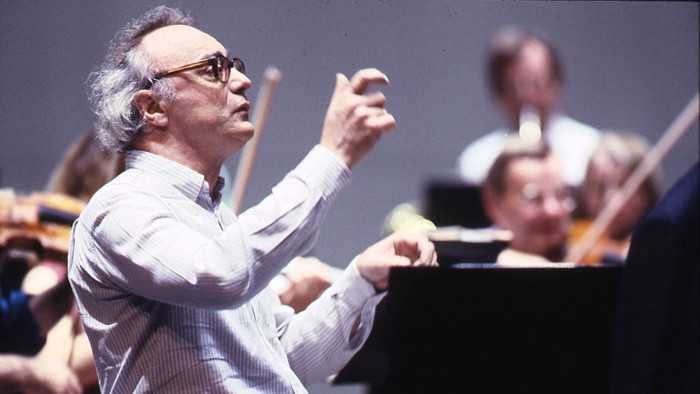
Alfred Brendel, who has died aged 94, was, when he retired from the concert stage in 2008, arguably the most famous living pianist in the world. His name was synonymous for many with the idea of what a concert pianist should be: a cerebral artist whose performances eschewed superficialities of expression for a perfect balance between structure and detail. His mildly dishevelled appearance — with professorial wisps of grey hair that seemed, when lit by the stage lights, to radiate a mysterious electric charge from the thick dark rims of his glasses — combined with often visible embarrassment when receiving applause. He would sit motionless at the keyboard, long after the final notes of a recital had ceased reverberating round the auditorium, retreating deep inside himself to hinder any premature interruption of the silence which he took to be the music’s proper reward.
Even after retirement, Brendel continued to give lectures and lecture-recitals. At the Dartington Summer School in 2016 he was asked what he would have become had he not made it as a concert pianist. He paused briefly before replying that he should have gone into stand-up comedy. The room erupted into laughter, not because the idea was ridiculous, but rather so obvious. The lectures he gave in Dartington that year covered two subjects: Beethoven’s late piano sonatas and Woody Allen’s 1983 film Zelig. Humour, he often remarked, was simply the sublime in reverse.
Brendel’s mastery lay, above all else, in his sense of timing, and this extended equally to his tongue as to his fingers. His dry, even diction and rather indeterminate Mitteleuropean accent issued measured sentences that were heavily punctuated by pauses. The pauses could be long or short, but were never a matter of finding the right words. He knew the right words, but also knew instinctively how long his audience needed to locate in their minds the place where the right words should find their best welcome. And these were exactly the qualities that marked his playing: the sounds and silences he drew from his instrument always had a quality of inevitability, of being just so. His performances aimed beyond interpretation to a clear grasp of what seemed in his hands at least to be the simple, often sublime, facts of the musical matter.
Timing, too, undoubtedly played its role in his career, the unlikeliness of which Brendel often remarked upon. “I was not a child prodigy,” he said, “I’m not a good sight-reader, I don’t have a phenomenal memory, and I didn’t come from a musical family.” He was born in 1931 in Moravian Vizmberk, moving aged three to the Dalmatian island of Krk, now in Croatia, where his father, an architect, had begun a new career as a hotel manager.
It was there that young Alfred discovered music through the hotel phonograph, and would entertain guests by playing records, sometimes singing along. He received piano lessons, but as a teenager was largely self-taught, and it was only after his rather idiosyncratic concert debut (accompanied by an exhibition of his paintings) aged 17 in Graz, Austria, where his family had moved during the war, that he came into contact with the European musical establishment. A year later he won fourth prize in the 1949 Busoni competition, and took masterclasses with, among others, Edwin Fischer, who remained the pianist Brendel felt had taught him most.
His early career thus coincided perfectly with the revolution in sound recording represented by the long-playing disc, the greater sound quality and length of which enabled listeners to hear whole sonatas in one sitting. Brendel went on to record more than 100 albums, including the first ever complete cycle of Beethoven’s sonatas and concertos (he recorded two further cycles), and though a quick glance at the catalogue betrays a steady focus on the central repertoire of Mozart, Beethoven and Schubert, his musical interests ranged much more widely than is often supposed. He championed Balakirev in the 1950s, Busoni in the 1960s. It is in part thanks to Brendel that Haydn’s piano music attained its rightful place in the repertoire, and his frequent performances of Liszt’s B minor Sonata, magnificent renditions of the Années de pèlerinage as well as his many opera transcriptions and paraphrases, probably did more than anyone, Liszt included, to establish the Hungarian’s reputation as a composer.
Brendel was married twice and had four children. In the 1970s, he moved to Hampstead in north London, where he lived until his death. His farewell concerts in London, Hanover and, finally, in Vienna’s Musikverein on December 18 2008, concluded with an encore which had become increasingly dear to him in his later years, Busoni’s transcription of Bach’s “Nun komm, der Heiden Heiland”. The slow chorale melody, and the measured, sober lines woven around it, immaculately voiced, seemed offered as benediction and gratitude for his tearful audience: the fire extinguished, the hearth swept, a great artist taking dignified leave of his art.
Read the full article here