

Stay informed with free updates
Simply sign up to the Film myFT Digest — delivered directly to your inbox.
Whatever “art cinema” is these days — and it can be many, many things — it is very much an endangered species in a harsh commercial environment. As a matter of survival, many filmmakers have retreated into varying degrees of conservatism and caution. That is why April is such an inspiring anomaly: this second feature from Georgian writer-director Dea Kulumbegashvili is uncompromising both in theme and in style.
Kulumbegashvili made a stir with her 2020 debut Beginning, a nightmarish drama set in a Jehovah’s Witnesses community. In April — with star auteur Luca Guadagnino among its producers — Kulumbegashvili pushes the boat out even further, beginning with the enigmatic and disturbing opening shot. It shows a stooped naked figure, faceless and with a body seemingly of clay, slowly wading through a black lake in darkness.
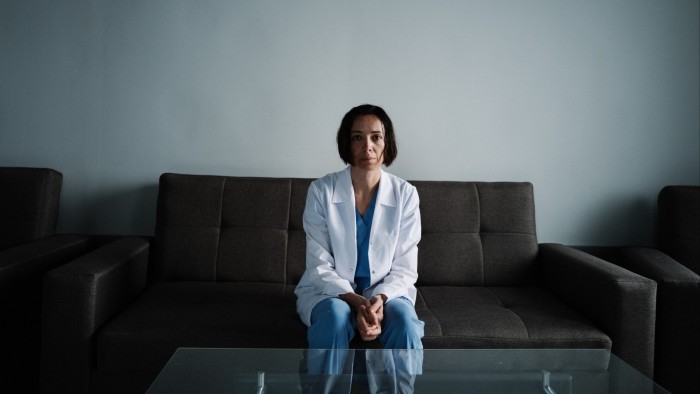
Most of the film follows a realist path, however stylised. Nina (Ia Sukhitashvili) is an obstetrics doctor in a provincial Georgian hospital. She is first seen at the birth of a new baby — evidently an actual delivery, shot directly from above — but spends much of her time driving to a nearby village, where she provides care and performs abortions for women in poor families. Sometimes, she stops en route for impromptu sexual encounters, one of which ends brutally — but, disconcertingly, without further comment.
When a newborn at the hospital dies, Nina is held responsible. Her colleague David (Kakha Kintsurashvili) must investigate; but he is also her ex-partner, unable to understand why she has chosen to pursue her vocation rather than start a life with him or anyone else.
This is a film of few words, the wan, often unreadable Sukhitashvili suggesting at once fragility and self-possessed control; people tend to talk around or at Nina, whose opaque silence is the film’s base note. Nor does April itself give much away. Its theme is very resonant at a time when abortion as a practice is under intense attack, but rather than tell a transparent, polemically angled story, Kulumbegashvili takes an oblique approach. She foregrounds style of an austere, sometimes disorienting sort. Rooms, shot from one end then the other, seem unnaturally elongated. In one extended sequence, the camera drifts upwards from a close-up of grass in the rain until we catch sight of Nina’s car stalled in the far distance on a muddy road, squeezed into a corner of the screen.
Then there’s the recurring creature, not quite fully formed — seemingly an incarnation of Nina herself, or so POV shots and an insistent sound of breathing would suggest. But it’s not easy to pin a clear meaning on this figure: the film leaves it to our interpretation, and our anxious imagination.
You could easily imagine April screened in a gallery as video art: part of its brilliance is in the tension it maintains between storytelling and a hardcore commitment to the imagistic. Lovers of that elusive quasi-genre “slow cinema” might detect affinities with directors such as Béla Tarr, Carlos Reygadas or the late Chantal Akerman. But Kulumbegashvili is very much exploring her own path here, fearlessly so.
★★★★★
In UK cinemas from April 25
Read the full article here