

Unlock the Editor’s Digest for free
Roula Khalaf, Editor of the FT, selects her favourite stories in this weekly newsletter.
Out go the wilting post-Christmas cyclamen and the poinsettias shedding leaves. The great Christmas indoor massacre is over. Is there a way of avoiding it and growing happy house plants in a heated, sunny apartment that you can leave behind for at least a week?
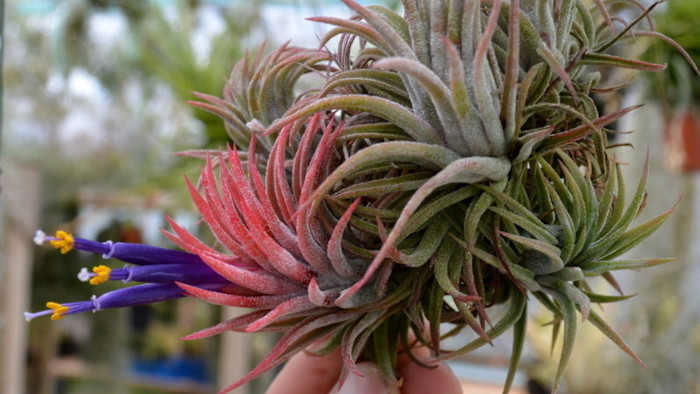
The answers are air plants, remarkable orchids which do not need soil. Their popularity has been soaring in the past decade. They are living evidence of the adaptability of plants, way beyond what gardeners believe: they will grow on wood or cork or even on a well-tended shelf indoors. Botanically they are tillandsias, members of the bromeliads, a big class of orchids. They are epiphytic, a word which means they grow “on” things, usually other plants.
Parasitic plants are epiphytic too, but tillandsias are not parasites. Parasites draw nutrients up from the plants on which they sit, whereas air plants take nothing from their hosts. Instead, they draw nutrients from water. They take it in through little cells on their leaves called trichomes, hairy spots which give the leaves a textured look. Their roots merely allow them to hang on: they are fixatives, not extractors.
In the wild, some tillandsias cling on to rock, especially those endemic to Peru. Others grow on the trunks or branches of trees. Indoors, they will do the same. The wood-huggers are the ones to opt for: they can be fixed on to plaques of wood and then hung on a wall. They can even be left on a windowsill with nothing between them and the surface. Imagine the joy of them: they need no soil, no pots and no sweeping up when a cat knocks one over, as there is no compost to be spilled on to the carpet. Wind plastic-coated wire, not copper wire, round them to fix them on to wood.
I have yet to grow them myself, as my gardening still focuses on the grim outdoors. It has yet to swerve indoors, even in Britain’s wet winters. Actually, tillandsias love humidity and live off rainwater; not, though, rain from weeks of sunless gloom but rain combined with sunlight and freely circulating air. They will be ideal options if I ever join you in an apartment and leave the garden shed to leak.
I first realised tillandsias’ potential when I saw them in the lovely Silver Garden and the Cascade Garden at Longwood Gardens, that peak of horticulture in Pennsylvania. Long silvery stems of a tillandsia known as Spanish moss were dangling down wires in the Silver Garden. Others were dotted down the rocks and walling of the Cascade Garden, enjoying the humidity from the splashing water. I thought they were beyond everyday gardeners’ competence, but I then learnt quite the opposite from a session with an epiphytic expert.
Angel Lara is vice-president of botanical horticulture at Selby Gardens in Sarasota, Florida, whose collection of epiphytic plants, including fine tillandsias, is top of the class. For decades he has been growing tillandsias on wires, bits of tree trunk and wooden frames: one on one, he guided me through a morning session on their likes and dislikes.
Soil is not needed, but freely circulating air, sunlight and water are essential. Lara explained that like many orchids, tillandsias are best stood outdoors when the risk of frost is past; they must be brought indoors again in early autumn as they are not frost hardy. Indoors they prefer a temperature which does not fall below 40F (4.5C). They need sunlight, but not direct sunlight all day as it is too strong for them. A site on a windowsill behind a net curtain in a south-facing sunny shower or bathroom is ideal. The air needs to circulate round them, at least through a door left open for a time. Online posts and nursery lists sometimes show tillandsias planted in clear glass containers or bowls. Lara warns that they are death traps as air plants hate direct light intensified though glass.
Online sources also show owners and presenters merrily misting their tillandsias once or twice a week, spraying them with a handheld spray filled with water from a bath or sink. This misting is a mistake. It can leave drops of water in the middle of the plant until it becomes a grey ghost, slowly dying out. Merry misters also use tap water which is full of unwanted chemicals. If it has sodium bicarbonate, it blocks up the pores or trichomes through which an air plant takes up water. If the tap water is hard, not soft, it will badly damage the plants. Rainwater is the best source, collected from a butt outside, even on a balcony.
The best way to water a tillandsia, he taught me, is by soaking it head down in a bowl or basin. Leave it there for about half an hour and then stand it on a towel, turning it upside down to let the water drain out: shake the plant too. A good soaking once a month suffices in winter when light levels are low and the plants are hardly growing. From spring onwards, a soaking three times a month is needed. Lara has a cardinal tip, ignored in much to be found online: never water a tillandsia at night, let alone by standing it in a basin the whole night through. Its trichomes open at night to take in water and if they are submerged then, the plant will drown.
I asked him to name two easy tillandsias and two top sources of plants for readers in the US. He suggested Tillandsia cyanea, now renamed Wallisia but still on sale under its old name. It has grassy green leaves which trap water in the centre of the plant as if it is a tank. It then bears a flower like a fat pink pine cone for up to six months of the year. Tillandsia harrisii is his other top choice, an air plant whose silvery leaves cluster like the top of a pineapple. These two varieties contrast with each other prettily. As for suppliers, he recommends Bird Rock Tropicals in Encinitas, California (birdrocktropicals.com) and Tropiflora Nursery in Sarasota, Florida (tropiflora.com), two first-class growers with decades of experience.
I returned from my tutorial to trawl online in Europe. After too many presenters who flirted, bored on slowly, or both, I found Summer Rayne Oakes from Brooklyn interviewing expert Eric Gouda, the force behind Utrecht Botanic Gardens’ major collection of tillandsias. Her two videos give a good impression of silver and green tillandsias at large while Gouda slowly shares hard-earned knowledge. In Britain I recommend a short post for the RHS by Andrew Gavin, winner of gold medals for the excellent tillandsias he grows and supplies by post from Newlyn, Cornwall (andysairplants.co.uk). General suppliers like Thompson and Morgan or Dobies offer keenly priced collections of tillandsias too, but avoid the ones in glass containers.
In the 1960s, trendy Londoners used to hang fluttering mobiles from ceilings in their sitting rooms. Tillandsias on wires would have been closer to nature. No soil, no fuss, and you can lock up for a fortnight and go away. There is no risk of encountering squirmy worms. I have yet to find woodlice in a bathroom.
Find out about our latest stories first — follow @ft_houseandhome on Instagram
Read the full article here