

Théodore Géricault’s 1822 oil painting “Portrait of a Kleptomaniac” has long fascinated the Indonesia-born artist Fiona Tan. Made towards the end of the painter’s career, the poignant work is thought to be a quick study of an unnamed inmate at the Salpêtrière asylum in Paris. The painting was commissioned by Étienne-Jean Georget, a leading figure in the burgeoning medical field of psychiatry.
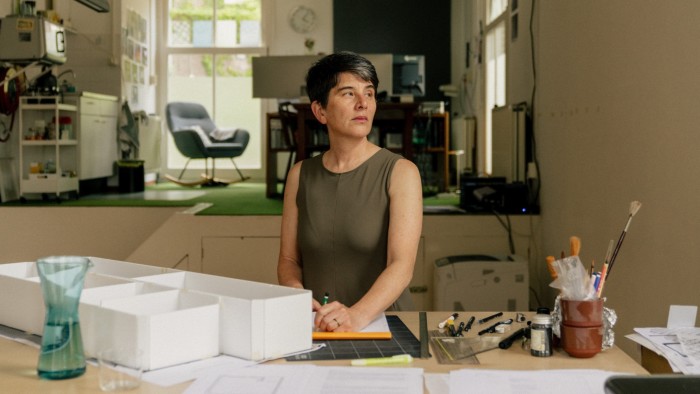
“There’s something about that painting I find deeply moving and touching,” Tan says, sitting at her desk in her beloved studio of 20 years, in a quiet pocket of east Amsterdam. An entire wall is lined with books she has amassed over the years, while another is left bare, for testing film projections. “It still feels completely fresh, there’s something about the immediacy, the way it appears to have been done without judgment, just one human being looking at another.”
The portrait belongs to a series of 10 paintings of patients with different psychiatric conditions at Salpêtrière by Géricault; only five still exist today. Unlike other portraits in the series, titled Les Monomanes (“Portraits of the Insane”) there is nothing in the “Portrait of a Kleptomaniac” that explicitly suggests the man’s madness. This paradox of attempting to visually represent the mind attracted Tan, whose previous films, photographs and research-based installations since the 1990s have included a journey to her family’s ancestral village in China, a reimagining of a preserved whale exhibited in a lorry across Europe in the 1950s, and a slideshow of found images of Mount Fuji. “You can’t see on the outside what’s wrong — trying to portray something invisible was an interesting field of tension for me as an artist.”
When Amsterdam’s Rijksmuseum approached Tan with an invitation to curate an exhibition with their collection, Tan thought again of the Géricault painting, held in the collection of the Museum of Fine Arts in Ghent. Her first idea was to research the missing paintings and possibly “make an artwork that could take their place. But when I started in earnest, I realised the questions were much more complicated than that.”
Instead, she decided to research, through the Rijksmuseum collection, early ideas about psychiatry in the 19th century, when artists and physicians shared an interest in exploring how an individual’s inner world might manifest itself. “I’ve always been interested in what’s going on in there, in how memory works and how we process imagery — that all came right to the forefront looking into the birth of psychiatry,” Tan explains. The title of her exhibition, Monomania, which opens next week, refers to a condition defined in the 19th century as a single psychological obsession.
“It was quite amazing, now I look back,” says Tan, reflecting on how she embarked on the enormous task of sifting through the Rijksmuseum’s collection of more than 1mn objects. “The director basically gave me the key to this huge museum and said ‘here you go’.” Tan was given unprecedented access and 10 rooms (the entire Philips Wing of the museum) to fill with an exhibition. Early on she set two rules: to only show pieces from the museum’s depot that had never previously been on public display, and to present “a historical range of strange objects, and not only artworks”.
The far-ranging exhibition mines medical history as much as art history. The first artwork visitors encounter is, of course, the Géricault portrait. Inspired by the theories of Jean-Étienne Dominique Esquirol, a founding father of psychiatry in the 19th century, and his theories connecting insanity and emotional excess, Tan has included large etchings from the Rijksmuseum collection by Charles Le Brun, who in 1667 created an influential manual of emotions, depicting 24 facial expressions.
Sculptures by Franz Xaver Messerschmidt from a century later were intended to cover the full spectrum of human emotions — according to Messerschmidt, there are 64.
Also intertwined with works from the Rijksmuseum collection are fascinating works on loan that enrich the story. A suite of four photographic portraits from the Wellcome Collection portrays patients, each with their diagnosis detailed beneath their image. They were taken in the 1870s at West Riding Lunatic Asylum, Wakefield, then a cutting-edge psychiatric hospital led by pioneering young psychologist James Crichton-Browne. Crichton-Browne promoted compassionate care — occupational therapy rather than restraints — and set up a photo studio there. “What he did was groundbreaking,” Tan tells me. Three patients were diagnosed with monomania of pride — “what we would now call psychosis with delusions of grandeur”.
The second half of the show moves into murkier territory: the challenge of representing what we cannot see, charting experiences we cannot feel. “How does it feel to be having hallucinations, to be delusional?” Tan asks. Here, the works on display have a more intuitive, instinctive response to the subject of mental illness: “I chose objects that felt as close to those sorts of experiences as you could get.” There are prints by Goya and Munch, but also less expected objects, such as antique Japanese painted wood masks, created for Noh theatre performances. With their grimacing mouths and contorted expressions, they embody a kind of existential angst. “I find them really beautiful, they have an incredible aura.”
Tan has also brought in a collection of exquisite, handmade christening gowns. The tiny dresses evoke the horrifying case of Henriette Cornier, a 27-year-old servant in Paris who brutally murdered an infant in 1825. There was no motive for the murder — Cornier told the police the idea just came to her. Cornier spent three months at Salpêtrière, where her mental state was assessed and her difficult life story revealed. Tan tells me that she became one of the first patients to be diagnosed, by Esquirol, as “monomaniac”, and at trial in 1826, the first person to have their sentence reduced due to a psychiatric diagnosis — she was sentenced to hard labour for life. Despite her significance in the history of law and psychiatry, there are no known portraits of Cornier. Part of Tan’s project is to reinstate the identity of 19th-century case studies that shaped the development of psychiatry but then disappeared from view.
This humanising aspect continues in the final two works included in the show, both Tan’s own: the multichannel video installation “Pickpockets” (2020-2021), made during the artist’s residency at the Getty Research Institute, Los Angeles, where she came across an album of photographs of pickpockets arrested during the 1889 World Fair in Paris. Tan imagines fictional backstories for each, played as audio accompaniments on headphones.
The final room is a giant three-screen film installation made specifically for the Rijksmuseum, “Janine’s Room”. It is inspired by a description of WG Sebald’s colleague Janine Dakyns’ office in his 1995 novel The Rings of Saturn. The sumptuous, slow-moving 17-minute film transports viewers into a study piled high with books. The floorboards creak and the curtains are lifted by a breeze. The figure of Janine comes in and out of the frame, immersed in her work, even as later, sand begins to seep in and slowly fill the room. The artist at work in her studio? “Janine is to an extent me, or an imagined bit of me”, Tan says.
The work is about the attempt to “get closer to how it might be to be delusional or have a shift in reality, where your world makes perfect sense, but that reality is not shared with other people, and that’s where society starts going very wrong”. “Janine’s Room” also subtly suggests the possibility that an artist’s practice, or an academic’s study, or any singular obsession might be its own kind of monomania.
Tan likes this more humane way of looking. And her research reveals progressive approaches to treatment that existed two centuries ago. The terminology may have changed, but the desire to understand our common ground as humans remains unwavering. “What is normal or not normal has been a continuous discussion — it was very helpful and interesting to see we have never solved it. It’s easy to be critical of what was happening in the 19th century, but I think that’s misplaced. Do we know more now?” Tan wonders. “After years researching it, I haven’t found many answers, but more questions.”
July 4-September 14, rijksmuseum.nl
Find out about our latest stories first — follow FT Weekend on Instagram, Bluesky and X, and sign up to receive the FT Weekend newsletter every Saturday morning
Read the full article here