

In the southern French city of Arles, Wael Shawky is building his own version of Mount Vesuvius inside a former ironworks. It’s typical of the Egyptian artist, who is not one to shy away from working at grand scale and this summer has exhibitions opening in both Arles and Edinburgh.
In France, a film that interweaves the origin stories of Greek and Egyptian myths will be on view at the end of an internal street lined with kiosks. In these little booths, with outer walls finished in deep pink stucco, the masks, jars and animals in clay, bronze and glass that appear on screen have come to rest in perfect three dimensions. Meanwhile in Edinburgh’s Talbot Rice Gallery, the exhibition includes the third film in a trilogy called the “Cabaret Crusades”. “The Secrets of Karbala” (2015) tells the story of the bloodiest period of the Crusades, from the 12th to 13th centuries, though it loops back and forwards in time over 400 years. It is two hours long and involved a team of 300. So mountains are quite within the artist’s reach.
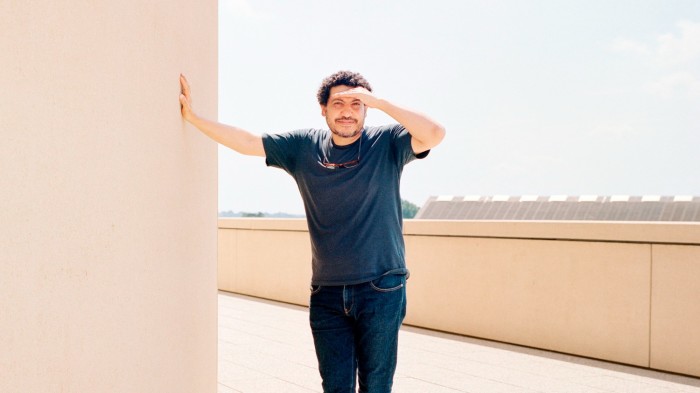
Shawky, 53, seems unflustered when I meet him at the Parc des Ateliers in Luma Arles, where his show is taking shape. Brush in hand, he is working on a large painting at one side of the Grande Halle, a 5,000 sq metre ex-industrial ironworks where trains were once built and repaired. Fantastical creatures in shades of blue and violet, with bowed heads and trailing fronds, are conjured by his hand — a process he describes as “automatic”. “A drawing can take a day, an hour, 10 minutes,” says Shawky, his face framed by curly black hair. “It’s what I do instead of speaking or writing.”
Yet Shawky (his name is pronounced Weh-el Sha-o-key) is an artist who deals painstakingly with words, digging into historical Arabic texts to create the libretti for his operatic films, shifting the voice from dominant west to marginalised east. “They killed everyone — Jews and Muslims,” says Shawky of the Crusaders who sought to clear the Holy Lands of so-called infidels. “In the end, it wasn’t about religion at all, but politics and power.” In “The Secrets of Karbala”, where the protagonists are marionettes fashioned in glass by the master makers of Murano, the brittle material suggests that the survival of humanity is protected by only the most fragile of skins.
“I try not to put any personal opinion into the work,” says Shawky, for whom the puppets also allow a lack of performative interpretation. “I believe that history is a human creation, and I try to translate it into a readable format through drawings, sculpture and film.” Sometimes he works with actors, as in “Drama 1882” — a retelling of ’Urabi’s revolt, in which Britain, thanks to an initial petty conflict that arose between a Maltese man and a local donkey seller, succeeded in colonising Egypt. (It was made in 2024, and shown in the Egyptian Pavilion at the Venice Biennale.) Shawky turns the actors into puppets too, directing them in swaying, robotic groups as the words are chanted in the style of the rhythmic recitation of the Koran. The effect is metronomic and mesmerising. Meanwhile, current world events mean his work is never anything less than searingly relevant.
Shawky’s stories are severe and bloody, but the world he brings to life is awash with colour and texture, time-slips and entangled ideologies. “I really love to work with different mediums, so there are all these different dimensions,” he says. “When you walk into this room,” he says of the huge shed we are in, “you see the artefacts in bronze and velvet, and then you see them in the film, and it’s all inside this industrial architecture.”
Filmed in the archaeological park of Pompeii, the ceramic-masked actors among the ruins create a swirling dialogue between histories and times, between the thriving Roman city of Arles (whose own archaeological sites are nearby) and the commercial hub of Pompeii, whose citizens didn’t see disaster coming. “I wanted the artefacts in kiosks to look like they’re on sale in Pompeii’s little shops,” says Shawky.
“In my films, I try to investigate the past and see how it is connected to life as we live it now,” he says. “Drama 1882”, for instance, uses the tangled narratives of the mythologies of ancient Greek, Roman and Egyptian cultures to explain the development of modern European civilisation. “I’m trying to see all these things from an anthropological point of view, rather than a religious one,” he says. “I actually love religion. I am a Muslim and, for me, Islam isn’t a problem, though the way people translate it might be.”
Shawky was born in Alexandria, but moved with his family to Mecca, where he lived from the age of four to 13. “It was still the Arab world, but a completely different culture,” he says. “Egypt is agricultural. Saudi is tribal and Bedouin and very tough. This was the 1970s and they didn’t want to accept anyone from the outside. Arabs were driving Cadillacs in bare feet and building all these oil platforms [for the Americans], although they didn’t really understand why.” The alienation he felt there, he says, has informed the way he has made art as an adult, looking for what might bind us together rather than break us apart. “It introduced me to different cultures, different systems at an early age,” he says.
Later, in the mid 2000s, he lived in Istanbul, as Turkey divided into those who wanted to join the EU and those who sought to be close to the Islamic world. “There was a really big clash, demonstrations in the street,” he says, “but people were just trying to protect their identity. I understand.”
Shawky studied art in Alexandria before heading to the University of Pennsylvania in Philadelphia to complete an MFA in 1999. “I was married to a half-American, half-Egyptian, so I didn’t have any shocks,” he says. “But I spent most of my time in my studio rather than attending classes.” What he did discover was video. “When I came back to Egypt, my work became films.”
Since then, his impact on Alexandria’s art scene has been significant. In 2010, he turned his studio into an informal art school called MASS, inviting international curators and artists to visit and give talks and guidance. “There were no conditions for entry — at one point we had someone aged 13 and someone aged 45,” Shawky says.
This year he is bringing the project to Doha, Qatar, where he was named artistic director of the Fire Station, a contemporary art space with artists’ residencies, last year. “We received 1,000 applications — 100 from China, 50 from France, even one from Israel,” he says. With his jury — which includes Swiss curator Hans Ulrich Obrist and Ethiopian-American artist Julie Mehretu — it is being whittled down to 20 and the courses will begin in mid-September. “It’s exactly what’s needed now,” he says.
With this emphasis on education, it is apt that the location of his Scottish show is University of Edinburgh’s art gallery, named after the Islamic and Byzantine art historian and scholar David Talbot Rice. “It was set up to educate the students, and then the public,” says the gallery’s director, Tessa Giblin. “We’ve done shows on Brexit and abortion rights in Ireland. We want to depolarise public debate.” Shawky, with his facts and counterfacts, his puppets and mountains, seems the right man for the job.
Edinburgh, June 28-Sep 28, trg.ed.ac.uk; Arles, July 5-November 2, luma.org
Find out about our latest stories first — follow FT Weekend on Instagram, Bluesky and X, and sign up to receive the FT Weekend newsletter every Saturday morning
Read the full article here