
Artist Y.Z. Kami: ‘Come to the Hudson Valley for the quiet; for a party, go to the Hamptons’

Outside the quiet, rural hamlet of Garrison, in Upstate New York’s Hudson Valley, the early 19th-century clapboard home of Iranian-American artist Y.Z. Kami reveals a cache of deeply personal objects. Chief among them is a masterfully woven silk Persian rug, richly red, given to him by his mother. Others clustered on surfaces include a silver-framed photograph of his parents, honeymooning in Rome, and a small collection of ceramic vessels. “In the very old Persian pottery I have, I see the dryness of the land and the different colours of the earth from the part of the world where I come from,” he says.
At a time when Iran is dominating headlines and Kami is about to open a major solo show at Gagosian gallery in Los Angeles, his relationship to his childhood home of Tehran is being drawn deeper into a politically complex conversation. But it is one that exists outside his approach to making art, which is philosophical and contemplative, exploring notions of selfhood and spiritualism. Today, “my relationship [to Iran] is primarily through language, especially the language of Persian poetry,” he says, citing 13th and 14th-century poets Rumi and Hafez.
The country’s rich cultural heritage is a powerful influence on his work — from Persian architectural motifs, which inspire his abstract and esoteric Dome paintings, to the portraiture by his artist mother, examples of which are dotted around Kami’s home.
Kami, 69, first grabbed the art world’s attention in the 1990s with Untitled (18 Portraits): a series of monumentally sized and hauntingly poignant portraits of young men, which drew a parallel with the lives around him at the time being lost to Aids. His inclusion in the 2007 Venice Biennale, a series of five paintings called In Jerusalem, remains one of his best-known works; the small and intimate portraits depict religious leaders — Muslim, Jewish and Christian — who were united in opposition to a proposed Gay Pride march in the Israeli capital.
Today the series is part of the Pinault Collection, helmed by billionaire businessman François Pinault, and which has museums in Paris and Venice. His work has also been acquired by the likes of the Metropolitan Museum of Art and the Museum of Modern Art in New York, and the British Museum in London. This month, as well as the LA showcase, Kami’s work is on display in group shows at two major French institutions: the Centre Pompidou-Metz and Paris’s Musée de l’Orangerie.
Kami made his way to Garrison, on the eastern bank of the Hudson River in Putnam County, after first discovering it about 15 years ago, en route to lunch with Glenn Lowry, the long-standing director of New York’s Museum of Modern Art. He was struck by the remoteness of the village, just 50 miles north of Manhattan, where he was then living, and where he still has an apartment and studio, in Chelsea.
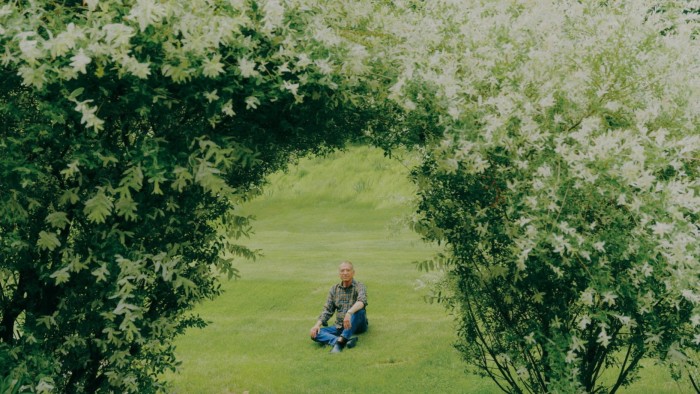
He and his husband Daniele bought their Garrison home in 2014 — “to be close to nature, basically”, says Kami. Reached by a driveway winding through forest, the classically proportioned, white-painted house dates to around 1814, built in the Dutch colonial style as a hunting lodge on part of a larger estate. Today, wildlife sightings on the 6-acre grounds include deer, black rat snakes, bobcats and black bears; the old cherry trees and hundreds of metres of forsythia are interlaced with June-blooming lavender, poppies and peonies.
Outside the house, a courtyard garden of haphazard paving stones, designed by Kami and Daniele, is thick with creeping thyme; one flagstone marks the tomb of a beloved cat, the name Pishoucheh (meaning “little kitty” in Persian) hand carved by Kami, edging on to the vast rolling lawn.
Kami was born Kamran Youssefzadeh. His father was a businessman; his mother “had a studio at our house, where I grew up in Tehran”, he recalls. “She was of that tradition of Persian painters at the end of the 19th century who brought the techniques of Old Masters back from Europe to Iran.” His earliest memory of her is an olfactory one — “the smell of linseed oil mixed with paint”, he says. “It’s my madeleine.”
He decided to leave Iran to study — first in the US, at the University of California, Berkeley, then in Paris. “I studied philosophy at the Sorbonne,” he says, dressed in jeans and a shirt, his manner open, his voice soft yet animated. “It was the end of the 1970s and early 1980s, and Paris was very alive in the humanities. It was the time of Michel Foucault, Jacques Derrida, Roland Barthes.” The life of an artist still called, though, and he began merging his philosophy training with his painterly upbringing, developing a quietly thought-provoking style.
On a trip to New York in the mid-1980s he fell in love with the city — “its energy, the galleries, the work being made there — and there’s a very special light in New York”, he says. He moved, then snappily shortened his name — inspired by the monikers of poets such as TS Eliot and CP Cavafy.
In Garrison, the couple are not cut off entirely from the art world — nearby institutions include Magazzino Italian Art, Dia Beacon and the Storm King Art Center — but, on the whole, it is an escape: a space for Kami to immerse himself in painting. “The village is 10 minutes away, and is only a post office, a school, a church and a gas station,” he says. “We are pretty much in the middle of nowhere. The only noises are the noises of nature. People who come to the Hudson Valley come for the quiet. If you want a scene and a party, you go to the Hamptons.”
His studio is converted from an old barn and dominated by a huge north-facing window. “I work with natural light and oil paint — a habit I’ve had since childhood,” he says. There is also a space dedicated to meditation.
Painting “is always full of conflict and tension”, says Kami. His portraits are often hazily indistinct, as if trying to capture someone’s aura. Other ongoing series are titled Messenger — showing a figure from behind — and Dome, their meticulous concentric marks exploring the mystical mandala in pulsating shades of black, blue, white or gold. Examples of both feature in the Gagosian show opening this month.
His studio also reveals a new line of interest. He gestures to a figurative work on the wall; “It’s the last in a series of paintings I’m doing after a picture of the 19th-century English painter and spiritualist Georgiana Houghton — an extraordinary artist and a real leader in abstraction, who is only now getting attention.”
Inside his home, the suite of elegantly ordered living spaces is also dotted with Kami’s works. Prints by Matisse are hung alongside photographs by Cartier-Bresson and Horst P Horst — images of Truman Capote, Cy Twombly and Alberto Giacometti. The rooms feel laid-back and homey, yet pulled together with a Zen-like rubric. In the library — a favourite spot — rare books and first editions range from philosophy to Persian poetry.
The “sunroom”, a bright-white conservatory-style addition, reveals a more contemporary link to the country of his birth: colourful nylon-woven chairs by Iranian-French architect and designer India Mahdavi, a friend. “We have a dining room, but it’s become like an extension of the library, so now this is our main dining room,” he says.
It’s easy to see why: the original dining table is strewn with books. “The chairs, like a lot of the furniture in this house, we got from the antique stores up in Hudson,” says Daniele, his accent revealing that he was born and brought up in London. “They’re very pretty but we can’t actually use them because they’re quite fragile.”
The couple were introduced to each other by a friend. “We met at the beginning of 2013 and were married by the end of 2013 — we acquired this country house a few months later,” says Kami. Their work lives are as intertwined as their home ones — Daniele manages both of Kami’s studios. “Daniele usually cooks the lunch because I’m at the studio, and I cook the dinner,” says Kami, matter-of-factly. “We both love to cook — and this is the most wonderful kitchen to cook in.” From the dishes on the table to the spiritual “Domes” on the wall, a sense of harmony is palpable.
“Y.Z. Kami: The Domes”, Gagosian Beverly Hills, June 28-August 8; gagosian.com. “Copyists”, Centre Pompidou-Metz, until February 2 2026; centrepompidou-metz.fr. “Out of Focus”, Musée de l’Orangerie, Paris, until August 18, musee-orangerie.fr
Find out about our latest stories first — follow @ft_houseandhome on Instagram
Read the full article here