

Liverpudlians queue with tourists in late-summer sunshine to ride Snowdrop, a Merseyside ferry painted with “dazzle” camouflage — pioneered by British first world war artists to make vessels harder to target. “Everybody Razzle Dazzle”, Snowdrop’s zigzagged makeover, is an artwork by Peter Blake (the pop artist famed for The Beatles’ Sgt Pepper album cover). Co-commissioned for the 2016 Liverpool Biennial and preserved by public demand, it is lasting testimony both to an art that saved lives and to contemporary art’s regenerative powers.
Liverpool’s Biennial is the UK’s oldest, and its biggest free festival of contemporary visual art. Founded in 1998, it is one of roughly 300 such large-scale international exhibitions following the global 1990s “biennial boom”. This year’s edition, titled Bedrock, came to a close last weekend, but September is also a month of openings, with established offerings in São Paulo and Istanbul, and two fledglings taking wing: the first Bukhara Biennial in Uzbekistan, which opened on September 5, and the International Biennial of Art and City in Bogotá, Colombia, opening today.
While Frank Gehry’s 1997 Guggenheim Museum sent a rippling “Bilbao effect” among cities intent on post-industrial regeneration, art biennials seem to have overtaken contemporary museums as must-have cultural adjuncts for aspiring world locations. Enduring artworks such as Blake’s “become part of the fabric of the city”, says Marie-Anne McQuay, curator of Liverpool’s 2025 Biennial, just as Antony Gormley’s coastal Merseyside ironmen installation, “Another Place”, is an iconic legacy from 2005. In McQuay’s view, cities without art biennials have “no capacity to renew themselves”.
Opening up historic buildings, biennials can indeed offer fresh ways to navigate their locations, grasp their layered histories and reforge links to the wider world. Walking through Bedrock, I moved from Dawit L Petros’s poetic installation of sound and maquettes counterpointing colonial tomes on the 1884 Nile expedition at the Hornby Library, and Maria Loizidou’s glittering bird tapestry in praise of sanctuary suspended in Liverpool Cathedral, into Europe’s oldest Chinatown, with Montreal-based Karen Tam’s remodelling of a Cantonese opera. Rather than spectacular works airlifted in, this international art — much of it site-specific — engages intimately with place. Istanbul-based Cevdet Erek’s multimedia installation recreating the rhythmic chants of a football stadium has inescapable resonance in a city still scarred by the 1989 Hillsborough disaster, a crush that claimed 97 lives.
Yet the unstoppable relay of the biennial circuit — only briefly interrupted by Covid — faces flak, with concerns from environmental profligacy to reinforcing a sameness in global art. And then there is the idea that the biennial model itself is outdated. The Venice Biennale prototype of 1895, with its national pavilions and hierarchies of modernism, is disparaged as an heir to imperial world fairs. The Havana Biennial, founded in 1984 as a challenge to Venice, eventually succumbed to its contradictions as a state-controlled event that artists resisted. There have been recent moves to bolster infrastructure between biennials, and to jettison the curatorial auteur, which risks usurping artists’ own prerogative to define their work. Yet with proliferation — notably across Asia — the gripe that there are too many raises the question: for whom? The local audiences they serve, or the jaded few jetting between them?
Luring roving curators and critics for intensive preview days, biennials can transform regional artists’ (and galleries’) global standing. Latin America’s oldest, the São Paulo Bienal was founded in 1951 to emulate Venice but bring the art world to Brazil, and its Oscar Niemeyer-designed pavilion has offered free admission since 2004. Its president, Andrea Pinheiro, stresses progress towards democratising the event, with schools outreach and a touring component. Hotels and restaurants benefit. In São Paulo, she says, “everything art happens during the bienal.”
Their geopolitical capacity to redefine regions was also manifest at the Art Encounters Biennial in Timisoara, western Romania, this summer, reactivating rusty links between central Europe and the Balkans at a former crossroads between the Habsburg and Ottoman empires, while Sharjah in the UAE is known for hosting subcontinental artists kept apart by militarised borders. Ovidiu Sandor, the software engineer turned entrepreneur behind Timisoara’s biennial, tells me that “it’s been a catalyst for energies not expected in the city”, spawning artist-run spaces and contemporary programmes in museums.
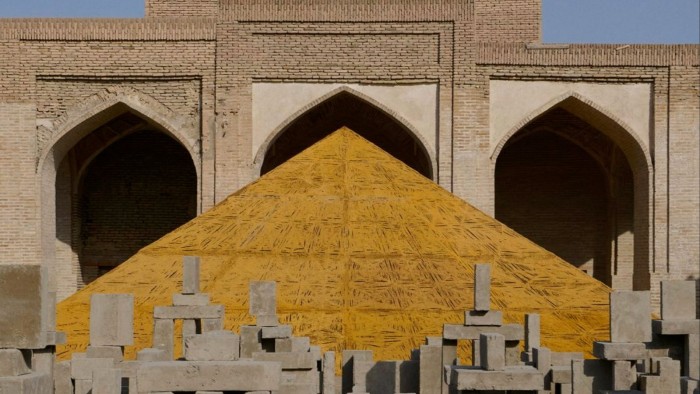
By design non-commercial (unlike art fairs), biennials may have private patrons. But their soft-power potential increasingly attracts state and municipal funding. The Bukhara Biennial just opened in the medieval Silk Road city is part of a concerted drive to bring Uzbek art to the world after three decades of post-Soviet collapse. Its commissioner, Gayane Umerova, heads both the Art and Culture Development Foundation (created in 2017 by the Uzbek president, Shavkat Mirziyoyev) and the administration’s Department of Creative Economy and Tourism. A 2011 British Museum exhibition on Afghanistan inspired her, Umerova tells me, “to do something about our region that had never been done” — hence Uzbek loans to shows such as the British Museum’s Silk Roads. “Uzbekistan has learnt from the outside world. Our president [Mirziyoyev] was prime minister for years. He knew we needed culture.”
With ambitions to create a biennial “on the same level as Venice or Korea”, Umerova seeks to boost Uzbek artists’ “presence in the international market”. While the “government is fully supportive”, she says, “25 per cent of the biennial’s funding comes from private sponsorship.” Umerova states that a further aim is “geopolitical networking” to rebuild links with “neighbours including Korea, China, the Middle East and Afghanistan” — where economic ties are also being forged. Since 2015, landlocked Uzbekistan has been a partner in China’s Belt and Road Initiative infrastructure programme. Earlier this month, President Mirziyoyev met Chinese President Xi Jinping in Beijing to consolidate strategy, while affirming the one-China principle.
So are all these goals compatible? Cultural events, like sporting events, justly draw human-rights scrutiny. Will artists play ball? Even the more arm’s-length biennials can be derailed. Istanbul’s, created in 1987 by the private Istanbul Foundation for Culture and Arts, had to be postponed last year when the appointment of British curator Iwona Blazwick over the Turkish-born Defne Ayas — known for supporting artists whose work addresses the officially taboo Armenian genocide — provoked a furious backlash among Turkey’s artistic community. With demands for transparency, speculation about self-censorship was rife. The current biennial director, Kevser Güler, denies that was a factor, but regrets, she tells me, that “the bridge between community and biennial was damaged”. This year’s edition, under Beirut-based curator Christine Tohmé, opens today in an extended format, running until 2027. It features a vigorous showing of Palestinian art. This ranges from Ramallah-based Khalil Rabah’s site-specific nursery of fruit trees in red barrels on the contested land of a ruined French orphanage, and Mona Benyamin’s absurdist video of a hellishly repeating news cycle, to Sohail Salem’s Diaries from Gaza (2024), searing ink drawings depicting daily life under siege that were smuggled out from the territory.
Safeguarding free expression can mean walking a tightrope. Since artists boycotted the 1969 São Paulo Bienal in protest at Brazil’s military dictatorship, “we try to be apolitical,” says Pinheiro — not least as a donor-funded event reliant on tax breaks. Yet artists and curators can and do push the possible, if backed by robust leadership. In 2019, Sharjah in the Gulf managed a whole edition with the politically sensitive topic of migrant labour as an unspoken thread.
That they go ahead in extremis, like the 2011 “crisis biennial” in debt-shattered Athens — inseparable, for this critic, from the acrid stench of tear gas — may be their ultimate rationale. Guatemala’s Bienal de Arte Paiz, created in 1978 in the midst of the 1960-96 dirty war, opens on November 6 and has never missed an edition. The country’s Mayan population “suffered through the internal conflict”, says Waseem Syed, artistic director of the family foundation behind it. An artist from Pakistan who moved to Guatemala 33 years ago, he sees the biennial as a “trampoline that gave indigenous artists visibility”. Now their art is feted — not least at Venice last year.
“One of our core values,” says Syed, “is we don’t censor. We try to maintain our neutrality to let artists’ voices be heard. It was dangerous in the civil war, but in art, you can disguise . . . Resilience kept it alive.” It’s a brave stance that should stiffen others’ resolve.
Find out about our latest stories first — follow FT Weekend on Instagram, Bluesky and X, and sign up to receive the FT Weekend newsletter every Saturday morning
Read the full article here