

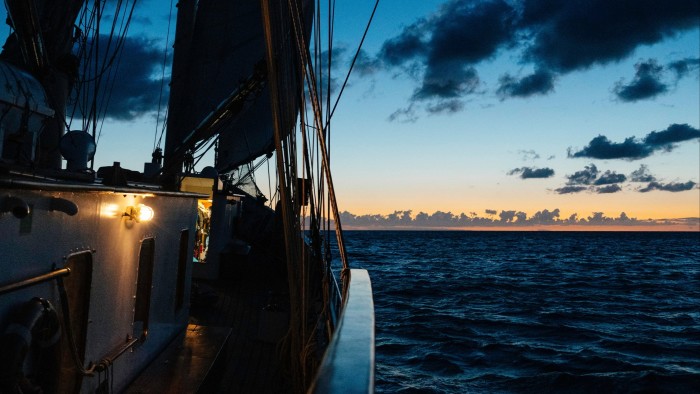
When you’re not using the sails on a traditional tall ship you tie them down, which is how I find myself hanging out on the bowsprit as it dips gently up and down over a calm sea. Here, at the furthest tip of the boat with two crew mates, I wrap ties around the folded jib to secure it to the bowsprit. I look back and see the rest of the ship, her sails standing majestically as we fly along under the afternoon sun, the bow cutting through the waves.
Suddenly a pod of dolphins breaks through the water’s surface below us. Jumping and diving in threes and fours, they play in the bow’s wake, weaving through the water and splashing us with bursts of sea spray. It’s such a wild, magical moment that we all stop to take it in, marvelling at the sheer luck of being there at exactly the right time.
Dolphins are a good omen at sea, symbolising protection and good fortune. Writing about his solo voyage around the world as part of the 1968 Golden Globe race, the French sailor Bernard Moitessier recalled how a group of dolphins guided his yacht away from hidden rocks in the south Pacific. Lining up alongside him they turned right, over and over again, until he changed course. They then escorted him for hours, until only a couple remained, “two fairies in the waning light”.
But mainly they are just so full of joy you can’t help but feel your spirits soar at the sight of them. Out on the bowsprit, I remember these are the moments of life at sea that you only experience when actively involved in the sailing of a ship — pulling lines, keeping watch and steering at the helm. It is why I have come aboard Blue Clipper, a three-masted gaff rig schooner, whose guests are encouraged to take part. We are a few days into a 1,400-mile voyage through the Mediterranean, sailing from Portimão in southern Portugal, eastward through the Gibraltar Strait and up to Monaco.
I hadn’t even known it was possible to join a tall ship — I only had a vague idea that there were a few still in existence that you might visit like a museum, so I was curious. It was also an opportunity to see the Mediterranean coastline from a new perspective.
As one the world’s biggest seafaring nations, Britain once had many tall ships. But a large number of them ended up at charities before being sold off or turned into scrap. Blue Clipper was sitting idle in Greece until she was bought by Maybe Sailing, a not-for-profit organisation that channels the profits from adventure cruises into youth sail training on its sister ship TS Maybe.
Built in 1991, Blue Clipper is 44m long with 10 sails. The wood-furnished interior feels cosy; there’s a comfortable saloon, with en suite guest cabins down below. A cook prepares breakfast, lunch and dinner, including fresh bread. Guests need no sailing experience, whether it’s an offshore passage like this or island hopping around Scotland or the Caribbean, as the crew show you the ropes.
It’s mid-April when a dinghy picks me up in Portimão to board Blue Clipper, at anchor in the bay. There are about 20 of us, including seven guests, and we are almost all European — joining from Germany, Switzerland, Spain, Denmark, Ireland and the UK.
There’s a lively atmosphere in the saloon as everyone gathers for dinner and a briefing from our skipper, Jack Cartwright. The plan is to leave the following day, when the wind is due to shift to the south, putting us at a better angle to sail towards Gibraltar.
In the morning, we find that the two anchor chains have become tangled, which means lifting and lowering them to shake out the knots while Jack turns the boat around. A dozen mini sailboats are bobbing about on the flat sea around us, receding into the distance as we leave the Portuguese coast behind. We head south-east with the sails up, and soon there is nothing but the sea around us for miles.
During the second night we pass through the Gibraltar Strait, the dark sea dotted with the lights of cargo ships. To our left is Tarifa, its lighthouse beaming amid the yellow lights lining the Spanish coast; the lights of Morocco to our right. Viewed from the water between them, the two continents seem startlingly close — at the narrowest point, less than nine miles divide them.
It’s migration season for bluefin tuna and I half hope to see the Iberian orcas that hunt for them here. These are the orcas that have taken to ramming into small yachts over the past few years, most likely for fun, sometimes breaking off rudders. Jack would rather we didn’t see any, but he seems confident that Blue Clipper — a big boat with a steel hull — wouldn’t be a target.
We sail eastward out of the strait and after a few hours we pass Málaga, before the snowy white peaks of the Sierra Nevada mountains on Granada’s coastline come into view, rising high behind the mist.
One afternoon I sit on deck with Jacko Gorman, 21, to sew a patch on a rip in the mainsail, which is already a patchwork of repair jobs. She tapes a strip of fabric over the tear to hold it in place and then we sew a zigzag of stitches round the edge, pushing the needle from one side to the other using a palm thimble.
Repairs can take hours, but Jacko finds it therapeutic. Having grown up in a rough part of Dublin, she was introduced to Blue Clipper through Ireland’s sail training programme, joining the crew last year to sail the Bay of Biscay. “It’s opened my eyes to a different life altogether,” she says. “Now I’ve done two Atlantic crossings, had my birthday in the Caribbean, I’ve seen so much of the world.”
Sometimes guests underestimate how quickly the weather can turn, she says: “It can be nice and calm and then next thing you know, boom . . . it’s 40 knots of wind and everybody’s running around deck grabbing on to lines, making sure the sails are all right.”
I see this for myself when a squall comes through as we’re passing Almeria. One minute the mountain peaks are softly shadowed against a warm yellow sky, then dark, heavy clouds loom on the horizon and soon wind and rain are whipping across the deck. First mate Grace Metcalfe yells orders to reef the flapping sails, the crew hastily pulling lines: “Two-six, heave! Two-six, heave!” Then the sky turns a deep gold beneath a blanket of grey as the sun sets and a faint rainbow appears.
With everything so weather-dependent, sometimes not all goes to plan, says Grace, 39, who has also served as skipper. There was a trip to see the puffins in Scotland: “Six guests had come over from America, and the bloody puffins were a fortnight late.” Even moving around the boat is hard when the weather’s bad, she adds. “She’s as rough as dogs sometimes, she’s got no stabilisers like your modern-day superyacht.”
I’m surprised by how quickly we all feel like one crew after just a few days, and the intimacy of the watches, where you spend hours talking under the stars, and the little rituals of making tea for each other, taking turns at the helm.
“It’s a floating family,” Grace tells me. “There’s just something so different about being at sea. You get a group of people on board, never met them before, there isn’t really anywhere else you get that.”
One of the deckhands, Pete Ludlow-Williams, 21, who’s in charge of my watch, studied software engineering in Belfast but swerved a career in front of computers after volunteering to help with the boat’s refit last year. “I just love how real it is,” he says, “how physical and hands-on.”
Like Jacko, he now runs around on deck, climbing aloft to adjust something at the mast or dangling off the boom like it’s no big deal. When I look up at all the sails and rigging, it’s hard to grasp how it’s all connected. For guests, there’s a balance between wanting to be useful and trying not to get in the way, but the crew take care to give everyone a job.
“It’s satisfying to watch people learn,” Pete says. “I’ll tell you guys to ease a line, you might not know the name of the line but you know what that means. We’re all working together to make this thing go that way.”
Having passed Cartagena on Spain’s south-eastern corner, we sail north-east towards the Balearic Islands at 8 knots. Aside from dolphins, we see a couple of turtles, the stiff dark line of a shark’s fin and hundreds of tiny blue Portuguese man-o-war jellyfish floating on the water’s surface.
Night falls as we approach Ibiza, sailing up the western coast. Under a sky full of constellations and the glow of the full moon we pass the silhouetted rocks of Es Vedrà — said to be the home of the sirens who tried to lure Odysseus from his ship. I have spent time on the island’s beaches, but seeing the coastline from the deep sea in this light feels magical.
The Mistral, a strong northerly wind, is about to blow through, so we head to Mallorca to wait it out, dropping anchor in the northern bay of Pollença in the early evening, below rugged green cliffs and a blue sky brushed with soft pink.
We leave at 5am the next morning, flying out fast as we catch the tail-end of the Mistral.
A south-easterly wind pushes us to the French coast and past Toulon, but the sea is bumpy now, which makes for an awkward arrival into Monaco. We lower our fenders and prepare for mooring stern-to next to a shiny white superyacht, its crew in their smart polo shirts peering down at us anxiously. A crowd gathers to watch and I feel proud of our own crew and this beautiful sea-worn ship, weary from the voyage with her patched sails and rough lines, settling in among the luxury yachts lining the marina.
Jack, the 29-year-old skipper, was working on container ships in the North Sea before he discovered tall ships six years ago. There’s a thrill to sailing Blue Clipper, he says: “She’s going along at 5 knots or so, and then the wind suddenly picks up to 15-20 knots and she leans, you can feel her powering up, driving through the waves.”
But it’s the people that make it special — the crew and the guests from all walks of life: “We’ve had astrophysicists, air commodores . . . last year there was a 90-year-old who went paddleboarding off the boat in Scotland. His wife had passed away and he wanted to do something different.”
Sometimes people are just looking for a break, Jacko tells me later. “You don’t really have time to think of what’s going on at home, you’re just taking in the beauty of what the world has to give. You look out and all you see is sea, and at night-time the stars. When it’s four o’clock in the morning, and you have some music playing . . . it’s just peace of mind out here.”
Amy Bell was a guest of VentureSail, which offers sailing adventures on a range of classic ships. A berth on a 10-day passage from Portugal to Monaco is £2,200
Find out about our latest stories first — follow FT Weekend on Instagram and X, and sign up to receive the FT Weekend newsletter every Saturday morning
Read the full article here