

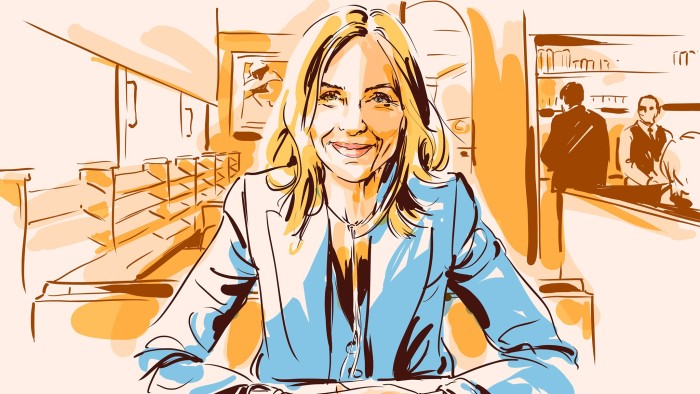
The premise of Lunch with the FT is that you are what you eat, or at least how you eat it. Trinny Woodall’s philosophy is different: you are what you look like.
When she enters the grand café near London’s Notting Hill, she radiates a cosmetic agelessness, an aura that only money can buy and only success can carry off. Her powder-blue suit gives the place a new hue of confidence. “The perfect colour,” admires Jeremy King, the restaurateur, when he comes over later.
In the 2000s, Woodall and her friend Susannah Constantine reset Britain’s sense of style. In their hit TV show What Not to Wear they harshly critiqued women. It worked because they also befriended them, and were open about their own imperfections. Woodall was a former addict. After the show ended, her ex-husband, and father of her daughter, died by suicide. She later dated Charles Saatchi.
Now 61, Woodall is back in the limelight with a make-up and skincare company, Trinny London. If you wish to pay £68 for a cream that promises to lift your sagging neck, you’re not alone. Trinny London’s sales were £70mn last year. The founder isn’t resting on her laurels. “We’ve got to do this and this and this.”
Indeed, Woodall is now an even more relentless shaper of women’s habits. Once she grappled with other women’s bodies on camera; now she grapples with her own, broadcasting on Instagram. Before our lunch, I watch her educating her 1.4mn followers about lipstick shades, weight training and how to make tracksuit bottoms part of a smart outfit.
All this captures our age. In 2025, appearances can be achieving. Donald Trump chose many government appointees for how they looked on TV. The mainstream is swept along on Botox, Ozempic and fast fashion. Europe spends more on facial fillers than the world spends on research into emerging infectious diseases.
I confess to being adrift. Preparing for the interview, I realise that I can’t spell the word moisturiser. Am I missing out?
Oh yes, Woodall tells me. “If you feel full of energy, you totally change your perception of how you see yourself. Then also how others see you . . . Some women look in the mirror, and they say, ‘Look at that line on my neck’. But a lot of women just think, ‘I feel tired’.” Trinny London’s products aim to make women think they won’t feel tired any more. But there seem to be limits. Before we turn to the food, my guest orders a macchiato.
“We’re doing two courses, right?” says Woodall, a little performatively. “Do you do pudding as well?” She orders an artichoke salad, and — in a move whose significance I do not realise at the time — the crab linguine. I go for the vegan options, an asparagus salad followed by courgettes. “God, that’s so light,” she interjects before I can order my side of chips.
Believe it or not, Sarah-Jane Woodall was a shy child. Her father was mysterious and entrepreneurial. When his fortunes dived in her late teens, she knew university wasn’t an option, so she went to work as a City trader. “Let me be in finance, and my dad notice me, because I have youngest kid inferiority complex.”
By then she was addicted to drink and drugs. “You can look at addiction being a hereditary gene, you look at circumstance. I focus less on that, and how can I not be in this cycle? By 26, I was exhausted by it all, and I went to rehab, and I never took a drug again.”
She met Constantine at a dinner party hosted by Princess Margaret’s son. They went into fashion journalism, tried a dotcom fashion business, then found their way on to the BBC. Was Woodall’s rude TV ego a caricature? “No, that was me. [But] I never wanted someone to walk away feeling shitty.”
Are we more obsessed by appearances today than in the 2000s? “There’s now many things that live in conjunction together. There’s an ‘age gracefully’ movement: is that saying I can’t do anything to myself and I can never dye my hair? There’s ‘I’ll do everything to look young’: ‘I’ll do every treatment’, ‘I’ll have a facelift’. There’s ‘I have a body dysmorphia’. And there’s somebody who clinically has some issues around weight, and it’s beneficial for them to go on a drug like Ozempic.
“I think there’s more personal choice today, where before there were quite clear streams of thought. It was, ‘You look shit, we’ll make you look better’. I never really look at trends any more. I wear colours that I think make me look good, I wear shapes that I think suit me.”
She thinks she’s softer. “When I did the show, I was like: this is what it’s going to be. My language now is: consider this. I prefer today.” She once told women with large breasts not to wear polo necks, because “you can be a bit uni-boob”. But “if you’re cold, and you get a cold neck, does it matter?”
The colour rules remain the same. She looks at me. “I would say your skin is neutral. Your hair is neutral, and your eyes are neutral-cool. So you can wear white, but if you wore cream, you might feel washed out, OK?”
I might rethink my cream suit, I say. “Do you really have a cream suit?” she sighs. “Is it cream or is it ecru?” With that, I learn a new word.
The starters arrive, and Woodall begins with butter beans and ricotta. I quote from the TV comedy Fleabag, when a lecturer asks women if they would give up five years of their life for the perfect body, and Fleabag and her sister immediately raise their arms. Does Woodall recognise women trapped by such pressures?
“I think you’re really compartmentalising women,” she replies, sinking back into her seat to make clear that this is not a compliment. “You shouldn’t just attach that to women, but they just have more permission to say it.” Fleabag’s real problem was that her life “was car-crashing”. I dig deep into my salad.
Woodall’s success in starting a business as a woman in her fifties is unusual. A recent report from Noon, a women’s social network, concluded that female entrepreneurs are more likely to turn to public or charitable funding than bank loans or venture capital.
She herself found that potential investors “would say, how are you going to protect from the downside? They wouldn’t say, how are you going to maximise your upside . . . ‘Hey, do you think you’ll have the energy to run the business?’ — I got that once. I just let that one slide, because I was like: you have no idea.”
Does she miss anything from her TV days? “I look forward and don’t look back . . . Should, would, could are the most damaging things we can do in our life.”
Other celebrity brands just tweak a generic product. She insisted on doing the work. “I’ve been so obsessed with skincare for so long. I had very bad acne until I was 30.” Products then didn’t list their ingredients. “So I’d always be trying to figure out what’s in this that’s really working. By the time I was 40, I’d done about 300 brands. I would never, ever just put my name on something.”
Her cream for sagging necks is made with a Japanese plant extract. She talks confidently about peptides and their uses. “Lift a sagging eyelid — this has not been ever done!” Not everyone listens. Her 21-year-old daughter heard on TikTok that beef tallow was brilliant for skin. “Beef tallow is going to give you spots!” says Woodall. “It’s a molecule that’s so big it’s going to block your pore.”
Large plates come and go. Woodall tries my courgette. I spill chips on the table. Disconcertingly, each time she takes a mouthful, she covers her lips with her hand, like a Premier League footballer preparing for a free kick.
“Age is irrelevant, it’s about the energy that you bring. You could be 30 and exhausted, or 70 and energised. I can sit across the table from somebody and feel the energy and passion that they have for life.” I quietly sit up.
We come to a moment that I hadn’t prepared for. “Do you want me to diagnose you? Are you all right if I touch your skin? I’ll close my eyes because I feel your skin better.” She leans across and grasps my temples. “You clean your face, but you might not clean it with product. Do you wash your hair every day? I knew you didn’t . . . I have clients who are men more vested in looking after themselves including skincare, as well as a shirt that has been ironed.” Touché. If I can describe Woodall as well as she has described me, the interview will be a success.
What Not to Wear’s advice is now a period piece. It told women that “a normal, healthy appetite can do terrible things to the body”, and that chunky ankles “should be disguised whenever possible”. In her book Girl on Girl, journalist Sophie Gilbert argues that the show was part of a culture that made beauty something you had to buy: it used “bitchy, elitist insults” to encourage women to spend money they didn’t have.
It must cost a lot to look like Woodall? “It needn’t . . . I do my skincare religiously, and I also do a massage every morning which takes five minutes, I probably Botox twice a year. I don’t have extractions, because I don’t have spots any more. I do microneedling, which I do at home. And that’s it.”
She starts the day with lemon water, collagen powder, lion’s mane extract and turmeric chai, and sometimes a personal trainer. Her beauty spending, including dyeing her hair from being “90 per cent” grey, was once estimated at £10,000 a year. “No, that was the Daily Mail. Botox is like £600, twice a year . . . If someone can’t afford our skincare, I will try and offer them things that they can do. Do facial massage: your fingers are free.”
Does she do it all for herself or for others? “One hundred per cent for me . . . When I turned 50, I stopped worrying about what people thought about me. It’s not that I stopped caring, I stopped worrying.”
Jeremy Clarkson is seated at a table behind us. After a session with Trinny and Susannah, he once said: “I’d rather eat my own hair than shop with these two again.” Woodall’s version is different: “He ran out of the shop, then he did go back a week later and spend three grand in that shop.”
Trinny London relies on influencers. Does that culture baffle her? “No. I’m so fucking fascinated by it.” She has her sights on the US market. On a trip there, she learnt to think of influencers as mini-department stores.
But influencers have to expose so much more of their lives than TV presenters such as Woodall did. “You think ‘they give everything to it’ — you in different ways give everything to your role as a writer.” I protest that there is no camera in my bedroom, and I worry about the impact on young girls. “If I meet anyone who has a life where they just show one side [in Instagram], I always ask them to consider showing every side,” she agrees.
I have other questions about beauty culture — whether it contributes to the backlash against feminism, why Trinny London uses mainly young models when it targets older customers, whether her own Instagram videos answer women’s insecurities or exacerbate them.
Apart from anything, cosmetic treatments can be so obvious. Does Woodall worry that people look at her and know she’s had Botox? “You overthink a lot, don’t you?” she replies, sharply. I realise I might as well have asked a pine tree if it’s scared of heights.
Clarkson’s table is getting louder. “Are you going to have pudding? I just slightly feel I want to today.” We go for sorbets and coffee.
I spin out a dull comment about her success. She sees straight through me. “I think you’re thinking, what question do I ask next?” She’s right: I want to ask her about the suicide of her ex-husband, Johnny Elichaoff, in 2014.
Elichaoff had run up massive debts, including to Woodall. She saw it all, yet soon after dared to start her own business. How? She says she knew her work with Constantine was ending (“I’m probably more driven, and she knows that.”) She already had the germ of Trinny London. After Elichaoff died, “I had a moment of two weeks thinking, should I pursue it? I just thought: I have to do it. I have to sell my house, I have to sell my clothes [to fund it] . . . I look forward and I don’t look back . . . The hardest thing about suicide is looking at what’s your responsibility.”
Today Woodall’s daughter is turning into a fashion influencer like her. She, in turn, jokes she is turning into her daughter: addicted to her phone.
I ask her verdict on the food. “The butter beans were delicious. The balance of textures was good, the softness of the cheese and butter beans — sometimes you think it would be too squidgy together and it wasn’t. The crab linguine was delicious, it had just enough chilli in it. I didn’t have enough of the rocket. I didn’t know it was going to be a spicy rocket.”
Her powers of observation are impressive and exhausting. After we say goodbye, I walk past Clarkson’s table, steaming with carefree, blokeish energy. I wonder if any of them can spell moisturiser or indeed ecru.
The next day Woodall announces on Instagram that she has been throwing up with food poisoning. “All my life I’ve hated more than anything else throwing up and feeling sick . . . because I also throw up through my nose, sorry just to get technical,” she says, filming in bed with what appears to be perfectly applied make-up.
Someone once died the day after Lunch with the FT, but no one before — to our knowledge — has later been violently sick. Perhaps the thought of my cream suit was even more revolting than I realised. Kindly, on Instagram, she blames “crab”.
I send an apologetic get-well-soon email. A day later Woodall is on camera doing restorative training, and I receive a reply insisting that the illness was nothing to do with our lunch. Was it a different crab? Does she not wish to offend Jeremy King? After spending two-and-a-half hours looking at Woodall, I am unsure where reality ends and artifice begins. Her drive, however — I can safely say that is real.
Henry Mance is the FT’s chief features writer
Find out about our latest stories first — follow FT Weekend on Instagram, Bluesky and X, and sign up to receive the FT Weekend newsletter every Saturday morning
Read the full article here