

Unlock the Editor’s Digest for free
Roula Khalaf, Editor of the FT, selects her favourite stories in this weekly newsletter.
Endeavouring to perform a correct action that rarely pays off, often results in lethargy. Here, however, the slightly more complicated method pays dividends . . .
Bidding
Dealer: East
N/S Game
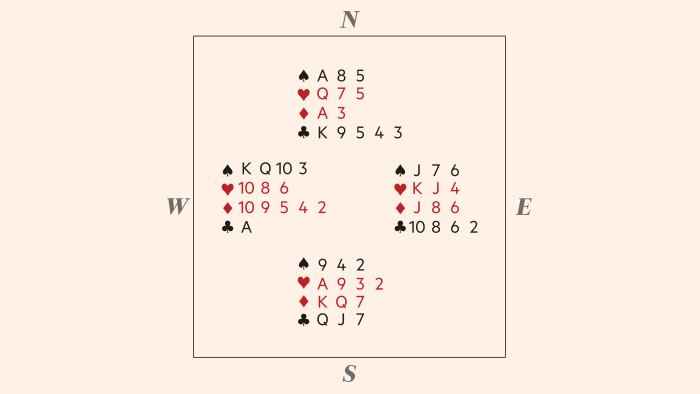
Whether North or South played in 3NT, the opening lead was usually a spade. Here, South opened a weak NT; West led K♠. Assuming West held a five-card suit — the correct thinking when considering how many times to hold up in order to exhaust East of his supply — declarer ducked the first round and won the continuation. East unblocked J♠ on the first round to tell West that he could safely continue leading the suit. At virtually every table, Q♣ was advanced next and, as a result, two club tricks are now set up for East-West and the contract is doomed to fail, often by two tricks. Instead, declarer must focus on doing everything possible to ensure four club tricks and so, at trick three, to cater for West holding a singleton A♣, South should lead 7♣. On so many occasions, this will make no difference but here it secures the contract. West takes A♣ perforce and cashes two further spade tricks, but the rest belong to declarer.
This is why, so often, the stronger player seems to complicate matters, and sighs with resignation when everything behaves. Indeed, such players occasionally long for odd distribution — against which they can counter — as this provides their edge.
Find more of Paul Mendelson’s Bridge columns at FT Puzzles and Games
Read the full article here