

Stay informed with free updates
Simply sign up to the Climate change myFT Digest — delivered directly to your inbox.
Stefan Legge is an economist teaching at the Executive School of the University of St Gallen
The slow progress in reducing the cost of direct air capture, which removes carbon dioxide directly from the atmosphere, has raised questions about the technology’s future role in global climate strategies. Once heralded as a key tool in reaching net zero targets, DAC’s developers face mounting economic and technical challenges that threaten scalability.
The Intergovernmental Panel on Climate Change, the International Energy Agency and others have argued that carbon removal technologies such as DAC are essential because emissions reductions alone will be insufficient to meet climate targets, particularly since hard to abate sectors such as aviation, cement, and steel, will continue emitting residual CO₂.
IPCC and IEA scenarios indicate that large-scale carbon removal is necessary this century to offset residual emissions and potentially reverse atmospheric CO₂ overshoot.
DAC also offers verifiable, permanent carbon removal that is free from the land constraints facing natural solutions such as soil, forests, mangroves, seagrass and kelp.
However, with costs remaining high, progress on scaling up DAC is slow. Average capture costs across the industry still hover at about $900 per tonne, declining only to about $500 by the end of the decade, according to Bloomberg NEF analysis.
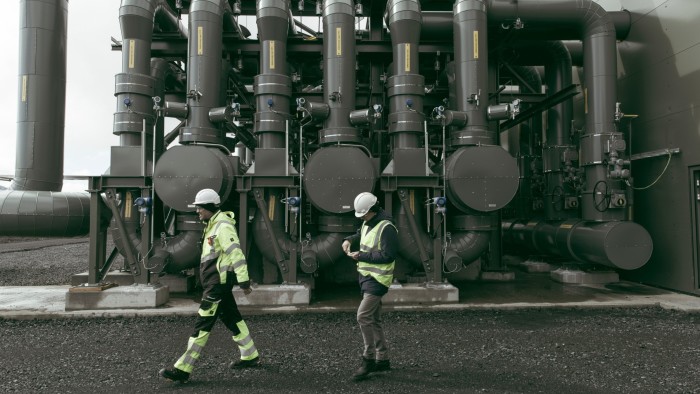
In September, Swiss company Climeworks, which operates Mammoth, the world’s largest DAC facility, in Iceland, told the Financial Times that its cost reductions were falling well behind earlier projections. In 2019, it aimed to cut capture costs from $600 per tonne to $100 within four years.
Now, it expects to reach only $250 to $350 per tonne by 2030 and $100 per tonne by 2050, according to figures Climeworks shared with the FT. The company, which has raised more than $1bn from investors, is reducing its workforce by 20 per cent amid rising energy and operational costs.
Investors in DAC face steep capital costs, uncertain scalability and dependence on abundant low-carbon energy. Competing chemistries and immature supply chains heighten obsolescence risk. Policy, regulatory and liability frameworks for storage and verification remain fluid, limiting confidence in long-term returns.
Public resistance over land use and perceived moral hazard adds non-technical risk. Sparse commercial precedents and opaque valuation metrics make exits uncertain, constraining investment.
Since capture costs remain far above carbon market prices, DAC projects rely on voluntary carbon credit markets, where credits from direct air capture command a steep premium over cheaper options such as reforestation. “You have to have some credit sale agreement to make it work,” Brendan Cooke of Rystad Energy, an energy consultancy, told the FT.
Government policy remains pivotal in shaping the DAC market. Subsidies, tax credits (such as the US’s Section 45Q, which incentivises investment in carbon capture and sequestration) and procurement contracts underpin early adoption.
Yet policy uncertainty in the US — including reduced climate funding under President Donald Trump — complicates the financial outlook for an industry in which policy rollbacks or funding cuts can destabilise project pipelines.
Despite these challenges, optimism persists among major energy players and investors. Competition in the industry is intensifying among companies such as Climeworks, Heirloom of the US and Canada’s Carbon Engineering, now part of Occidental Petroleum. Through its subsidiary 1PointFive, Occidental is developing the $550mn-backed Stratos project in Texas, set to capture 500,000 tonnes of CO₂ annually, and soon to be the world’s largest DAC facility.
Companies are forming strategic partnerships with energy majors and financial groups — Climeworks with Swiss Re, Occidental with BlackRock — to access capital and scale infrastructure.
The IEA projects that removing up to 1.2bn tonnes of CO₂ annually by 2050 — compared with just 100,000 tonnes today — could be required to meet global net zero targets. This would translate into a market some estimate to exceed $100bn annually if DAC costs were to approach $100 per tonne. Yet realising this potential will require vast investment and technical breakthroughs to ensure costs per ton come down sufficiently.
Climeworks is now testing such technology at its Mammoth facility. The company says that, by using less energy and capturing carbon more efficiently, the technology will enable it to halve costs and scale up capacity, bringing it closer to its goal of operating the world’s first profitable DAC plant.
As of now, the economics remain daunting. “$100 per tonne is still that magic number,” Jeffery Jen, a senior analyst at energy data company Enverus, told the FT. “DAC is a long way from that.”
For those who hope to reap both the carbon reduction benefits and the potential investment returns of DAC, the question will be how to tap into both policy and market drivers to enable this promising form of carbon removals technology to be scaled up to meet global climate targets.
Read the full article here