

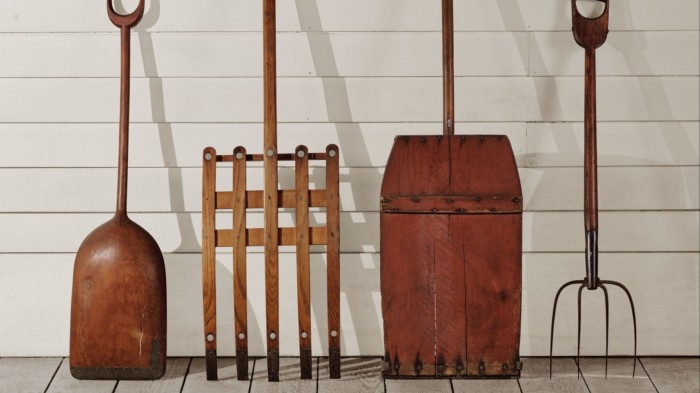
Every generation stages its own Shaker design revival. The Whitney Museum of American Art had a big show in 1986, in the middle of the postmodernist boom. The artists emerging in the 1960s, including Donald Judd, Jasper Johns and Ellsworth Kelly, were keen collectors of Shaker furniture; before that, artist Charles Sheeler depicted Shaker interiors as places of proto-modernist contemplation.
Today, countless furniture designers look to the Shakers — the celibate branch of the Quakers, who emigrated to the US from near Manchester in the mid-18th century — for inspiration. Catskills maker Brian Persico, Jasper Morrison, Neri & Hu and Matthew Hilton are but a few. But the group’s biggest impact remains in the kitchen: “Shaker” cupboard doors, with a framed central panel, appear everywhere from Ikea to upmarket deVol.
The fetishisation of Shaker design may be nothing new. But it is remarkably resilient. Indeed, more so than the group itself; there are currently two members remaining, residing in their own shrinking utopia, Sabbathday Lake in Maine. So what is it that makes their furniture so curiously, consistently influential? A new exhibition, The Shakers — A World in the Making at the Vitra Design Museum in Weil am Rhein, Germany, explores the question.
It’s difficult to think of another sect, cult or religion that has become known mostly for its chairs and storage. Officially known as the United Society of Believers in Christ’s Second Appearing, the group got their curious label from their nickname the “Shaking Quakers” (which sounds a little like a 1960s skiffle band). While their Quaker brethren sat and silently contemplated, the Shakers indulged in communal, synchronised dances based, in part, on the rituals of labour. This meant that spaces of worship had to be cleared to allow room for dancing; loose items, notably chairs, would be hung out of the way on rows of pegs on the walls.
Chairs, then, had to be lightweight and mobile, “with no place for the devil to hide”, they said. That clearing of the space (which also made cleaning easier, and they were very interested in cleanliness) would later appeal to the modernists, who similarly desired to banish darkness and shadow with rational, almost transparent furniture (their spindly ladderback chairs are frequently copied; think, too, of the Bauhaus’s tubular designs).
Storage, meanwhile, was built-in and made-to-measure, rather than the then popular freestanding cupboards, chests and wardrobes. Shaker furniture did away with gaps, making things fit snugly: something now so familiar we don’t even notice it. Most people moved house often; but the Shakers were committed to living in the utopia they created, so they had the time to build things.
Shaker products were (like their modernist descendants) plain and unadorned — decoration was seen as prideful and consequently, sinful. In the Vitra museum, among the extravagant fruits of a century and a half of invention in modern furniture design, it might seem that Shaker products are not particularly innovative. Shakers were more interested in gradual improvement, working with the (mostly English) archetypes of their collective memory. The rocking chair on show (1850-70) is clearly an adaptation of their standard chairs, as is the wonderfully eccentric Tilting Chair (also 1850). Furniture was often adapted to particular tasks: for example, the 1845 Cobbler’s Bench, which seems to presage both mid-century aesthetics and surrealism.
But, unlike, say, the arts and crafts movement, the Shakers were not averse to using technology: they adapted designs so that they could be made in a modular manner, effectively mass producing them with tools of their own making and a sophisticated division of labour. Some credit the invention of the circular saw, something that completely transformed timber manufacturing, to Shaker Tabitha Babbitt in 1813. The Shakers didn’t believe in patents, however; they believed instead in communitarianism — inventions were a gift to the community and became common property.
That said, if Shaker style has become a brand, it was one the religious sect laid the foundations for themselves. As early as the mid-19th century, they invited visitors into their self-sufficient communities across the US, and flogged their chairs and oval boxes as souvenirs.
Perhaps one characteristic that has imbued Shaker work with a kind of soul, even if it was effectively mass produced, was the conviction that labour and making were themselves a form of spiritual practice. “Do all your work as though you had a thousand years to live and as you would if you knew you must die tomorrow,” as founder Mother Ann Lee (1736-84) famously (and beautifully) said.
What drove them was a sense of urgency: a belief in the imminence of the second coming and the establishment of paradise on earth. But their solution for how to live in what they believed to be a short moment was to do so in the calmest, most organised manner possible. Curator and writer Glenn Adamson (who contributed one of the essays in the exhibition catalogue) suggests that the reason for the current revival in admiration for Shaker design is that we too are anticipating an end to the world, with climate breakdown, anxiety about overproduction and consumption, and erratic and extreme politics. Like them, we are asking, “how do we live now?” Maybe in a world of too-much-stuff, bare rooms and simple furniture look like the ultimate luxury.
There is something tragic about the Shakers’ legacy surviving only through kitchen cabinets: all that anticipation, energy, labour and craft is reduced to big box retail parks and lifestyle pages. Genuine Shaker furniture is rare but still cheaper than a new “Shaker” kitchen from an upmarket supplier. You can currently get a set of six beautiful dining chairs from the Shaker village of Mount Lebanon for around £15,000.
Perhaps this show can remind us of a rare moment when design and craft were a part of everyday life rather than a commodity — something entirely alien to the Shakers. All their property and their things were held in common.
“The Shakers: A World in the Making”, Vitra Design Museum, June 7- September 28; design-museum.de
Edwin Heathcote is the FT’s architecture and design critic
Find out about our latest stories first — follow @ft_houseandhome on Instagram
Read the full article here