

It has never occurred to me before that elephant ears — those ridiculously huge, comically floppy things — could look menacing. But it is remarkable how quickly your perspective can change when a herd of wild forest elephants is charging towards your open vehicle, their great grey earflaps getting larger and less cartoon-like by the millisecond.
“To the right!” shouts Jonathan Wright, the owner of the safari company I am travelling with, to our driver, his voice almost completely drowned out by the deafening ensemble of trumpeting sounds coming in our direction. “Right! Right!” I grab on tightly to the safety rail as we lurch round an acacia bush.
The charge is being led by a young mother (mid-twenties, Wright estimates) who does not seem to have appreciated us turning up to her family gathering unannounced, and though we are trying to get away from her as fast as we can, we are facing some most inauspicious driving conditions. We’ve had to turn off the track to try to get around the herd, meaning the ground is bumpy and uneven, and the 7ft-high Hyparrhenia grass — the same stuff that provides such lovely thatched roofs back in the safety of our lodge — is making it difficult to see where we are going. Further, while the sun only set 10 minutes ago, darkness is rapidly descending, as it does in this part of the world.
We are at the eastern edge of the Albertine Rift Valley in western Uganda, close to the border with the Democratic Republic of Congo, in a brand new national park, Toro Semliki. It was for a long time gazetted as a hunting reserve, and later as a wildlife reserve, but as of September — thanks largely to Wright’s lobbying and conservation efforts — it now has national park status, meaning more funding, more protection against poachers and potentially more tourism.
Not for now, though. Some 133,000 acres of one of the most biodiverse habitats in Africa stretches out around us — rainforest, wetlands, grassland, Borassus palm savannah, acacia woodland — and we are, amazingly, the only tourists here. Our base is the luxurious Semliki Safari Lodge, the first of WildPlaces Africa’s six lodges and camps, and the only place you can stay in the whole of the national park.
Wright tells me that this area used to be one of the best locations in Uganda for seeing lions and leopards, but that during decades of conflict, from the late 1970s through the 1990s, the big cats were killed off by poachers or by the poison of local farmers trying to protect their livestock. He is now on a mission to bring them back, building four new rangers’ posts in the park and equipping the staff with all-terrain vehicles, smartphones, tents and other gear, all funded by the WildPlaces Conservation Foundation, into which $25 of each guest’s nightly rate goes.
Even without the big cats, there is plenty of wildlife to see. There are seven different species of primates (including chimpanzees and the black-and-white-streaked colobus monkeys that wake us up with a loud dawn chorus each day), various species of antelopes, hippos, cape buffaloes, warthogs — surely the sweetest animals in the bush, their little antenna-like tails swishing through the grasses — as well as a wonderful array of unusual and exciting birds. A boat trip on Lake Albert, which separates Uganda from DR Congo, takes us through frilly lily pads and pale purple water hyacinths in search of a shoebill, a rare and prehistoric-looking bird whose bulbous hooked bill and gigantic stature remind me of a dodo.
And then there are the elephants. Africa is home to two types, both of them found in Toro Semliki: the more common, larger savannah elephants, and these feisty forest elephants, distinguished by their straighter, downward-facing tusks, adapted to help them pass through the dense rainforest undergrowth without getting caught up in branches or lianas. A sighting is not to be sniffed at — since 2021 they have been designated as critically endangered.
But I must confess to being thoroughly relieved when we have left them behind and get back to safety, or the closest you can be to it when you’re out in the savannah. Wright later tells me that he doesn’t think we were in real danger — he has had a couple of dozen comparable experiences over the three decades he has been doing this — but even he is looking a little flustered. My legs are still shaking visibly below me.
He turns to me. “Exciting stuff, eh? This is a real safari.”
My adventure starts 10 days earlier, a little further to the north in Uganda’s oldest — and largest — conservation area, Murchison Falls National Park, named after the spectacular waterfall that squeezes through a 7-metre gap in the rock and then thunders down 43 metres into the Nile. “They call this part the crocodile restaurant,” Wright helpfully tells me during a boat ride that takes us close to the bottom of the falls, pointing out that every little lump in the water around us is a croc. “And in here you got proper 18-footers. This is somewhere you don’t try to swim to shore.” (Lucky he told me.)
I am on a group tour that will take me around several of WildPlaces’ luxury safari camps and lodges in the west of the country. The company was founded in 1994 by Wright, who was born in Uganda in 1963 to British parents but left during the bloody and turbulent Idi Amin years, and his wife Pamela Kertland, whom he met at university in Canada and who takes the lead in designing all of the lodges’ interiors. It was not the easiest place to set up business: Wright recalls a human skull being left in the driveway of the Semliki lodge by local rebels as a warning, and he used to sleep with a gun on his chest.
Neither was it the life they had imagined for themselves — they had been in the process of setting up a hotel in Newfoundland when a chance encounter with the Ugandan ambassador in Ottawa led to a meeting in Washington with president Yoweri Museveni that changed their trajectory. (At 81, having held power for 40 years, Museveni is one of Africa’s longest-serving leaders, with another election approaching amid familiar doubts about its fairness.) “So I tell Museveni my story about growing up in Uganda and leaving during the Idi Amin years,” Wright tells me, “And he says: ‘We are a new country. You must come home. You are a son of Uganda.” With the president’s support, Wright did just that.
Despite the fact that overall tourism is doing pretty well — 2024 saw a record 1.37mn visitors enter the country — Uganda is not considered a go-to destination for a big-game safari, and most tourists come from other countries in Africa (just over 10,000 British people travelled here in 2024). Traditionally, animal-spotters have flown in to see the mountain gorillas that can only be found here or in Rwanda, and then flown back out to areas more densely populated with wildlife like the Masai Mara in Kenya or the Serengeti in Tanzania. But Uganda is carving out a niche for a different kind of higher-end, lower-impact safari tourism that focuses explicitly on “quality over quantity”. And a new direct Uganda Airlines flight from London to Entebbe, which launched in May, could make it more appealing to British travellers.
While the country might lag in its sheer numbers of the “Big Five” — precise statistics are hard to come by, but the Ugandan Wildlife Authority estimates that Uganda has 5,000 elephants, compared with more than 36,000 in Kenya — it outperforms in terms of its bird and primate offerings, as well as its sense of adventure: you have to actually look for the wildlife here, and when you find it, it might not be expecting you.
In Murchison Falls we are staying at Papa’s, a “bush camp” that comprises five luxury tents set just a few feet back from the roaring rapids of the Nile, as well as a larger tent that functions as a dining room, bar and communal living space. All of the WildPlaces lodges are kitted out with antiques that Kertland and Wright picked up in auctions in the UK, and with furniture designed by them and handmade using Ugandan mvule wood in a workshop at their Kampala home. The plush, handcrafted interiors are matched by a premium service: visitors are outnumbered three-to-one by staff. One particularly decadent feature is the in-person wake-up calls that come with a pot of hot coffee or tea and a freshly baked muffin — mine by the delightful Maggie, the only person in the world I could forgive for waking me up at 4.55am.
But despite the extravagance of the service and the setting, there is always a sense of also being truly in the wild; the company played around with the tagline “hard days, soft nights” for a while, and I can see why. We are each given a walkie-talkie and are under strict instructions not to leave our tents on our own at night — the hippos like to graze in the dark, and while they do look very cute and cuddly, they are in fact the deadliest land mammal in the world.
Like at Semliki, we have a vast expanse to ourselves in Murchison — not the entire national park, some of which is relatively touristy, but a designated 185,000-acre “low-use zone” with only one place to stay for now: Papa’s, which is 67 miles away from the nearest town. Early next year Kulu Ora, the company’s newest and even more upscale lodge (with just 11 canvas suites), will open a little further along the Nile.
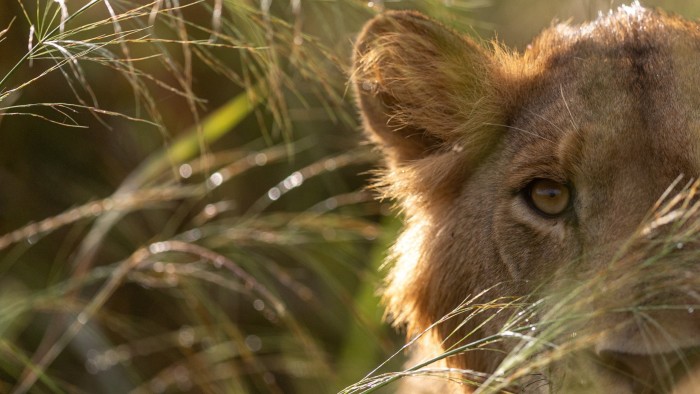
Wright reckons some 70 lions live in the area, but while I spot an astonishing number of things that I mistake for a lion on our first day of looking — Ugandan kob, termite mounds, tree bark, rocks — we find none. So it is all the more thrilling the next morning, just as the sun is coming above the horizon, when we finally hear the unmistakable sound of a lion roar. We follow it to find the majestic seven-year-old head of the pride, Tony, named after a former manager at Papa’s because of their shared attributes: a broken tooth and a limp.
After a freshly cooked bush breakfast of the Ugandan speciality, “Rolex” — a deliberate malapropism for “rolled eggs”, comprising of chapatti rolled up with beaten eggs and whatever fillings you want — we spend the rest of the day marvelling at Tony’s pride from just a few feet away. I have never seen a lion before and I find it a moving, exhilarating experience. There’s one particular two-year-old lioness who I take a shine to, but who hasn’t yet been given an official name. After some discussions between Wright and our driver, David, a happy decision is made: she will be called Jemima.
Before Semliki, it’s time to experience Uganda’s most famous tourism attraction: the once critically endangered mountain gorillas that are slowly being brought back from the edge of extinction, in the Bwindi Impenetrable Forest.
At more than 2,000 metres above sea level, the climate is rather different up here, and the cosy Clouds Lodge we are staying in, with stunning views over the mountains, reflects that. Each room features an open fire; a hot water bottle is placed in your bed while you are having dinner. The food throughout the trip is excellent, but here it is a particular highlight, with almost everything made out of the organic produce grown in the lodge’s grounds. Weeks later I am still dreaming of the freshly made butternut and sage ravioli I have on my last night there.
There are two options for gorilla trekking — a four-hour habituation experience, in which gorillas are slowly accustomed to humans, or the standard one-hour visit with an already habituated family, as we are doing today. We set off from Nkuringo with our guides and a couple of rangers armed with AK-47s (for “scare shots”) down the steep, terraced hillsides of the Albertine Rift. We pass through bright green tea plantations, placed here as a “buffer zone” for the gorillas — the primates don’t like the taste of the tea leaves, so will always return to the deliciousness of rainforest shoots and roots and leaves — before entering the forest ourselves.
We’ve been warned that we could be in for a long day — gorilla trekking is never predictable, and finding them isn’t guaranteed — but after just 90 minutes of walking, our guide thwacking away at the jungle thicket with a machete at the front of our pack, we hear a thudding noise just to our left. We have found the 18-member Posho family (so-called because of the gorilla trackers’ fondness for the local posho bread to keep them going).
We walk towards the gorillas tentatively, some of us a little nervously. But the primates seem utterly relaxed in our company. The great 27-year-old silverback, Magara, does look a little intimidating at first, especially when he sits up and looks straight at us, but he then rolls on to his back like a baby, turns on to his side, and falls asleep. We provide no interest for him. A mother and her six-year-old are snuggled up with another baby, a one-and-a-half-year-old who they are grooming together just a metre or so away, totally unfazed.
That’s not to say none of them are curious: while I am standing alone, one of the female gorillas — a 21-year-old named Rutuku — comes right up to me, brushing herself along my left leg before settling down on her haunches just behind me, and then pulling down leaves from above her to munch on nonchalantly. I never thought I could be so calm about a 200lb primate that is about seven times stronger than me, but I feel an odd sense of serenity. The bush is funny like that. You never quite know how nature is going to behave — yourself included.
Find out about our latest stories first — follow FT Weekend on Instagram, Bluesky and X, and sign up to receive the FT Weekend newsletter every Saturday morning
Read the full article here