

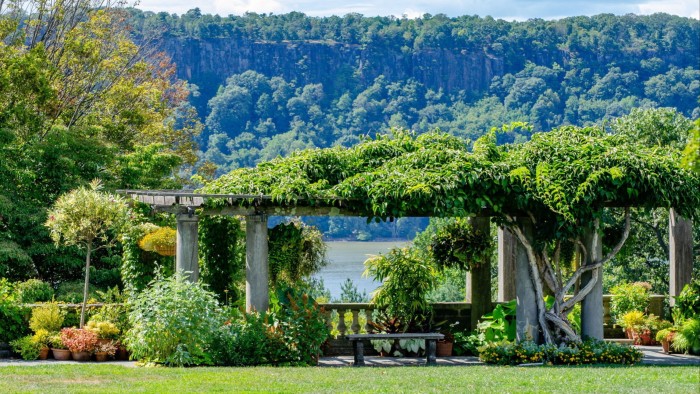
Just beyond the far northern tip of Manhattan, where the Metro-North train veers sharply west with a bend in the Harlem River, the environment suddenly changes. Close to the sprawling urban tower blocks to the south and the east, a hilltop garden suddenly comes into view.
Wave Hill Public Garden and Cultural Center sits on the slopes above the Hudson River, a 28-acre green expanse enveloping two historic buildings at the north-western extremity of the Bronx. With trees, lawns and varied and colourful year-round flowerbeds overlooking the river, it feels almost as remote as when it was a lengthy carriage ride from the city for William Lewis Morris, the lawyer who built the original Wave Hill House in 1843.
“It’s an amazing bubble,” says one visitor on a day trip from central New Jersey with her husband, both charmed by the wilder woodland paths sloping down towards the river.
With just 100,000 visitors a year, Wave Hill is little known beyond gardening afficionados and long-standing local fans. But as it celebrates its 60th anniversary as a public garden, its current management is gearing up to attract a wider audience, taking advantage of its setting, broadening programming and planting for a new ecological era in a move to reimagine itself for a new phase.
For a site that is less than 5 per cent of the size of its better-known peers Central Park and Prospect Park — the estate impresses with its variety, colour and rustic vistas with their sense of space and calm. More than a dozen small gardens — from herbs to wild and tropical — are laid out between multiple lawns and borders, surrounded by woodlands including rare trees more than a century old.
For the past two years, the garden has been managed by Ray Oladapo-Johnson, previously a vice-president at New York City’s High Line, the elevated freight rail track repurposed as an urban garden walk. He follows in the footsteps of Marco Polo Stufano, Wave Hill’s influential founding director of horticulture, who retired 24 years ago.
Oladapo-Johnson’s primary driving force is, inevitably, adapting the garden to the pressures of climate change, and gently broadening its appeal to new audiences, including the city’s younger, less wealthy and ethnically diverse population. “We want them to be what New York looks like,” he says. “What’s our cool factor?”
He has so far raised more than $30mn in a campaign to support extensive renovations to eroded paths, build a forest rain garden with specialist plants to better manage water run-off, and develop projects offering new opportunities to engage students and young people with nature.
He has already made waves — by introducing hip-hop concerts and humorous Instagram videos, and organising summer camps and ecological internships for local children. All the while, he has built on its tradition of hosting of art installations. There is contemporary art inside and out, including most recently Sara Jimenez’s Folding Field: bright pink textiles draped between a linden and an oak tree.
Wave Hill House has a rich history. It was bought from Morris by William Henry Appleton, Charles Darwin’s American publisher, in 1866 and leased variously to Theodore Roosevelt’s family and Mark Twain. The financier and conservationist George Walbridge Perkins bought both it and the neighbouring Glyndor House at the end of the 19th century, and hired landscape gardener Albert Millard to bring the estates together and lay out the basis of today’s garden.
Planting at the time was modest, dominated by trees and lawns, with an emphasis on views. But as instigator and founding chair of the Palisades Interstate Parks Commission, Perkins was instrumental in preserving Wave Hill’s striking vistas, with the acquisition and protection of the woods and cliffs on the far western side of the Hudson to prevent their destruction.
He even commissioned what may have been New York’s earliest green roof in 1909, with lawns covering a large underground recreation building with a billiard room, bowling alley and a squash court.
Today — just as the houses were rebuilt over the decades — the gardens are substantially a modern creation. The general layout retains Millard’s winding pathways, as well as a number of now mature trees, including red oak, grand copper beech and a dawn redwood from the 19th century.
But when Wave Hill was taken over by the city in 1965 and handed for management to a non-profit, Stufano, who still lives nearby, established the current layout, drawing inspiration — as well as seeds and cuttings — from Italy and above all England, including Great Dixter in Sussex.
He removed rose beds to create what he called the 1693 garden, named for the $16.93 spent on seed packets to create it. He replaced a rock garden with a wild garden, and filled a former swimming pool with native plants.
Some of his original plantings have since been trimmed back, and Wave Hill’s seven gardeners have “considerable autonomy” to experiment on their own patches, says Oladapo-Johnson. The result is a variety and unpredictability of changing colours and textures through the seasons, with undulations in the landscape, trees and occasional low walls creating self-contained and sometimes surprising spaces, from cottage garden to aquatic zones.
Cathy Deutsch, director of horticulture, says: “Everything we do is on a shoestring budget. We propagate a lot of our own plants, sow a lot from seed and use self-sowing annuals.”
The garden already has switched to electric vehicles and lawnmowers. She is also discussing the conversion of one lawn into a wild meadow, the renovation of glasshouses and a state-of-the-art composting facility.
After all, at 60, why not start planning for a new future?
Andrew Jack is the FT’s global education editor
wavehill.org
Find out about our latest stories first — follow @ft_houseandhome on Instagram
Read the full article here