

Unlock the Editor’s Digest for free
Roula Khalaf, Editor of the FT, selects her favourite stories in this weekly newsletter.
In the late 1970s, the Bulgarian artist Christo and his French wife and creative partner Jeanne-Claude, landed in the United Arab Emirates to work on what they hoped would be their greatest masterpiece. “We arrived there in 1979 and that all became part of our existence,” he later recalled. But half a century later, “The Mastaba” remains unrealised.
At Art Basel Qatar, Gagosian, which represents the estate of the late artist, will be showing early sculptural works created by Christo in the late 1950s and early 1960s. The selection features pieces from his Packages and Wrapped Objects series that anticipated the later large-scale site-specific installations — such as “Wrapped Reichstag” (1995) and The “Pont-Neuf Wrapped” (1985) — that he produced in collaboration with Jeanne-Claude. But the fair’s location and the works on view also echo the artists’ long-standing engagement in the Middle East — and the art still to come.
The works selected for Qatar include “Wrapped Oil Barrels” (1958-61), a group of four barrels, two wrapped in fabric, resin and steel wire. The piece illustrates Christo’s budding fascination with barrels — which he saw not as a material but as a series of modular units to be used for their mass, rhythm and colours — objects emblematic to the region. For Christo, however, they were neither a celebration nor a critique of the oil industry.
During a career spanning half a century, Christo proposed several temporary works for the Middle East, many of which remained unrealised (cost, practicalities and state sign-off constrained many of his projects). These various concepts spanned sites in the UAE, Qatar and Saudi Arabia. These included “The Wall”, conceived in 2002 for Sheikh Saud al-Thani’s proposed Sculpture Garden in Doha, and “The Walk (Project for Doha)” — an inflated, walkable air passage proposed in 2017 that would connect Jean Nouvel’s National Museum of Qatar with IM Pei’s Museum of Islamic Art on the Corniche. That same year, in Saudi Arabia, Christo imagined wrapping the Nabataean religious tombs of Qasr al-Farid and Qasr al-Bint in Hegra.
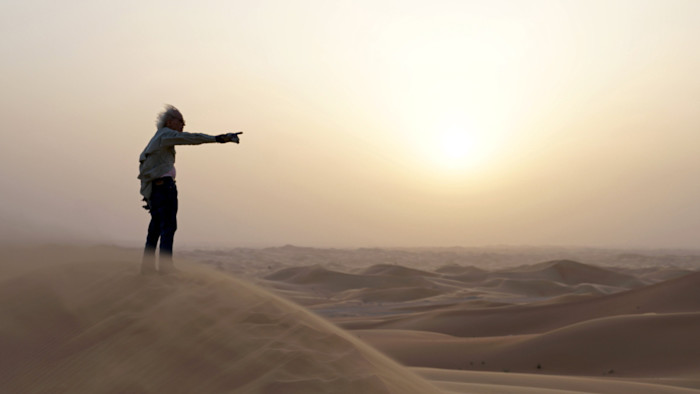
His and Jeanne-Claude’s interest in the region peaked with “The Mastaba”, a monumental structure of oil barrels to be built somewhere in the sand dunes of Abu Dhabi. The as yet unrealised installation would be the artists’ only permanent public artwork. A mastaba is a type of flat-roofed rectangular tomb with sloping sides that dates back to Egypt’s Early Dynastic Period. Christo created other, smaller, mastabas, most notably a floating version made for the Serpentine in London’s Hyde Park in 2018.
The structure proposed for Abu Dhabi is some 50 times larger than the London sculpture. It was first conceived in 1977 and between 1979 and 1983, Christo and Jeanne-Claude spent considerable periods in the emirate developing the project. Christo later recalled his wife’s attachment to its topography: “She was born in Morocco and she had a great affection for the desert.”
Following the deaths of Jeanne-Claude in 2009 and Christo in 2020, making “The Mastaba” dream a reality has been the daunting responsibility of Christo’s nephew Vladimir Yavachev, who worked with the artists for more than three decades and is now director of projects for their estate. “We had many trips together to the region, including Qatar, Saudi Arabia and UAE,” recalls Yavachev of his time working with his uncle. “Christo was deeply attentive to landscape, history and scale. He was drawn to the beauty of the desert as a sculptural space and to the region’s long tradition of ambitious, enduring structures.”
“The Mastaba” is “a fully developed artistic project,” says Yavachev. “Christo and Jeanne-Claude worked on it for decades, and its form, scale and materials are all defined and finalised. The remaining work relates to site confirmation and execution.” There is no fixed completion date.
Christo once likened creating his vast environmental interruptions to “building highways, bridges or airports.” All of his projects, he explained, were the result of alliances with “professionals who have nothing to do with artists who make sculpture.” “The Mastaba” represents the zenith of those logistical challenges. The sculpture would measure 150 metres high by 225 metres wide and 300 metres long and consist of 410,000 multicoloured barrels. Christo explained that they would be the “Rolls-Royce of barrels,” each one specially fabricated for the work. The facades would consist of a mosaic of 10 colours — “like a pointillist painting” — with the frontal walls echoing the abstract compositions found in Islamic architecture. If completed, the installation will be the largest contemporary sculpture by volume in the world.
Yavachev believes that the mid-century avant-garde works by Christo to be shown at Art Basel Qatar — which include “Package on a Luggage Rack” (1962), “Wrapped Painting” (1962) and “Dolly” (1964) — have a particular significance for the region. “There is a shared seriousness of ambition,” he says. “The region is engaging with contemporary art in a way that values scale, material presence and long-term cultural significance rather than short-term spectacle.”
Works by Christo will be presented by Gagosian at Art Basel Qatar, February 5-7, gagosian.com
Read the full article here