

Stay informed with free updates
Simply sign up to the Film myFT Digest — delivered directly to your inbox.
David Attenborough has just turned 99. In other words, he’s 11 years older than Pope Francis was when he died, and 18 years older than Joe Biden was when he withdrew from the US presidential race.
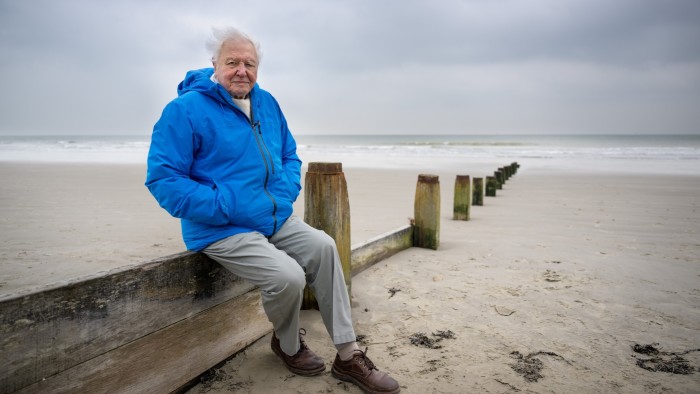
Still, the great conservationist soldiers on. His latest documentary, Ocean, hit UK cinemas last week. In one of the opening scenes, Attenborough stands alone by the water’s edge on a deserted beach: viewers might wonder if this is really wise.
What’s most notable about Ocean is how angry Attenborough becomes. Old age has (thankfully) not taken away his velvet voice, but it does seem to have made him more political.
The object of his anger is the fishing industry — in particular, its technique for trawling the bottom of the sea. “Over three quarters of a trawler’s catch may be thrown away,” he says. “It’s hard to imagine a more wasteful way to catch fish.”
Bottom trawling involves fishing boats dragging iron nets along the sea floor, catching every animal in their path and damaging the seabed itself. The makers of Ocean have managed to get unprecedented footage of the process: attaching a camera to a commercial trawler’s net.
Greenpeace has tried to get similar footage and failed. Even for those who have heard of bottom trawling, seeing it in colour and sharp focus is shocking. We see fish, including a ray, trying to escape. Huge amounts of sand and carbon are thrown up from the seabed.
One of Ocean’s directors, Keith Scholey, has said that some of the worst images — “terrible shots of all these spider crabs being crunched up because the dredge has these teeth” — were cut from the final film because they were deemed too upsetting.
Attenborough likens bottom trawling to bulldozing a rainforest. Very few places are safe from this — including “almost nowhere in my own country” (Britain), he adds. We also see how scallop-dredging turns the sea floor off western Scotland from life-filled pink to dead grey.
Ocean takes care to praise sustainable fishing practices. Still, it sets up a noteworthy showdown: Attenborough, the UK’s most popular person according to YouGov, against the fishing industry, the sector that British politicians felt obliged to prioritise in Brexit negotiations.
It’s also a remarkable turnaround for Attenborough himself. At the beginning of his broadcasting career, he presented an ethically dubious show called Zoo Quest, in which animals were plucked from the wild and brought back to London for examination. In the following decades, his glorious nature documentaries were criticised for showing a fantasy world free of human destruction.
When they did start to show some of the devastation, they shied away from difficult targets. Blue Planet II, which the BBC broadcast in 2017, highlighted plastic pollution. It led to public outrage around plastic use; Michael Gove, the UK environment secretary, eventually banned plastic straws.
Even then, the journalist and campaigner George Monbiot pointed out, Attenborough did not dare to single out the fishing industry. (Fishing nets and other gear accounts for much ocean plastic, including between 75 per cent and 86 per cent of the plastic waste in the Great Pacific Garbage Patch, according to one study.)
What’s changed? Potentially the funders. Ocean is not a BBC film: its backers include the Australian mining tycoon turned environmentalist Andrew Forrest, as well as conservation organisations. Campaigners want a ban on all dredging in marine protected areas, which currently cover less than half of Britain’s waters. Currently bottom trawling is banned in only 5 per cent of the UK’s marine protected areas.
The UK’s fishing industry has complained that Ocean is “indiscriminate” (arguably an ironic adjective for anyone involved in trawling). The documentary has nothing “about aggregate dredging; about subsea cables; about seabed mining” or about wind turbines and the damage they do to the seabed, the National Federation of Fishermen’s Organisations said in a statement. “Bottom trawling is a relatively small, but important, part of [the industry] in the UK today.”
Ocean’s political impact remains to be seen. Its rallying cry is for countries to make good on their promises to protect 30 per cent of the oceans. It has brought in more money at the UK and Irish box office than any other nature documentary in its opening weekend, the filmmakers say. But political momentum is easier when your show has a precise target and broadcasts on terrestrial TV (see Mr Bates vs The Post Office), rather than aiming wide and going on a streaming service (Netflix’s anti-fishing documentary Seaspiracy).
At the start of Ocean, Attenborough bills the seas as “the last great wilderness . . . our final frontier”. Having revealed the reality of modern fishing, he is more honest: “No one alive today has known the abundance of a truly wild ocean . . . We have drained the life from our ocean. Now we are almost out of time.” There comes an age when it’s not worth pretending.
In cinemas now and on Disney+ and National Geographic from 8pm on June 8
Find out about our latest stories first — follow FT Weekend on Instagram and X, and sign up to receive the FT Weekend newsletter every Saturday morning
Read the full article here