

Unlock the Editor’s Digest for free
Roula Khalaf, Editor of the FT, selects her favourite stories in this weekly newsletter.
When Krzysztof Warlikowski came on to the stage for his curtain call after Wednesday’s Der Rosenkavalier premiere in Paris, the audience greeted him with a storm of boisterous boos. The slight Polish stage director flinched visibly, and stood apart from his cast, isolated and bemused. Presumably the public wanted gilded coaches and corsets, though why they would expect them from Warlikowski, whose work is well-known in the French capital, is anybody’s guess. It was difficult not to project upon the director all the sensitivity and torment he had just displayed in Strauss’s characters.
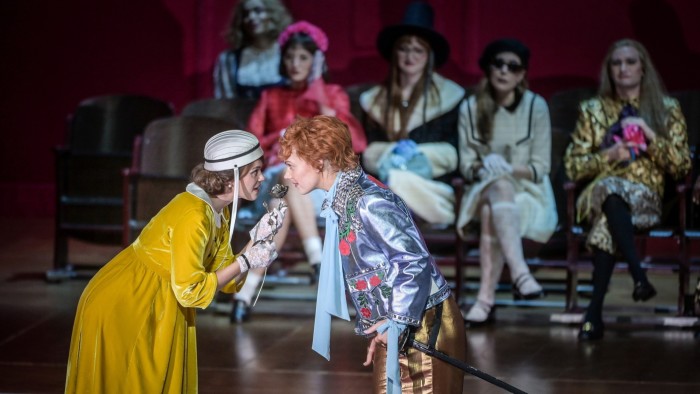
Warlikowski is a thinker; the provocation is a side-effect. Of course he does not present Octavian as male; who needs that in our gender-fluid age? Hugo von Hofmannsthal and Richard Strauss wrote a series of love scenes between women, and asked us to believe that a mezzo-soprano is a boy who dresses up as girl — it is not much of a leap to drop the pretence of an appendage. When Faninal finally observes to the Marschallin, “Young people today . . . !” do we need any further explanation?
Of course designer Małgorzata Szczęśniak has supplied an ambiguous space that is part hotel lobby, part film studio, part mansion, and costumes that flirt with the fashions of the past seven decades and with Austrian conservatism. Of course Warlikowski’s production examines class and power structures and social media. Perhaps the biggest surprise of the Théâtre des Champs-Élysées’ new production is the depth of biting humour that Warlikowski and his team bring to Strauss’s perfumed score, and the complexity of his moral questions. Véronique Gens is a definitive Marschallin, with radiant, nuanced singing and gut-wrenchingly affecting dramatic performance. As the young lovers Sophie and Octavian sing their final duet, we see a film of the Marschallin returning to her luxury apartment to share an awkward drink with her husband. It is a stroke of genius. In this moment, Warlikowski reminds us that she is just as culpable as the lecherous Baron Ochs; though we seldom regard the Marschallin as a predator, Octavian, the central figure in her love triangle with Sophie, is only 17 years old.
Gens’s superb Marschallin is matched by Peter Rose’s Ochs; he inhabits the role completely, with such love for every shading of each word of text that the part could have been written for him. Regula Mühlemann, ironically one of the few native German-speakers in the cast, sings Sophie with beautiful lines but far less clarity of diction; Niamh O’Sullivan fares better as Octavian, with both a gloriously open upper register and an evident relish for her role’s seductive confidence.
Conductor Henrik Nánási keeps the pace brisk and his forces well together, but draws neither clarity nor transparency from the Orchestre National de France; there is far more detail and transcendent beauty in the score than he allows us to hear. If the onstage level of subtlety and depth were reflected in the pit, this would be a perfect evening.
★★★★☆
To June 5, theatrechampselysees.fr
Read the full article here