

It’s the middle of May, and German designer Valentin Loellmann is busy making huge ceramic tiles in his studio in Maastricht. “Each one is different, because they’re handmade and hand-glazed,” he says, holding up a finished example, its stippled surface glossy with a blood-red glaze. “Everybody told me I couldn’t do it. So of course, I had to,” he laughs, though he is not really joking. Loellmann’s career has been a sequence of successful risks.
Those who know the name — and Loellmann has an increasingly high profile in the world of collectible design — will think of fine furniture crafted from wood and metal: waxed walnut tables with curved edges; a long charred oak bench teetering on polished brass stiletto legs; chairs with spindly, Giacometti-like steel armatures and charred wooden seats. His designs — each carved and cajoled into being in his Maastricht workshop — have a dreamlike and surreal quality.
The ceramics — a new venture — are destined for London, where they will line a pool that Loellmann is creating in David Gill’s gallery in the heart of St James’s. It is the designer’s first solo show in the city, and goalposts must be moved. Each tile measures 60cm x 40cm, about the size of an A2 sheet of paper. “This is an ambitious project,” says David Gill’s chief executive and artistic director Francis Sultana, “but then Valentin has always been ambitious.”
Loellmann’s pool — a shallow 7 x 2 metres — will have its own room. Here, light patterns from the water will flicker on the walnut-panelled walls, carved in fabric-like folds. The main gallery will display his furniture, including a particularly striking dark walnut piece that is a jigsaw of elements — a sinuous sofa, shelving and occasional table in one.
It’s no surprise that Loellmann has turned his hand to clay. (He ordered 2,000kg to complete this project.) Now 42, he grew up in rural southern Germany where his father, Uwe, is a highly respected ceramicist, making fine stoneware pieces according to methods he learnt in Japan. “When he was 18, he sold his moped and bought a potter’s wheel,” says Loellmann. “He’s dedicated himself to the craft ever since.” His mother looked after the family, the garden and the animals. “We had chickens, sheep, goats; grew kiwis, apples, pears. We were self-sufficient.”
Not a child particularly suited to the disciplines of school, he preferred playing by the river, building huts and filling his bedroom with plants. By his teens, he often skipped classes in favour of long days spent skateboarding and exploring tumbledown buildings. “Decrepit buildings have their own functions and dysfunctions,” he says, recalling the adventures. “So you have to rely on your senses — smell, feel, sound. Along with skating, it’s where I learnt to trust my judgment.”
Loellmann graduated from the Maastricht Institute of Arts in 2009 with the collection Past Memories, for which he reassembled existing objects and old furniture parts into new pieces, held in place by white vinyl. “The teachers said I hadn’t designed anything, that I was arrogant,” he recalls. But a representative of the US store Anthropologie, with connections to the college, saw the work and begged to differ. A Belgian collector bought the lot.
Since then, Loellmann’s star has risen. He has designed and handcrafted two stores for Aesop, one in Amsterdam and one in Paris, and juggled a steady string of commissions, for lighting, furniture and interiors. “Everything you do with him is a shared experience,” says Yana Peel, Chanel’s president of arts, culture and heritage. “He comes to the house and anchors himself in the space. Then he creates spontaneously from that experience.” Peel has commissioned items including a desk, a suite of three burnt-oak pieces for a bedroom; a console for storing games; and six velvet upholstered stools. “The dialogue and the journey is a real luxury, and you arrive at a mutually enjoyable destination.”
Against his success, Loellmann has gambled with the development, or search and rescue, of buildings around Maastricht. In 2013, he revived a roofless house by the river Maas into a gabled residence for himself and his family. In 2012, he had bought the former hat factory where his studio had been for three years, later turning a section of it into a home with an internal garden (complete with a skate ramp). All the while, he continued to make work. “I am trapped in the role of someone who has to be creating something the whole time,” he says. He often seems overwhelmed by the relentlessness of his own drive.
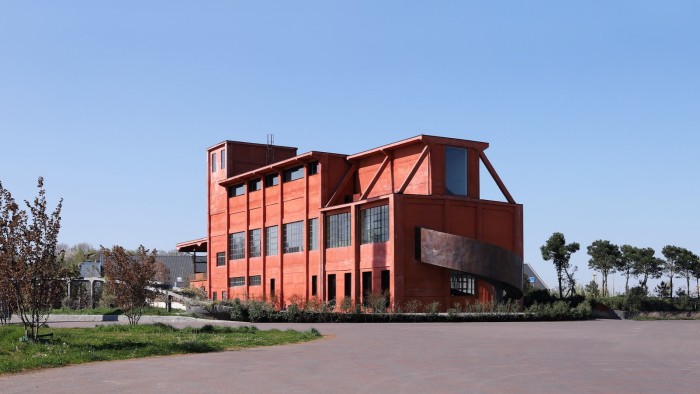
The place where Loellmann is making his ceramic tiles is his most extreme project of all. In 2019, he acquired a former gas factory designed in 1912 by the important Dutch modernist Jan Gerko Wiebenga. Abandoned since the 1970s, it was nothing more than a skeleton of rotten concrete. “A listed ruin, that no one else wanted,” he says. “The concrete restoration took an entire year. It was the biggest cost and the biggest worry. We had no idea if we would ultimately succeed.” Within two years, the building was functional, with a dramatic new staircase curving up an exterior wall.
The building, finished in a dramatic red, has already become a landmark on the edge of town. “I was inspired by Ayers Rock [or Uluru, in Australia], how it glows in the late afternoon light,” says Loellmann of the colour choice. At the edge of the site, a performance pavilion, clad in bronze panels, is nearing completion. “My grandfather is a violin maker. He was in a group with Django Reinhardt,” says Loellmann. “There was always music in the house, a lot of parties. To make those kinds of creative gatherings, it’s a gift.”
The gas factory accommodates Loellmann’s workshops and spaces for his co-workers — most of them young and designers themselves. (His older brother Jonas, an art photographer, also has a studio.) In the kitchen on the ground floor, photographs show nearly 100 fresh faces who have spent time helping Loellmann with his work.
Upstairs, rooms are under construction where artists, designers and other creatives passing through Maastricht will be welcome to stay. “It’s about creating a community, a point of exchange,” says Loellmann. The surrounding park — a detoxified post-industrial site — is now 4,800 sq metres of grassy hills, pools and streams. “I thought about studying landscape design in Japan,” says Loellmann, but instead he went DIY, hiring diggers to spontaneously create the landscape. “It’s a garden for the city,” says Loellmann — he hopes to turn it over to public use. “It’s for generations to come, and it will get more beautiful with time.” Loellmann’s furniture shows just the same signs of maturing with grace.
Valentin Loellmann, David Gill Gallery, June 6-30; davidgillgallery.com
Find out about our latest stories first — follow @ft_houseandhome on Instagram
Read the full article here