

Unlock the Editor’s Digest for free
Roula Khalaf, Editor of the FT, selects her favourite stories in this weekly newsletter.
The writer is a professor at MIT and Politecnico di Milano, and founder of Carlo Ratti Associati
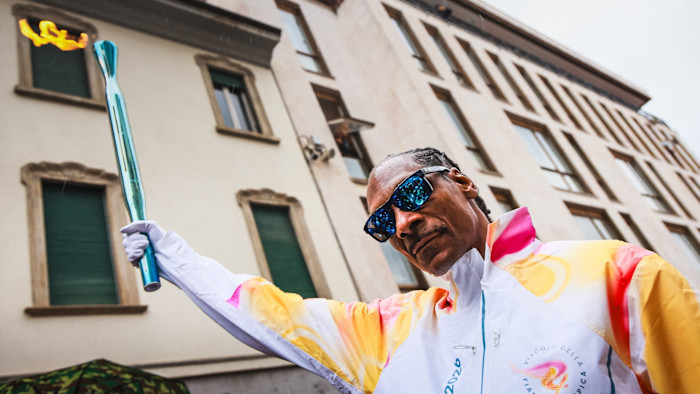
Three years ago my team began working on the design of the Olympic and Paralympic torches, as well as the relay cauldron, for the 2026 Winter Games, which open on Friday in Milan.
For a designer, working on a global symbol is never a matter of form alone. It also involves attempting to express in a single object the values of an era — a particular challenge at a time when the world appears to be drifting ever further from the ideals of friendship and co-operation associated with the Olympic Games.
The Olympic torch relay is one of the few ancient rituals left in the modern world. Passed from hand to hand, carried across borders and through contrasting landscapes, the torch transports a flame first lit in the 8th century BC in Olympia and still ignited there using concentrated sunlight.
When it arrives in a city, it performs a small civic suspension. For a brief moment, everyday life loosens its grip — each place imagines itself as part of something larger and older.
Our own path as designers began with a relay of sorts. Together with the Organising Committee and with Versalis — official supporter of the Games — we visited the Olympic Museum in Lausanne, where a collection of modern torches offers a concise history of contemporary design.
In recent decades, the design of Olympic torches has tended to follow a logic borrowed from automotive culture. A technical heart — the burner where the flame is generated — is wrapped in an expressive body. The surface performs emotion, while the “engine” discreetly withdraws from view. National identity is suggested through metaphor and finish. For example, the torch for Paris 2024 alludes to the fluidity of the Seine while the Tokyo 2020 torch evokes cherry blossoms.
We tried to invert that relationship. The true heart of the torch is the flame. Fire simultaneously evokes ancient myth and primitive technology, from the legendary mirrors of Archimedes to the sacred flames that burn in temples and churches. In ancient Olympia, fire was associated with Hestia, goddess of the hearth and of civic unity. That lineage, rather than surface symbolism, became the centre of our project.
We treated the technical core as a given and reduced the torch to its minimum form, leaving only what was structurally necessary. The result is among the lightest Olympic torches ever produced, weighing just over one kilogramme. The burner is visible through a narrow opening that reveals how the flame is born and shaped by air, pressure and flow.
Designing less, however, does not mean designing simply. Architects and designers worked alongside engineers, chemists and specialists in aerodynamics. The colour of the flame derives from bio-LPG produced from renewable raw materials by Eni, premium partner of the Games. The form had to withstand extreme winds at altitudes of up to 4,500m and was therefore subjected to repeated fluid-dynamics testing.
Designers have long been tempted to add unnecessary details in the hope of completeness. Think of those behind Baroque churches who would accumulate cherubs and gilding in the hope that one more ornament would finally resolve the whole. But the positive response to our design suggests that perhaps the age of excess is waning.
More importantly, in an era marked by division, art too must play its part. As Bertolt Brecht warned a century ago: “Art is not a mirror held up to reality, but a hammer with which to shape it.”
Design can and ought to aspire to transcultural significance, drawing on what we share as human beings. As the opening ceremony shows, it can perform a crucial civic function by bringing into view not what divides us but what still connects us.
Read the full article here