

The Puna is Argentina’s empty quarter. In the country’s far north-west, these high windswept tablelands in the lap of the Andes are an extension of the Atacama Desert. Remote and isolated, the Puna would make Patagonia seem busy. Bigger than Portugal (though the boundaries are hazy), it has a couple of paved roads, a handful of tiny hamlets and a population that would barely fill a small town.
Compared to the crowds that descend on San Pedro de Atacama across the border in Chile, the Argentine Puna gets few visitors; in a week I saw half a dozen other travellers. There may be more scientists than tourists, here to study the unique geology and an environment so high and dry — with landscapes shaped by wind rather than water — it provides an analogue for Mars.
From Buenos Aires, I had flown to Salta, a city famous for its gaucho culture and for the high altitude wines of the Calchaquí Valley. After a boisterous evening in a peña, with strumming guitars and whirling dancers, I set off the following morning into the outback with my guide, Gastón Huerga, in a 4×4 with coolers of food, demijohns of water and a sense of eager anticipation.
Over the course of the morning, the towns and the homesteads fell away. We followed a river bed, half-a-mile wide but with only a trickle of water, then swung up through the Toro Gorge between broad-shouldered mountains. From the top of a pass we looked out over the Puna. In that first moment, the scale seemed unfathomable. With a turn of my head, I could see 100 miles or more. The only signs of humans were a couple of tracks spiralling away into the hazy distance.
For those who dream of travelling to Mars but worry the air fares might not be affordable in their lifetime, the Puna is your place. The whole landscape is streaked with colour as if by a child let loose with crayons — carnelian and rust reds, magnesium greys, chalky white, obsidian black, malachite green. The silence and stillness were profound. I felt if I listened hard I might catch the sound of the tectonic plates grinding against one another beneath my feet. Dozens of volcanoes, active and dormant, stalk the horizons. Winds raise dust devils. Hot springs bubble, fumaroles vent gasses and salt flats shrink and expand in the turning year. The Puna is desolate, dramatic and surreal. It is also one of the most beautiful places I have ever been.
Our first night was in Tolar Grande. With a population of about 150, it is not that grand. It felt like a Wild West town, a grid of wide streets and low adobe buildings. Andean winds moaned between the houses. As the town darkened, there seemed to be no one about, as if Gastón and I were dangerous strangers and everyone was keeping indoors, peering out through shutters. In the hotel, a receptionist handed me a key without speaking.
Over dinner in a small eating house that had the feeling of someone’s back room, we chatted about outlaws and smugglers. Not so long ago, gauchos drove herds of animals, two- and three-hundred strong — possibly theirs, possibly not — across the Puna and over the passes into Chile. It was an illegal trade and a tough journey; the men would shoe the cows, like horses, to protect their feet in the high passes.
In winter, 100mph winds would howl across the Altiplano, and the gauchos sheltered their animals in caves they carved into soft sandstone. Coming back from Chile, carrying cash, the horsemen split up, the better to avoid an ambush, and met up again in Tolar Grande whose residents presumably locked their doors until the rustlers had departed.
The Puna may not offer smart accommodation (and certainly nothing like the range of lavish hotels available over the border in San Pedro) but the places I stayed were fun and quirky. The hotel in Tolar Grande felt a trifle gloomy but in Antofalla, population about 45, we stayed in a delightful guest house, properly the Casa de Altura but known to everyone as Olga’s Place, where a hearty evening meal included Llama alla Milanese and an excellent Argentine bottle of Malbec. In the small town of El Peñón we stayed in the Hosteria de Altura which, in this remote place, felt like luxury with large comfortable rooms and wonderful evening meals.
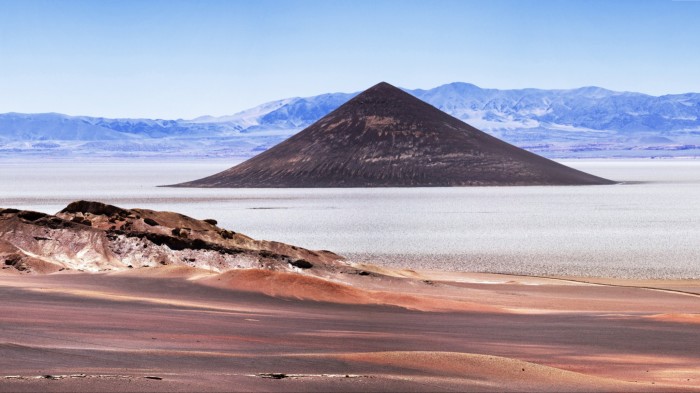
As the days passed we pushed further into the Puna. We crossed badlands known as the Desierto del Diablo, the Devil’s Desert, the surfaces of the red hills as wrinkled as elephant hides. We skirted the white blaze of salt flats like the Salar de Arizaro, the size of Greater London. On a track on its southern “shore”, a perfect pyramid floated above a mirage of glistening water, as if we had suddenly been transported to Giza in Egypt. Rising in isolation, the black Cono de Arita is a volcano that never erupted, the magma being slowly exposed by erosion rather than flowing as lava. Its striking profile made it a place of ritual ceremonies for pre-Inca cultures.
In the Laguna Grande we found flocks of flamingos, stepping delicately through the saline waters, dipping their heads to feed. At night we drove across salt flats, ghostly in the headlights, on routes once used by the Inca. We crossed swaths of black lava, littered with car-sized basalt blocks tossed here by distant volcanoes, the hard surfaces still showing the flow and eddies of molten liquid.
From the rim of the colossal Galán, we gazed down into one of the largest calderas in the world, some 24 miles across. Galan’s scale meant that it was only recognised as a volcano in 1975 by examining satellite images. At Campo de Piedra Pómez (literally Pumice Field), just outside El Peñón, we found the soft rock that had been deposited by yet another colossal volcano. Swept by scouring desert winds over millennia, blocks of pumice the size of houses had been sculpted into a maze of bizarre formations, a white playground stretching for miles across the plateau.
With the emptiness of the Puna, the handful of people that lived here were a fascination. Stands of planted poplars, their leaves shivering in the wind, marked and protected their homesteads. From a high ridge between glowering peaks, we descended a twisting road, across a wet vegas, the wide spill of a spring that had created a green sward. At the bottom was a tiny hamlet known as Antofallita, where two elderly inhabitants, a brother and a sister, lived in separate houses.
At dusk, we called in on the sister, Corina Calpanchay, knocking on the wooden door of her low adobe house. Gastón liked to check up on her, aware that no one may have called in the past week, or even the past month. A cat eyed us suspiciously from a crumbling wall. From behind a wood pile a dog rushed up, cravenly keen to make new friends. A wind turbine whirred on the roof.
It was some minutes before the door opened. Corina peered out at us. A tiny woman of 80, she looked annoyed, as if we had interrupted a dinner party she was hosting. Gastón gave her some supplies as a present. We could hear the sound of a television. “I am watching Brazil,” she said abruptly. “Can’t talk now.” With that, she closed the door on us. Gastón looked at his watch and motioned me away. “It is a Brazilian soap opera,” he explained. “She doesn’t like to miss any of it.”
Another day we went to visit Simón Morales who lived on the flanks of the De La Aguada volcano, his homestead marked by a blur of trees on the bare slopes. He lived in a one-roomed house, its interior blackened by smoke. Chickens pecked in a small walled yard. A lifetime in this stony paradise had made Simón a petrophile. Along the top of the wall was a collection of his favourite stones. He fingered them as we stood chatting: gypsum, quartz, basalt, green onyx, black obsidian.
Not far away was Simón’s hot tub. A long rectangular basin, fed by a hot spring, was brimming with water that steamed gently in the morning air. I wanted to come back here at night and soak under the stars, the salt flats ghostly in the valley below, the dark silhouette of volcanoes crowding the western horizons.
Simón had lived in the Puna since the age of six when he had arrived with his parents, who had come over the mountains looking for somewhere to make a home. Now in his sixties, he was musing on mortality. He had been asking Gastón to help him find someone who could make an onyx cross for his grave. Gastón suggested granite would be more feasible. Looking out over the valley, Simón nodded. “I could set some of my favourite stones into the granite,” he said at last. His voice was trailing off. “So many memories here,” he said, aware that his solitude meant they would die with him. “I wonder who will water my trees when I am gone.”
But the most compelling residents here were already dead. From a ridge in the Puna I gazed across to the snow-capped peak of Mt Llullaillaco, at 6,739 metres, the second highest active volcano in the world. In 1999, an archaeological team found a small stone chamber close to its summit. Buried inside were the corpses of three young children, perfectly mummified by the cold dry conditions of the mountain. This practice of capacocha, or ritual sacrifice, was part of Inca culture, marking momentous events such as the death of an emperor. Children were chosen for their physical perfection; for families, it is said to have been a great honour. With Inca priests, the children would have walked here from Cusco, the Inca capital, more than 1,000 miles away.
The older girl, probably about 13, has been dubbed la doncella, the maiden. In her display case in the Museum of High Altitude Archaeology in Salta, she was in an astonishing state of preservation. Other than a slight staining of her face, she looks like a child who has fallen asleep on the sofa, her head slumped forward on her chest. Her hair is braided. She wears a brown dress with a woven belt and a shawl. Tests suggest the children were drugged and froze as they slept. But according to traditional belief, they do not die. The mountains were the abode of the Apus, the gods, and the children were said to watch over people, crops and livestock like angels.
On the last day, we stopped by a series of small lakes, some hardly larger than a garden pond, known locally as ojos or eyes. These lakes, and others across the Puna, contain complex microbial communities that slowly grow into rocky mounds, a bit like corals. Geologists believe these communities may resemble those that existed about 3.5bn years ago, when oxygen was almost nonexistent in the atmosphere. Researchers from the University of Colorado, Boulder, say they could provide “a possible window into the earliest stages of life” on Earth.
I lifted my gaze from the dark water of the lakes, across vast reaches of white salt flats to the High Andes. Among stories of creation and rumours of Gods, this is how the planet looked before us, almost before anything, the Earth’s skeleton laid bare, the plateau like a great stage waiting for life to happen.
Find out about our latest stories first — follow FT Weekend on Instagram, Bluesky and X, and sign up to receive the FT Weekend newsletter every Saturday morning
Read the full article here