

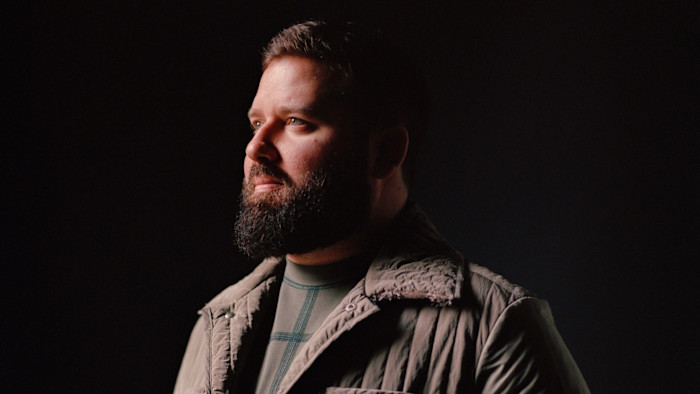
“I can’t watch any horror at all,” says theatre director Kip Williams, smiling wryly at the irony. “I haven’t watched a horror film since I was 14.”
This is quite a startling divulgence. The Australian has had a blazing success on three continents with The Picture of Dorian Gray, which used a stunning combination of video and live action to enable a single performer (Sarah Snook in the West End and on Broadway) to play all 26 roles in the adaptation of Oscar Wilde’s novel. He’s about to open his similarly audacious Dracula in the West End, this time with Wicked star Cynthia Erivo taking on two dozen characters. In 2022, he tackled Robert Louis Stevenson’s Strange Case of Dr Jekyll and Mr Hyde in Sydney.
For someone who doesn’t like horror, that’s a fair old rummage in the psychological depths of Gothic fantasy. “In a weird flip-around, I feel quite happy engaging with Gothic horror on this side of the table,” he says, as we meet in a break in Dracula rehearsals. But his Gothic trilogy amounts to much more than facing up to his fears. For him, these texts — often the staples of school reading lists — have taken on stark new resonance in today’s world.
“It’s a fascinating moment in western history, the Victorian era,” he says. “The word individualism gets used for the first time, there’s an acute growing awareness of the separation between the public and the private spheres, and there’s this burst in radical thinking, like Darwinism, together with the strong pushback against it. We’re now living in the apotheosis of the questions, changes and decisions that were being made 130 to 140 years ago.
“A lot of the writers that I’m drawn to are prophets in that sense,” he adds. “So in Dorian Gray you get somebody telling a story about a world obsessed with youth, beauty and materialism, and the dangers of that, not knowing that the mobile phone would turn the volume on that up to 20.”
Williams has forged a very specific new theatrical language to express that confluence between then and now: a dazzlingly complex interplay between the onstage performer, live video footage and prerecorded action that he terms “cine-theatre”. In Dorian Gray that yielded some jaw-dropping moments: at various points Snook dined with another six of her onscreen selves, chased herself with a gun and edited her own image projected, huge, above her.
But it also proved a brilliant fusion of style and subject. Williams reframed Dorian’s determination to retain his youthful beauty for an age obsessed with selfies, avatars and curated online content. And crucial, for Williams, was the fact that the ingenious use of technology simultaneously highlighted its shortcomings.
“I believe in the Shakespearean notion of holding a mirror up to nature,” he says. “So, when it comes to this technology, there is a deeply critical perspective in the work on the damages that it is wreaking on our lives. I don’t have a moral panic around technology: I think there are a lot of good things about it. But it is breaking and corroding the human intimacy and vulnerability that brings us closer together. I’m really, really worried about that.”
Truth and artifice, performance and identity are frequent themes for Williams. His staging of The Maids at London’s Donmar Warehouse last year offered a deep dive into role-play, while in Bram Stoker’s Dracula (a show he first staged in Sydney in 2024) he draws on classic cinema tropes and slinky shifts of character to sink his teeth into the story’s subtext of sexuality and taboo desires.
“[Having one performer means that] Dracula can emerge at any time from any character,” he says. “He’s not a monster, he exists right at the centre of each of them, and that is the part of themselves that they’re most afraid of.”
The integration of video into stage work has become increasingly sophisticated and meaningful in recent years. Director Katie Mitchell has crafted her singular and exquisitely precise “live cinema” shows (such as Bluets, The Waves or Miss Julie), deftly interweaving live performance and video; Jamie Lloyd made thrilling use of video in Evita and Sunset Boulevard. But, such has been the increase of cameras onstage lately, that some have grumbled about the trend. Does that worry Williams?
The director genially points out that he’s made dozens of shows without video, both in his recent role as artistic director of Sydney Theatre Company and, previously, as a resident director there. He adds that, when he does use his own very specific fusion of genres, it is integrated precisely into what the production is saying, and that the live element of the piece is vital.
“I have joyously made so many works with 18, 20, 25, 30 people onstage,” he says. “This trilogy of works is very specifically about examining that relationship between the individual and the world around them. It always starts with an empty space, an audience’s imagination and the actor inviting them into this imaginary world.
“And the curtain call for these shows is really important to me. Obviously, our virtuoso performer has a very well-deserved bow! But they then invite the entire crew onstage as well. When you’ve been looking at the dangers of narcissism and solipsism, the curtain call is an expression of community and collaboration and all the best parts of theatre.”
This innovative technique certainly makes unique demands of actors, who have to juggle between characters and genres at speed, interact with their onscreen selves and combine pinpoint technical precision with emotional truth. (Snook compared it to diving into an icy pool.) The camera operators too are often theatre makers, actors or dancers to support their live interaction with the performers. And rehearsals are a complex, multi-layered process. Dracula recently delayed the start of previews, which Williams says is down to the technical scale of the piece.
“I’m very lucky to get the actors I work with,” he says. “They’ve all worked on both stage and screen, so they bring that skill. But it’s a performance style and scale unto itself. It’s not quite screen performance. A joy of working with Cynthia so far, as it was with Sarah, has been the insatiable hunger to keep working. Because the moment it becomes locked off, like a piece of screen work, it dies. There is a live energy to it, which is why it works for an audience.”
Australia has produced some wonderfully original directors in recent years: artists such as Simon Stone and Benedict Andrews, who, like Williams, have a knack for cracking open familiar texts in fresh new ways. Williams has an intriguing explanation. “There’s this strange phenomenon in Sydney — a number of theatres which are more like rooms than proscenium arch spaces. And often the audience is sitting in a kind of V shape looking into the corner of that room. My theory is that it breeds in theatre makers [in Australia] the unavoidable acknowledgment of architecture.”
His own love for theatre was born in a genuine living room. His grandmother is actress Wendy Playfair, his uncle the folk musician Sean Cullip and his sister Clemence Williams composed the music for both Dracula and Dorian Gray. “My grandmother would always ask us to make plays for her in her living room,” he recalls, fondly, of his childhood. “You’ve got a curtain; you’ve got her wardrobe of costumes and wigs . . . ”
That formative experience, he says, is at the heart of all his work — even the most technically intricate: “You look at Dorian Gray and it’s so old-school theatre the way that piece starts and grows. ‘I look this way and do this gesture: I’m this character. OK, now there’s a wig and a jacket — now I’m this person.’ It’s me in my grandmother’s living room. It’s as handmade as that.
“I think about this a lot when I get asked about technology in my work. While some of the things I’m doing, using screens and cameras and phones, might be new, the act of using technology is not new. [Thousands of years ago] we used fire to create shadows to tell stories. That is technology. We’ve always used technology to tell a story.”
Dracula, Noel Coward Theatre, London, from February 7, draculawestend.com
Find out about our latest stories first — follow FT Weekend on Instagram, Bluesky and X, and sign up to receive the FT Weekend newsletter every Saturday morning
Read the full article here