

Unlock the Editor’s Digest for free
Roula Khalaf, Editor of the FT, selects her favourite stories in this weekly newsletter.
Singburi was a small Thai restaurant in east London’s Leytonstone that closed last November. At first it seemed on hiatus, then it turned out to be for good. The closure was greeted with shock in the food world because the restaurant – originally a fish and chip shop opened by Tony and Thelma Kularbwong in 1999 – had become legendary: “For so many, hands-down the best Thai restaurant in London, and for others one of the most outstanding restaurants in London, full stop,” according to Vittles editor Jonathan Nunn.
Singburi offered a paper menu of Thai staples such as pad Thai, green curry and morning glory. But the restaurant was best known for a blackboard menu of specials that were updated daily by Thelma and Tony’s son Sirichai (known as Siri). These more adventurous dishes included moo krob (crispy pork belly with garlic and basil), clams in roasted chilli jam and a tally of complex curries and stir fries.
Being a family-run, cash-only, BYOB restaurant on Leytonstone High Road that was also ranked 71st best restaurant in the UK at the National Restaurant Awards helped turn this “hidden local gem” into one of the most in-demand spots in town. People came in search of its “bracingly authentic” food (as the National Restaurant Awards described it). The fact that securing a reservation was “one of the great thankless rituals of London”, according to Time Out, contributed to the vibe: you could only book inside the restaurant or by phone and could never be sure anyone would pick up.
Following a surprise announcement in February, Singburi is set to return this summer in a brand-new site in Shoreditch that is more than double the size. Tony and Thelma have retired and passed the baton to their son. As co-head chef he is joined by two friends. Nick Molyviatis (founding chef at Kiln) is co-head chef and operations manager. Alexander Gkikas (co-founder of Catalyst café) is general manager. Given the restaurant’s humble roots and no-frills reputation, the relocation to hipster Shoreditch has raised some eyebrows. How will Singburi 2.0 compare?
“We know people will come and find errors,” acknowledges Molyviatis when we meet for a tasting. “They will say: ‘It’s not the same. It used to be better. The Greeks have made it worse.’” By “Greeks” he means himself and Gkikas, who grew up in Thessaloniki and Athens respectively.
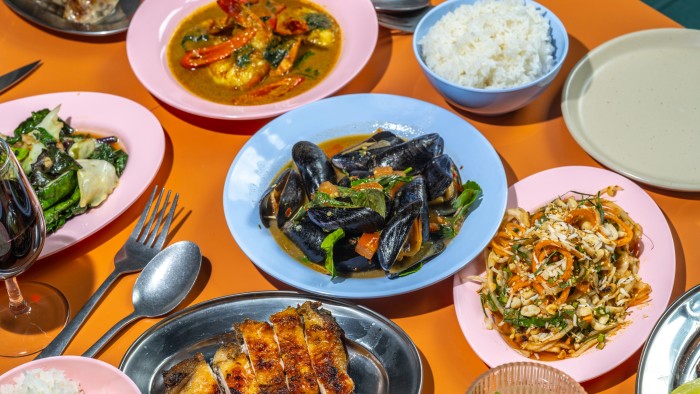
We’re meeting at Catalyst in Holborn as the new Singburi site in Montacute Yards is still under construction. Today’s dishes are drawn from a menu of snacks (grilled, fried, raw), salads, larger mains and curries. Everything buzzes with flavour. Crispy som tam fritters with a lime and nam prik pai (Thai chilli jam); fiery northern raw beef larb with shrimp paste and coriander; nuggety deep-fried sweetbreads dusted in lard spice. To follow, there’s a smoked tomato salad with hints of chilli and herbs; a robust pad cha with big chunks of monkfish, prawns and mussels, and a soupy northern turmeric curry with beef and kohlrabi. But the standout for me are the deep fried chicken liver balls sprinkled with crispy shallots served in a mustard-yellow curry sauce; crisp and soggy-bottomed at once.
“The only thing connecting us is the name, the sign [which is being hung on the wall inside] and Siri,” says Gkikas. Molyviatis elaborates: “If you boil it down, Singburi was about a person experimenting with whatever he could find that was interesting to him. That experimental aspect to Siri – along with his family – was the essence of the restaurant. We hope people will come and still see that in the new place.”
None of the blackboard mainstays currently feature at the new Singburi, though you can expect variations as the menu starts to evolve. There will be a low-intervention wine list with everything served by the glass, plus a small cocktail list and corkage for BYOB. The prices remain accessible: most dishes are between £5 and £25 with the occasional higher-priced item to share. Payment will be by card only. As for Shoreditch, they chose the area because it wasn’t too much of a leap from their former site: “It felt more humble than Shaftesbury Avenue… a step rather than a jump,” says Gkikas. Situated under an underpass with a terrace, the setting reminded them of Bangkok as well. When Molyviatis suggested launching a new restaurant together under the Singburi name “it was a Hail Mary”. Funding had already been secured via friends Z He and Lam H (founders of Bun House in Chinatown), who had agreed to back Molyviatis on whatever new restaurant he chose to launch.
What strikes most about this venture is how it reflects a younger generation’s wish to strike out on their own. Molyviatis has helped launch successful restaurants for other operators such as Plaza Khao Gaeng, Oma and Agora. But this is the first under his own name. For Kularbwong this new chapter is freighted with even greater significance as he’s been trying to wind down the old Singburi for years. “As much as it was great to get the accolades, my parents are in their 80s. It was rough on them,” he says.
Mainstream success only added to the pressure. “Gradually their regulars got squeezed out. You form these relationships with people in the neighbourhood and then you’re no longer a neighbourhood restaurant. That was a bit of a downer.” In December 2023, the family’s attempt to sell the lease fell through. “My dad had checked out already,” says Kularbwong. “It sucked.”
“Part of me worries the success of the old place wasn’t just the cooking,” says Kularbwong. “It was because it was a mum and pop place; cash only; we didn’t serve alcohol. I don’t want people to think, ‘Oh my god, they’re trying to open in Shoreditch now!’ One of the challenges of the new site is honouring what my parents built but also evolving it. I was talking to my mother. She said, ‘Don’t worry about meeting expectations, just make the food as good as it can be.’”
Judging from the dishes on the table, it is.
Read the full article here