

Very few things can be as personal, emotional and sensory triggering as perfume, which is why some people spend hundreds of pounds to get their hands on a favourite fragrance that has been discontinued.
Since 2007 it has been the job of Mathieu Iannarilli, a Paris-based vintage perfume dealer, to track down rare scents for clients who spend from €150 to more than €3,000 per bottle. “Some buyers only wear one perfume. When that is discontinued by a brand, from one day to the next, they find themselves orphaned of their olfactory identity. These people then turn to all possible ways to find their perfume again,” he says.
There is no estimate for the market of vintage and discontinued fragrances, but demand is high. A simple search for “discontinued fragrances” on eBay brings up more than 50,000 results. Among the most expensive listings are Tom Ford Amber Absolute ($4,300, shipped from the US), Vivienne Westwood Boudoir ($2,784, from Japan) and Giorgio Armani Prive Myrrhe Impériale ($1,500, from Sweden). The market is partly fuelled by the craze for “flankers” — short-term spin-offs of brands’ core fragrances, which are catnip for collectors. Estée Lauder Sensuous Noir, a 2008 flanker for Estée Lauder Sensuous, goes for £265 on eBay, for example, while Thierry Mugler A*Men Pure Malt, a version of Thierry Mugler A*Men from 2009, goes up to more than £600.
There are a few reasons why a fragrance might be discontinued: it might not be commercially successful; a long-used ingredient in its composition might later be banned and prove too difficult to substitute; or the brand itself might end its license or go into bankruptcy. “The prices of some fragrances from iconic British brands such as Vivienne Westwood and Stella McCartney have tripled since these brands ceased their perfumery business,” explains Iannarilli.
Other vintage perfumes from heritage brands such as Guerlain often reach high prices because they are both sought after by customers who want to wear them and by collectors who would preserve them. “[Guerlain] Djedi can exceed €3,000,” says Iannarilli.
It’s not just high-end fragrances that stoke demand. Since 2019, Alexander Fury, fashion features editor at Another magazine and the FT’s men’s fashion critic, has been buying Ultima II Sheer Scent for his mother as a Christmas gift. The Revlon fragrance from 1990 was and still is her favourite, but was discontinued at the turn of the millennium.
“I’m not hunting for it every day, but it is something I look for every week or so. It has become progressively more difficult and progressively more expensive,” he says over the phone. When Fury bought it the first time six years ago, the perfume was already selling on second-hand platforms for about £500. Today it can be purchased on Etsy for more than £700.
In some cases, people are hunting for the original formulation of perfumes that are still on shop floors today. Starting from the early 2000s, regulations on cosmetics ingredients have become stricter, particularly in the EU, forcing many brands to recreate best-selling scents using alternative ingredients. In some cases the results have been less than satisfactory — at least according to some noses — prompting the hoarding of older bottles.
“I have a tiny bottle of Guerlain’s Mitsouko from the 1970s that smells completely different and so much better than Mitsouko does now,” says Aimee Majoros, a beauty PR and fragrance collector from upstate New York who has worked for Guerlain, Givenchy, Acqua di Parma, Tommy Hilfiger and Donna Karan. Majoros, who learned to love perfumes from her grandmother, had at some point 300 bottles in her collection. “The best thing I have ever smelled in my life was a sample of L’Air du Temps by Nina Ricci from the 1960s,” she continues. “The current formulation smells awful. I know that in the fragrance community people are upset when things are reformulated.”
Claire Smith, a cell biologist based in the UK who has a 130-rich fragrance collection (around half of them are discontinued) became passionate about perfume in 2019. After reading rave reviews online of Thierry Mugler Alien Essence Absolue, which had been recently discontinued, she decided to go on a hunt for it. “It goes for hundreds of pounds, but I was very, very lucky and found a good deal. For a lot of people it’s about the find as much as the fragrance itself,” she says. “When I started I would only buy things that I could afford to lose the money for, until I learned what I was looking for.” Her self-training included watching online videos comparing fake and real fragrances to learn how to spot them (colour is a good giveaway). Smith now has a YouTube channel called @dr.claire.perfume where she talks about her collection, explains relevant terminology and tells the back-story for some famous fragrances, such as Chanel No 5 or Robert Piguet Bandit, to her 13,900 subscribers.
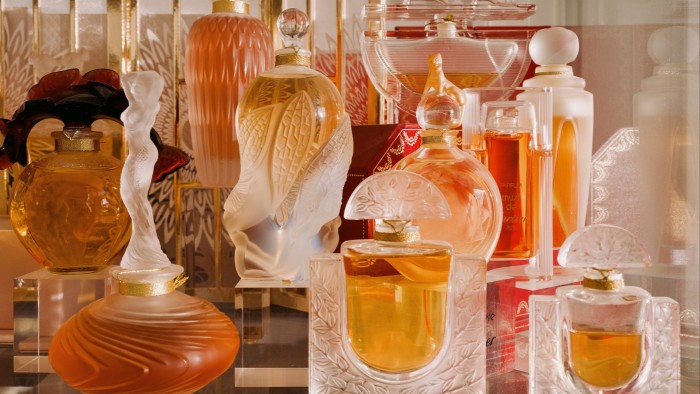
But for certain perfume collectors, the draw is not the scent but the bottle. Some even collect factices, the oversized display bottles brands used for advertising in pharmacies and department stores until the early 2000s. Simon Martynoff, owner of Galerie Martynoff in Paris, both sells and collects factices. Among his treasures currently on sale he lists a 30cm-tall Nina Ricci L’air du Temps bottle for €5,200 and an even taller (39.5cm) decorative bottle by Baccarat of Guerlain Shalimar for €4,100. “There are two different consumers: one is a collector who wants an example of each bottle, and the other is an [interior] decorator,” he says. Martynoff sources them from auctions or shops that still have them, but says they are becoming increasingly hard to find as the number of collectors increases. “The interest has gone up and you can see it from the prices. In the 1990s you could find some at a very good price, now some bottles are 30 to 50 per cent more expensive.”
Antoine Poujol is the founder of the Perfume Art Museum in Paris, which houses a collection of almost 8,000 bottles, factices, press kits and shop catalogues. He says interest in collecting perfume bottles started in the 1980s, when many of the bottles designed by artists such as Leonor Fini (Shocking by Schiaparelli, 1937), Raoul Dufy (Rosine by Paul Poiret, c1925) and René Lalique (for Lucien Lelong, 1929) started to hit the 50-year mark. His goal is to “keep track of everything that was and is made by the key brands, because the idea is to trace their evolution from the start to today,” he says, adding that his expertise has been tapped by some of the largest brands who want to build their own collections and retrace their histories.
Poujol’s collection includes rare examples such as Lancôme Révolte, designed by Georges Delhomme in 1936, which is a block of raw rock crystal shaped like the Parisian cobblestones thrown during the French Revolution (currently valued between €1,000 and €2,000), but also mass-produced bottles that can be purchased for €50. “We are in a universe where you have very expensive bottles, but you also have very nice stuff from €50 to €200, which can make a nice collection. You also have collectors of miniatures which go for €5, €10 and €15,” he says. “There are bottles for everyone.”
After speaking to Poujol, I took out my own collection of perfume minis, which I used to hoard as a kid in the 1990s. I used to spend an unusual amount of time admiring the small bottles and smelling them and they are still kept in a wicker box in a bathroom cabinet in my childhood home. I have at least 40 of them, an assorted selection that includes Miss Dior, Gianfranco Ferré Gieffeffe, Fiorucci Vanilla Scent, 4711 Cologne and La Perla Body Silk. While I’m quite sure there is nothing particularly rare in there, even if there were, I’m not sure I could part with it. It’s hard to put a price on something with the power to trigger such personal memories.
Follow us on Instagram and sign up for Fashion Matters, your weekly newsletter about the fashion industry
Read the full article here