

Unlock the Editor’s Digest for free
Roula Khalaf, Editor of the FT, selects her favourite stories in this weekly newsletter.
As new arts festivals go, the Southbank Centre’s Multitudes has shot out of the starting gate like a rocket. Over 11 days, the festival is presenting a range of music embracing other art forms, including dance, film, visual arts and theatre, involving major names from Marina Abramović to Kirill Serebrennikov.
At the halfway point, the extra-musical elements have proved to be rather hit-and-miss (though movement and acrobatics group Circa was said to have provided a stunning visual bonus to Ravel’s Daphnis et Chloé), so it has been the big classical music performances that have made it worthwhile.
Nothing could be bigger than Mahler’s Symphony No 8. With its huge orchestra, boosted by extra harps, piano, celesta, harmonium, organ and two mandolins, in support of three choirs, eight solo singers and an offstage brass ensemble, it is not dubbed the “Symphony of a Thousand” for nothing.
Most London performances take place in the vast arena of the Royal Albert Hall, which might have been built with this symphony in mind, but the London Philharmonic Orchestra remains loyal to its home, the Royal Festival Hall. Over 35 years it has given memorable performances there under three successive music directors, Klaus Tennstedt (also recorded live and in the studio), Vladimir Jurowski and now Edward Gardner.
The three have been quite different. Where Tennstedt conjured eternal romantic vistas and Jurowski exerted exquisite control of detail, Gardner offered an uplifting affirmation of life. The opening “Veni creator spiritus” shot past like a single cry for joy. The closing scene of Goethe’s Faust, which Mahler set for the second part of the symphony, followed a compulsive dramatic arc through to the final image of the eternal feminine leading man to salvation.
The unique selling point of this concert was the accompanying film and stage direction, but where were they in all this? On three screens, video artist Tal Rosner projected images of trees, spheres and, through part two, a man in a foetal position. The one inspiring moment came from stage director Tom Morris, when the man from the film appeared in real life; he crawled out from the back desks of the orchestra and was led by Gretchen out of the hall to his redemption (possibly in the bar outside).
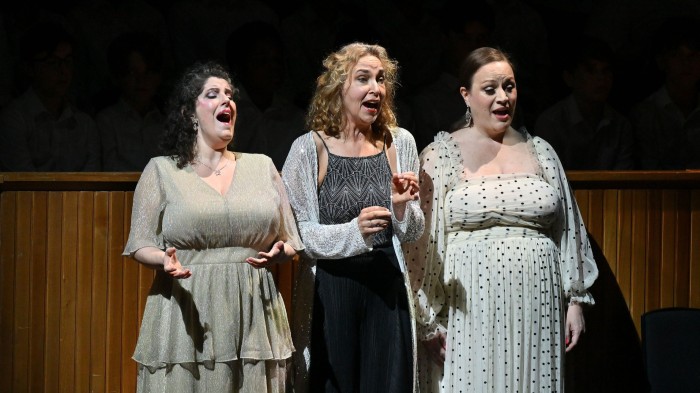
Among the eight solo singers, sopranos Sarah Wegener and Emma Bell were nicely contrasted and Christine Rice and Jennifer Johnston made commendable mezzos. Andrew Staples shone in the cruelly high solo of Doctor Marianus where some tenors come unstuck. Tommi Hakala sang strongly as the baritone, Derek Welton the confident bass, and the blink-or-you’ll-miss-it role of Mater Gloriosa was sung fearlessly by Jennifer France from a perilously lofty perch among the organ pipes, which was certainly a first.
Add in the London Philharmonic Choir, the London Symphony Chorus and Tiffin Boys’ Choir, all well drilled, and high-quality playing from the London Philharmonic Orchestra, and Gardner had everything he needed to lead a gripping musical performance. Did it matter that one soon forgot to look at the video screens? Not when the symphony sounded like this.
★★★★☆
southbankcentre.co.uk
Read the full article here