

In 1988, at the age of 74, Emily Kam Kngwarray painted her first picture. Titled “Emu Woman”, it’s a dense composition of earthy dots and skeletal forms. Although it could be described as abstract, the western art-historical meaning of abstraction — the rejection of visual reality — is a concept that holds little interest for many Australian Aboriginal artists. “Emu Woman” is, in fact, an evocation of the emu’s favourite food: fan flowers and the stems of raisin plants. The yellow dots signify the fat of the bird, the red ones half-cooked meat.
For Kngwarray, who died in 1996, artmaking was an expression of her “Country” and her “Dreaming” — complex Aboriginal world views that encompass kinship ties, laws, stories, traditions and a spiritual connection to the land, which is understood to be sentient. She painted sitting on the ground, talking and singing alongside her friends and family, many of whom were also making pictures. Her Country was Alhalker in the Sandover region (often referred to as Utopia) of the Northern Territory. It’s a place of vast horizons and enormous skies, rocky outcrops, sand plains and waterholes, where the emu plays a significant role in creation myths and rituals.
The artist, now considered to be one of Australia’s greatest painters, was an elder of the Anmatyerr people. Her paintings on canvas emerged from the decades she spent applying lines of pigments mixed with emu fat to her own and other women’s bodies before performing the traditional songs and dance ceremonies known as awely — an embodiment of Country and the women’s role as its custodians.
The earth, for the Anmatyerr people, is not property, it’s kin. Kngwarray believed her paintings had the power to make people understand its importance, which would stop it from being exploited.
Although Kngwarray only painted for 12 years, she created about 3,000 works. A representative selection are included in Tate Modern’s revelatory exhibition, which was developed in partnership with the National Gallery of Australia, and is based on its recent iteration there. It’s the first time Tate Modern has staged a survey of an Aboriginal Australian artist and the first major solo exhibition dedicated to Kngwarray in Europe.
Hung chronologically, the exhibition comprises 83 works of consistently staggering beauty and inventiveness. It follows the development of the artist’s work from her batik designs (a technique of painting hot wax and dye on to fabric) and early paintings to particularly significant works, such as the monumental 22-panel Alhalker Suite from 1993 — a pulsating explosion of colour and movement inspired by the passing seasons and spiritual forces that shaped the lands she loved so well.
Kngwarray was born around 1914 in Alhalker at a time when Aboriginal people had no political agency. From 1901 to 1971 they were excluded from being counted as part of the national population and they didn’t gain the right to vote in federal elections until 1962.
Immersed in traditional cultural practices, Kngwarray was known as Kam, the Anmatyerr word for the edible seed pods of the pencil yam, a drought-resistant food source that would appear frequently in the artworks she was to make decades into the future. Around the age of 10 she was named Emily by a cattle station owner who couldn’t say her Aboriginal name.
She spoke little English, but in her own language, the eastern variety of Anmatyerr, she became renowned as an orator and singer. For decades she moved around, working on cattle stations — at one point, she was a cameleer, a typically male job, which some say accounted for her strong painting arm.
In 1977, short literacy and numeracy courses for adults were introduced at Ankerrapw (Utopia Station homestead), where Kngwarray was living, by the Institute for Aboriginal Development. Jennifer Green, a linguist who has collaborated with Aboriginal communities for decades — and who advised the curatorial team of the NGA and Tate — led classes in tie-dying and woodblock-printing. The following year, workshops in batik were enthusiastically attended. However, funding was scarce, so the women raised money to buy materials by selling second-hand clothes and hotdogs on school film nights.
In 1978, the Utopia Women’s Batik Group was formed. Kngwarray, then in her mid-sixties, single and living in the women’s camp, became, in her words, “the boss for batik”. The new skills the women acquired were not only an outlet for their creativity and a method for earning money through sales but also a way to support their successful land claim for the Alyawarr and Anmatyerr freehold title over the Utopia Pastoral Lease in 1979. During the court hearings, batiks were used in conjunction with ceremony as evidence of the women’s connection to Country.
By her mid-seventies, Kngwarray had tired of the labour-intensive process of creating batiks — an onerous task in the searing heat of central Australia. From the moment she picked up a paintbrush, the pictures poured from her: profound articulations of Country inflected by life in the late 20th century.
The exhibition opens with three acrylic paintings from 1989 and 1990 from Tate’s collection: glowing clusters of dots that reference the seeds of Kngwarray’s name. Close by is “Awely”, also from 1989 — one of many paintings of the same name — which, with its heavy, gestural lines, refers to the ceremonial practices of body painting. To walk through the galleries is to witness the intensity and delicacy of Kngwarray’s mark-making: from myriad dots shimmering like constellations to lines as fragile as spider webs.
In one remarkable room, eight of Kngwarray’s radiantly coloured two-metre batiks — their intricate patterns inspired by landforms, native plants, emus and other animals — are hung from the ceiling. Surrounding them are rich groupings of paintings of extraordinary depth that variously evoke the mysteries of creation, the footsteps of animals in the dust, seeds seen through a microscope and the resplendent night sky.
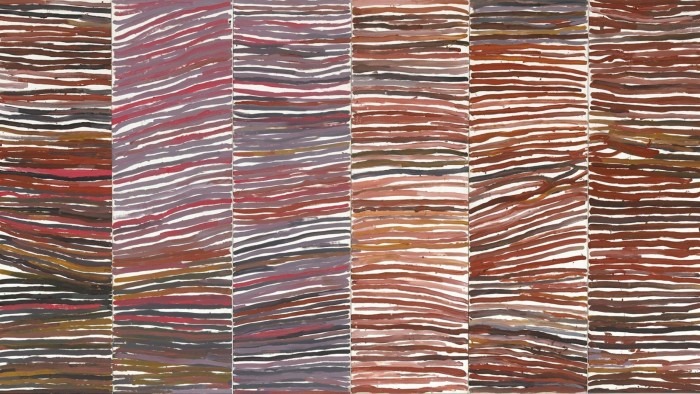
One of the defining features of Kngwarray’s approach to artmaking was her restlessness. As she entered her eighties, her style radically changed: dots gave way to sweeping gestural marks, and her subtle monochromes were replaced with a bold palette. In 1994, she painted the six panel “Untitled (awely)”, which was originally shown in the Australian Pavilion at the 1997 Venice Biennale. At around two metres high and three and a half metres wide, its rhythmic repetition of undulating ochre, brown, purple and black stripes invokes the painted skin of the Anmatyerr women dancing their ceremonies beneath an immense sky.
Teeming with life, colour, energy and inventiveness, it is hard to believe that the astonishing paintings hung in the final room of the exhibition were created in the last year of Kngwarray’s life — a period when she often made a painting a day. The five-metre “Yam awely” from 1995 comprises a frenzy of luminous tangled lines against a black background — a wild celebration of the artist’s life, her land and her Dreaming. It’s less a depiction of something than a total immersion in it.
As the artist declared in 1992: “I paint my plant, the one I am named after — those seeds I am named after. Kam is its name. Kam. I am named after the anwerlarr plant. I am Kam!”
To January 11, tate.org.uk
Find out about our latest stories first — follow FT Weekend on Instagram, Bluesky and X, and sign up to receive the FT Weekend newsletter every Saturday morning
Read the full article here