

Hello and welcome to Working It.
June is full-on meeting/conference/event season before people disappear on summer breaks. This week, I’ve spoken at the University of York on workplace loneliness, in London at the FT Women in Business Summit, and started shooting a new Working It video series. And, most importantly, we celebrated my father’s 90th birthday 🎂. (He’s been an FT reader for about 65 years!)
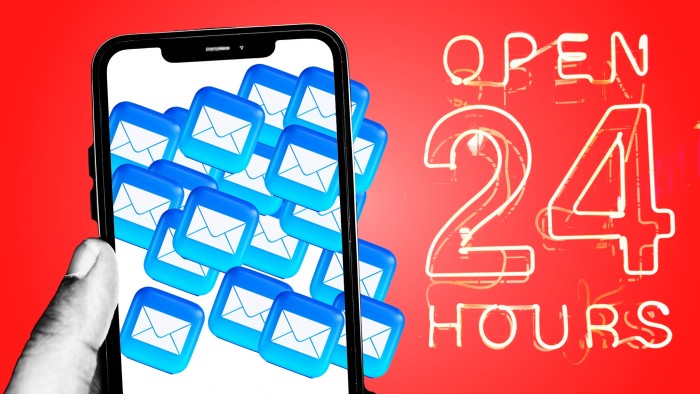
So if you’re feeling the overwhelm, you aren’t alone. The average worker receives 117 emails a day, and nearly a third of us are poking about in our inboxes at 10pm, or later. We just can’t stop ourselves 😳. Read on for more on these “infinite workdays”, plus how to set better boundaries — and even reimagine work. Possibly not “actionable” before the summer holidays, but you never know 🤷🏽♂️.
Do send me your ideas, workplace problems and stunning office views☀️: [email protected]. This was the view early today from the City offices of United Minds, a management consultancy.
To infinity and beyond 🚀: our work never ends
Did you know that workers are interrupted, on average, every two minutes “by a meeting, email or notification” ⏰? As future of work expert Christine Armstrong pointed out at the FT’s Women in Business Summit this week, that figure doesn’t even include all the notifications from our personal lives, including WhatsApp messages and emails from children’s schools. It’s a wonder we get any work done.
The two-minute interruption statistic is from Microsoft’s work trend index, and there’s a lot more scary stuff in there, drawn from trillions of anonymised productivity data points from Microsoft 365 users. (These log every time there’s a message, meeting, email etc). This week, the software giant went even deeper into its data and came up with a vision of always-on workers, engaged in a “seemingly infinite workday”. My favourite fact: 40 per cent of those who are online at 6am are “scanning overflowing inboxes, in hopes of getting ahead”. Yes 🙋♀️.
The term “infinite workday” nails the reality for many knowledge workers; days characterised by a lack of control because of the never-ending demands. Microsoft found that nearly half of employees (48 per cent) and 52 per cent of leaders said their work felt “chaotic and fragmented”.
I talked to Colette Stallbaumer, whose team in Microsoft’s WorkLab produces these reports. The promise of AI, as Colette sees it, is that it can help reduce this overload. “How can you use AI to help with focus time, to help take the drudgery out of work or with something we call ‘digital debt’? When we were asked in primary school, ‘what do you want to be when you grow up?’, nobody said, ‘well, I really want to do email all day.’”
Instead, she suggests, “the hope and purpose of AI is to give people some of that time back. Let them reclaim their workday.” As a staging point on the way to reclaiming our days, getting some focus time back would be good. Microsoft describes focus time as a “mirage” 🏝️, partly because many people’s peak productivity hour of 11am is also peak overload time for messaging and meetings.
Wherever we are in AI adoption, setting boundaries will help, as Colette points out. “We’ve had to learn, over the past five years, that it really comes down to each of us taking control of our own workday.” We can also overlay AI hacks: “How can I use AI to take more things off my plate?”
One example? “You never need to take meeting notes again 📝,” Colette says. “You can transcribe meetings and capture the action points.”
I do actually do this 😅 — and AI interview transcription has changed my life. What AI hacks have already helped you*? Email me: [email protected].
*I know AI is more than a set of neat tools. But I am also old enough to remember desktop computers arriving at work, and we started off liking them because they were timesavers. The existential stuff came later 😬.
Five top stories from the world of work
-
OpenAI says Meta is trying to poach staff with $100mn sign-on offers: Hannah Murphy and Cristina Criddle report on Sam Altman’s assertion that Meta is trying to poach engineers and developers from OpenAI, with enormous sign-on bonuses and pay packages.
-
The scourge of the non-compete clause: These clauses ban employees from joining a rival or starting a similar business for a period after leaving their job. Sarah O’Connor reports that some countries and US states are moving to restrict or ban them. Florida is going in the opposite direction.
-
The career boost of marrying well: New research tells us what we already know, that a supportive life partner is a big help in our careers. Pilita Clark reports that employees with “emotionally competent” spouses have many more traits that bosses value.
-
Can start-up success be taught? Getting an MBA or business school qualification is not traditionally associated with start-up life, but an increasing number of business schools are offering entrepreneurship on the curriculum, reports Andrew Jack.
-
HSBC considers ordering all staff back to the office three days a week: The global bank is thinking of issuing an all-staff global mandate to work in their offices three days a week, to replace “a patchwork of policies”, Ortenca Aliaj reports.
One more thing . . .
Andrew Palmer, The Economist’s Bartleby columnist and wry host of its excellent leadership podcast, Boss Class, has also launched a newsletter. Bartleby, for Economist subscribers, is “your guide to the agonies of office life”. It’s funny and insightful — and I think we can cope with two workplace newsletters in our inboxes 😉.
Book giveaways are back (finally!) 📚
Because of my own inefficiency (ie failing to heed productivity guru Cal Newport’s very sensible mantra: “Do fewer things. Do them better”), we have not had a Working It book giveaway for ages. We have a great book to mark their return: Good Anger: How Rethinking Rage Can Change Our Lives, by Sam Parker. I’ve heard Sam speak movingly about why he wrote the book, and about how embracing the darker side of emotion (in a good way) has changed his life. If you want to “figure anger out” — then this book is for you.
We will return to Sam, and to anger and its many impacts on our working lives 😡, in another newsletter. In the meantime, enter on this form to be in with a chance of winning one of ten copies of Good Anger. Closing date is June 20 at 5pm. Winners will be chosen at random.
Before you go . . .
Are we about to see a massive reversal in the kinds of careers that are valued and highly paid? That’s the thesis of a Substack essay by Carmen Van Kerckhove, titled “Your job used to impress people. That era just ended.” As she puts it: “We’ve built an entire social structure around the idea that ‘thinking’ jobs trump ‘doing’ jobs. That degrees matter more than skills.” Is that all about to come crashing down? Carmen (who works in marketing) doesn’t come to a firm conclusion, but suggests we all need to be prepared for a “flip” unlike anything we’ve seen before 🤯.
The rise of skilled trades as AI-proof careers is something I’ve been discussing with my Gen Z children. (If you can’t get a graduate job, should you train in something practical?) A “flip” in the kinds of jobs that are highly paid would not just change our notions of financial security — Carmen’s essay discusses how it would create a wholly new social class system in many economies.
Read the full article here