

Unlock the Editor’s Digest for free
Roula Khalaf, Editor of the FT, selects her favourite stories in this weekly newsletter.
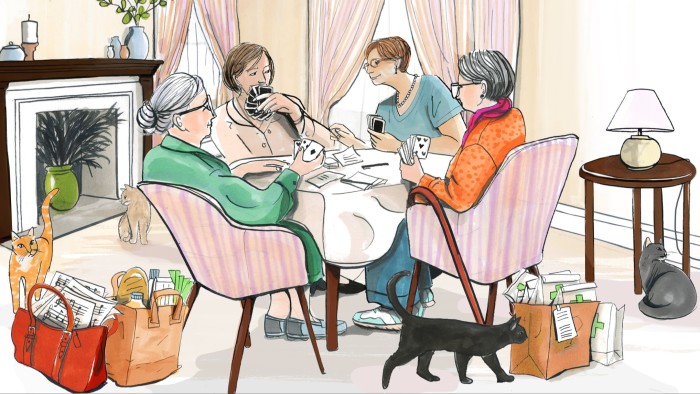
Old age is one long painful process of “incremental weakening”, writes the American novelist Stewart O’Nan in Evensong, his moving story of four elderly Pittsburgh ladies who find solace in assisting others. Emily, Arlene, Kitzi and Susie are core members of the Humpty Dumpty Club, an informal group of women who help friends and neighbours with the practicalities, indignities and relentless admin bound up with one’s final years: collecting prescriptions, ordering groceries, offering lifts to hospital appointments and, eventually, making the inevitable funeral arrangements.
The scene is near-present day — Covid is lingering, as is Donald Trump, who is heading towards his second term in office — allowing for politics and the pandemic to feed into prevailing anxieties. And, while the Pennsylvanian setting — with its cosy-sounding neighbourhoods, such as Shadyside Village and Squirrel Hill, and game nights supporting the Pittsburgh Steelers — provides further specificity, the elegiac atmosphere gives the novel a universal and timeless feel.
O’Nan’s compassionate quartet are believable as friends with issues of their own (and, occasionally, with each other). Emily is the widow of Henry Maxwell, a local engineer, who was the brother of Arlene. The Maxwell family has featured in several of O’Nan’s previous novels, including Wish You Were Here (2002) and Emily, Alone (2011). Now octogenarians, Emily and Arlene have spent more than half a century bickering and competing with one another: “The two of them couldn’t stand each other yet were inseparable. Here come the Maxwell sisters, friends joked.”
Kitzi is the only one in the group with a husband, the chronically ill and housebound Martin. But it is Susie’s narrative that lies at the heart of the book. At 63, she is the youngest of the four, a recent divorcee who misses her former garden more than her former husband. When she begins an autumnal romance with a pot-smoking musician, O’Nan allows for the possibility of new growth in unlikely circumstances.
A nod to a plot comes with the hospitalisation of the Humpty Dumpties’ irrepressible leader, 89-year-old Joan. Reluctantly, Kitzi takes the helm, allocating chores to the others, a difficult situation made worse when she is called out to visit Jean and Gene, a couple of ageing, once glamorous concert pianists, hoarders with a house full of mouldy rubbish, feral cats and old pianos. “Even before she’d breached the foyer, the smell hit Kitzi, a wave of ammonia and dung that made her clamp a hand over her nose and mouth.” In the garage, she finds a dead tabby and a Rolls-Royce.
In the US, O’Nan is considered something of a writers’ writer, praised by celebrity authors such as Elizabeth Strout and Stephen King (with whom he co-wrote a book on baseball). In Britain, however, he remains relatively little known. Unjustly so, for few writers evoke everyday pleasures and niggling troubles as successfully as O’Nan. Strout quite rightly called him “the king of the quotidian”. He also has a keen eye for the physicality of his characters: a church organist fusses over his sheet music and checks the stops “like a pilot preparing for takeoff”.
O’Nan loves strange collectives. In 2003, he published The Night Country, a New England-set ghost story told from the posthumous perspectives of several students killed in a car crash. And in Evensong, he imagines a co-operative of likeable and productive geriatrics who potter between libraries, cafés and doctors’ surgeries. In his acknowledgments, O’Nan notes that there really is a Pittsburgh Humpty Dumpty Club, a member of which shared her experiences of being a Good Samaritan with a pensioner’s pass.
The central theme of ageing is handled with candour: sleep is a “delicate business”, a stubborn jar lid can ruin a dinner, a Christmas card returned to sender has ominous implications. “They all had their losses,” writes O’Nan of his Pittsburghers, “and if time made them easier to bear, the dead were also more remote and harder to recall.” But there are consolations. The four find succour in the programme of their local church choir and routine and comedy in the antics of their cats and dogs. The behaviour of their grown-up children is more problematic.
Ultimately, companionship is the greatest balm. Some of the most touching and amusing scenes occur during the women’s monthly bridge nights. “They might have been in high school, trading gossip across a lunch table,” observes Susie as she shuffles the pack. Autumn turns to winter, feuds soften, bonds build and the women deal with memory loss, aches and pains and thankless Thanksgiving dinners. O’Nan’s crescendo is the titular choral service that marks the arrival of a new year.
Although largely a gentle, episodic chamber piece of character studies, Evensong is also a quiet rebuke to America’s healthcare industry. “All the system cared about was the insurance money,” observes Kitzi. “Everyone was getting paid, yet no one was responsible — a bleak conclusion, if true.” The onus is on friends and family to fill that void, a situation that amounts to little more than the luck of the draw. O’Nan has written a bittersweet tale of four women who, at least in this respect, have been dealt winning hands.
Evensong by Stewart O’Nan Grove Press UK £14.99/Atlantic Monthly Press $28, 304 pages
Join our online book group on Facebook at FT Books Café and follow FT Weekend on Instagram, Bluesky and X
Read the full article here