

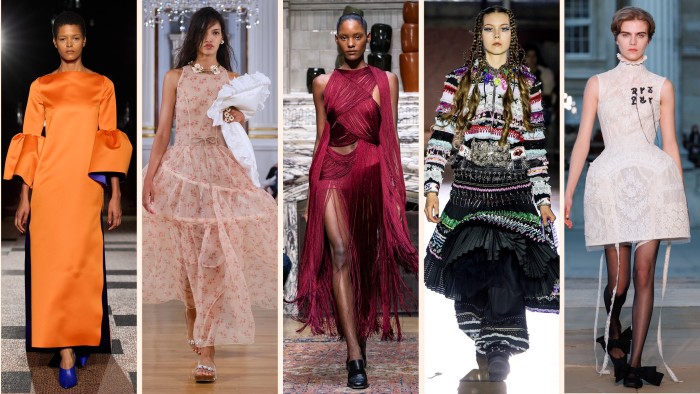
Of the four fashion capitals, London has been the most in need of a renaissance lately. The tough market conditions in recent years have taken a particularly heavy toll on the city’s designers. Several star names have defected to show in Paris (the exception being Burberry); emerging names have gone too, while others have gone out of business entirely. Slashed budgets for editors and buyers mean that more and more go only to the mainland European capitals, leaving London’s small independent brands with a tough choice: show at home, or go across the Channel to where there is ever more power, money and attention.
But a determined new British Fashion Council chief executive is hoping to not only reverse that trend, but to make London an essential stop on the fashion calendar once again. Laura Weir, a former magazine editor and creative director for Selfridges, has been shouting from the rooftops about the fact that the fashion and retail industries contribute more than £67bn to the UK economy and support more than a million jobs. London is also home to many of the fashion industry’s best design schools, making it a longtime training ground for top-tier industry names. To keep talent here, Weir’s first priority was to cancel the listing fee that brands had to pay to be part of the official LFW schedule. She has also been lobbying the government for more cash.
“Like so many creative industries, we’re still feeling the impact of Brexit and Covid, but what we can’t do is sit in that space. We have to look forward, not back,” says Weir. “For fashion to flourish here, it comes down to how easy we make it to create and make things domestically. Our brands need more support and respect at a time when it’s currently easier to build a fashion business elsewhere.”
A coup would be to entice some big guns from Paris back to London. Even a temporary return by the likes of Victoria Beckham, Alexander McQueen and Stella McCartney would turn the spotlight firmly back on the city. Beyond a nice show of patriotism, it might even offer some of those brands more attention than usual, given the now wildly crowded European schedules.
Among those still firmly flying the flag in London, there was plenty to see this season. Elegant, beautifully made pieces for the ladies-who-lunch crowd by the likes of Emilia Wickstead and Richard Quinn, as well as Queen Elizabeth II Design Award winner Patrick McDowell. Neon rugby shirts and slinky dresses in jersey and paillettes at Conner Ives’s effervescent show. Innovative takes on fabrics, techniques and proportions came from emerging talents: Paolo Carzana used fruit to dye cotton muslin shirts, waistcoats and crumpled trousers; Pauline Dujancourt reworked traditional Argyle knits sweaters and frumpy crochet squares using light yarns and tulle strips; and Talia Byre elongated rugby jerseys and aprons into dresses.
Here are some of the best shows we saw.
Simone Rocha
This season Simone Rocha flirted with the idea of girls on the cusp of womanhood; specifically, the awkward teenage debutante. The Irish designer was inspired by a 1992 essay by Maureen Freely about a young girl who had to wear her mother’s clothes and “wasn’t too happy about it” and Justine Kurland’s 2020 photographic book Girl Pictures. Rebellious sequinned bra tops and flashes of embellished thermal knickers were softened by full airy skirts in organza covered in tiny rosebuds or scalloped at the hem and festooned with oversize fabric rose corsages. Heads were crowned with askew diamanté tiaras, while arms were uncomfortably folded across oversized tailored jackets layered over little bloomers or tightly hugged pillowcase-shaped handbags. There were even pearl-encrusted ballerina-flat Crocs, part of Rocha’s ongoing partnership with the brand. As a 1960s-style prom soundtrack wafted up through the chandeliers and gilded reception rooms of Mansion House, it felt like we had all made it to the ball. EP
Erdem
As usual, Erdem Moralıoğlu hosted his show among the soaring columns of the British Museum and unveiled a collection of sumptuous pieces inspired by a quirky historical character. This season it was Hélène Smith, a 19th-century French psychic and artist, who was periodically possessed by visions of belonging to Marie Antoinette’s court, being a Hindu princess and even communicating with Martians. Her scribbled codes were embroidered in black on white lace hourglass mini dresses with hip-moulded skirts, starched tulle corseted cocktail bustier dresses and silk satin trenchcoats that dripped with rhinestones, while her flirtation with Indian courts found form in gauzy chartreuse and neon pink belted parkas layered over column dresses. But Sunday night’s event was a little different because it marked 20 years in business for one of London’s best-known designer names; champagne was served inside the museum after the show. Anna Wintour has called Moralioglu “London’s pre-eminent storyteller”. Building a two-decade-strong legacy in this city is definitely something worth celebrating. EP
Roksanda
Another designer celebrating 20 years at London Fashion Week is Roksanda Ilinčić. Her SS26 collection included nods to greatest hits such as 2012’s Margot dress with bell sleeves, rendered in orange duchesse satin. Held in the ballroom of the Chancery Rosewood hotel in Grosvenor Square, the collection was a polished return to form after a financially turbulent few years. Eveningwear was the standout, particularly column dresses with curved, cutaway shapes that reflected the fact that Ilinčić was inspired by the sculptor Barbara Hepworth, as well as draped gowns in brushstroke-print silk, strapless dresses with raffia fringing and a dramatic cobalt cape in taffeta. CL
Dilara Findikoglu
Dilara Findikoglu divides opinion and she likes it that way. The British-Turkish designer is one of London’s buzziest names. Her disturbingly beautiful designs revolve around anger, sex, feminism, emancipation, sorcery and history. This season was no exception. She took over a bastion of British male power — the Ironmongers’ Hall in the heart of the city — and sent models out in hyper-feminine razor-sharp corsetry or deconstructed silhouettes that tumbled from models’ bodies in an airy palette of nudes, whites and pinks. Silver chainmail face veils seemingly inspired by Arab battoulah masks cascaded over models’ eyes. Cherries burst with their juices smeared like blood down skirts. Horse tails sprouted from models’ bottoms, while Naomi Campbell prowled the shadowy halls laced in skintight black leather. Findikoglu’s fashion is not for everyone. Still, it was impossible to look away. EP
Chopova Lowena
Emma Chopova and Laura Lowena are masters of creating harmony out of seemingly incompatible sources. This season it was the turn of American football and cheerleading — think striped jerseys, varsity jackets, pleated mini skirts and slogan tees — and heavily decorated tiered dresses of the Greek-Bulgarian Karakachani tradition. But in the Chopova Lowena teen universe, sports jocks and popular girls are moulded with emo, goth and punk kids. Zip-up hoodies, ruched mini dresses and the brand’s signature carabiner skirts came covered in eclectic velvet, sequins and ric-rac trimmings; trackpants were revisited as a patchwork of denim, lace and checkered fabric. It was conformism and individuality blended together to create a completely new dress code. AB
Ahluwalia
Many of the London Fashion Week regulars have dialled up the finesse this season, and Ahluwalia was no exception. This show had all the energy and eclectic cultural influences (here, Bollywood and Shakespeare) that Priya Ahluwalia is known for, with added sophistication. Case in point: an evening dress made from wine-coloured silk fringe that swished as the model walked and played on the idea of revealing and concealing. And importantly, while sustainability feels like a rather neglected issue in fashion these days, Ahluwalia incorporated preloved materials and recycled denim laser-printed with images of mixtapes, a fun retro motif. CL
Burberry
Designer Daniel Lee played on the connection between music and fashion, evoking festivals, open-air concerts and free summer vibes, set to songs from the Black Sabbath archive. The show was staged in a giant tent with a sky-print ceiling and a sandy floor that put a chic spin on the mud that plagues Glastonbury et al. Models wore practical footwear including chunky lace-up boots paired with 1960s-inspired tops, skirts and mini-dresses made from beads, crochet and chainmail, while men’s suits came in acid pink and green, chocolate and purple. And for the inevitable British rain? None of those sad emergency ponchos here — outerwear included A-line raincoats in zingy pink, orange and green check. CL
Johanna Parv
Estonian-born designer Johanna Parv has been perfecting her formula for elegant but functional clothing for busy women since 2020 — the type who want to seamlessly transition from commuting on a bike to hosting a meeting before running off to an evening with friends. Many brands try to create hybrid clothing, but Parv is one of the few nailing the balance. Her pockets are hidden, zips discreet, silhouettes sleek and colours muted (aside from the occasional pop of red). Where she really shines, however, is accessories. The Pack bags and Belt bags can be carried (as the name suggests) as backpacks and belts, but look formal enough for the boardroom when worn as traditional bags, while the new Frame shoulder bag can be clipped to a bicycle frame for dashing off in style. AB
Follow us on Instagram and sign up for Fashion Matters, your weekly newsletter about the fashion industry
Read the full article here