

Unlock the Editor’s Digest for free
Roula Khalaf, Editor of the FT, selects her favourite stories in this weekly newsletter.
In Lila Raicek’s new play, architect Henry Solness has taken an old building and turned it into something new: transforming an ancient church into a place of meditation. In essence, Raicek has done something similar. Working from Henrik Ibsen’s 1892 drama, The Master Builder, she’s written a fresh piece that follows roughly the contours of the original but transports it to the Hamptons in 2025, reshaping and expanding some key characters.
Issues that swirl around in Ibsen’s original take on added weight in the current era. It’s an idea rich with potential, but the result feels curiously wooden and inauthentic, even with Ewan McGregor in the lead.
When we first meet McGregor’s Henry, he is delivering a press conference to mark the opening of his new building. There’s already a glimmer of fragility: we learn that he has become prey to vertigo and can’t ascend to the top of his own structure. It will later emerge that the new sanctuary is created in honour of his young son, who died 10 years previously.
Switch to the preparations for a celebratory party and all sorts of other demons start to creep out of the woodwork. Henry’s unhappy wife Elena (played with terrific bite and drive by Kate Fleetwood) fancies Henry’s former apprentice and now rival Ragnar (David Ajala); Ragnar is in a relationship with Elena’s assistant Kaia (Mirren Mack). Meanwhile Kaia has invited her friend, Mathilde, to the party: a young woman who turns out to have history with Henry from when she was his student a decade earlier. As the booze flows, the bad faith swells in the air until you can barely breathe.
Ibsen’s original is steeped in symbolism and thick with themes: hubris, guilt, regret and jealousy stalk the action. The play was partly autobiographical and in response, Raicek brings her own lived experience to bear. A programme note explains how she found herself a guest at a swish dinner in the Hamptons where she was clearly a pawn in a game between a married couple. Here that unfolds as an ugly three-way struggle, producing highly charged confrontations about desire, love, the abuse of power and the limited agency of women.
But timely as all this is, the situation feels oddly contrived and the dialogue often stiff and airless. McGregor suggests that Henry’s confident exterior is undermined by grief and remorse, but he struggles to animate some cloying lines. “You were like this brilliant beam of light in the dark tunnel of my life,” he says at one point. Another character talks of someone “undressing you with his eyes” — the sort of cliché that should have vanished with the first draft. And then there is Mathilde herself, who is expanded from the original and played with immense poise by Elizabeth Debicki, but still feels more like an idea than a person.
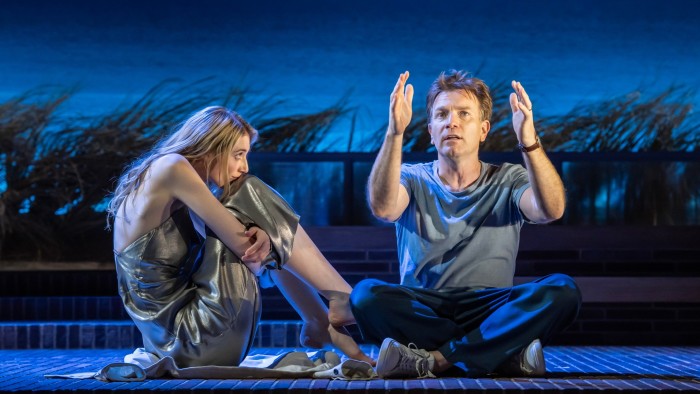
Richard Kent’s handsome set and Paule Constable’s eloquent lighting suggest a liminal location, where fashionable people run up against the rawness of nature. Ajala and Mack bring wit and spark and the usually excellent Michael Grandage directs with pace. But not even he can solve the melodramatic ending. This new piece feels like one of those renovations that hasn’t quite worked.
★★☆☆☆
To July 12, mymasterbuilderplay.com
Read the full article here