

The brutalist concrete planes and angles of London’s Southbank Centre seem to glint in the early spring sunshine as I make my way towards the National Theatre to meet the recently departed head of another beloved British institution.
Although the business of my lunch guest, Amanda Pritchard, is care rather than culture, her career has recently had its own quotient of drama. In late February, the 48-year-old unexpectedly announced her resignation after three and a half years as the head of NHS England, the body that runs the country’s free-to-use healthcare system, consistently rated as the feature of national life that makes people proudest to be British. The following month, Prime Minister Keir Starmer scrapped the body entirely, bringing the NHS back under direct government control after 13 years of operational independence.
Pritchard’s tenure — which began in the midst of the Covid-19 pandemic — has been as torrid as its conclusion. Although long waits for NHS treatment are now steadily falling, patients are still waiting for around 7.4mn “non-urgent” procedures, after Covid exposed the service’s long-standing fragilities. Following the election of a Labour government last year, health and social care secretary Wes Streeting bluntly declared the NHS “broken” and its leaders are keenly awaiting their own prescription in the shape of a 10-year plan expected in June.
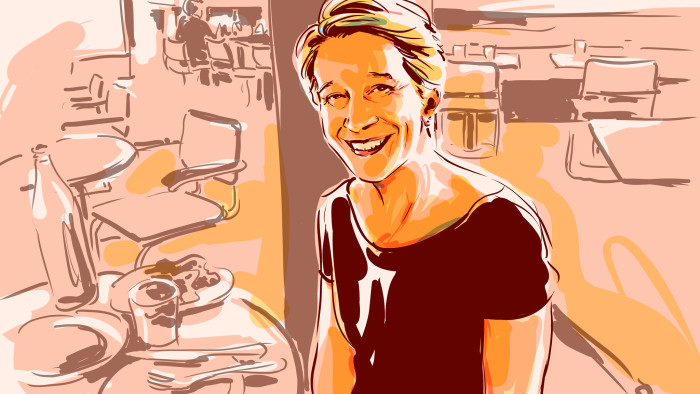
But far from appearing bruised, when we meet at Forza Wine, an Italian restaurant with views of the Thames, she radiates an energy that speaks more of beginnings than endings.
Later this year, she will take the reins as chief executive of one of London’s biggest hospital trusts, Guy’s and St Thomas’ (GSTT), returning to the job she held before entering the NHS senior leadership team — albeit to an organisation that is far larger and more complex than when she left it in 2019.
“I really believe you make a different contribution in different roles in the NHS,” Pritchard says. “I have made my contribution at the centre, and it is time for me to go back and run a big and exciting organisation.”
She joined the NHS’s management training scheme straight from the University of Oxford 28 years ago, instantly enthralled by its mixture of intellectual challenge and human endeavour. It “runs through me like a stick of rock”, she says.
The waitress suggests we order a total of four dishes to share. Given our respective food intolerances, the circles of the dietary Venn diagram overlap on cauliflower fritti with aioli, chickpeas with rainbow chard, caponata — a Sicilian aubergine dish — and sea bass with clams in a spinach purée.
Pritchard says that if I am going to have a glass of wine, she will join me. We agree on prosecco — a rare lunchtime indulgence with just two and a half days to go before she leaves one of the public sector’s most demanding roles.
We start by discussing the similarities between London’s National Theatre (a favourite haunt of Pritchard, who is a trustee) and the UK’s National Health Service. Both, she suggests, must balance long-term investment with a plethora of immediate demands. “You could forget about the building and just concentrate on what you need to do to put on a great show tonight. But if the building starts falling down, you’d regret that decision,” she says.
The analogy is all too apt for the NHS. The quality of its estate — some of it predating the founding of the health service in 1948 — is widely acknowledged to be having a significant impact on patient care.
Part of the problem, I put it to her, is the unusually tight central control that the Treasury exercises over health service funding, setting it apart from comparable countries. Without conceding the wider point, she accepts that in the case of NHS capital spending, relying entirely on state largesse “hasn’t worked for the last 15 years or so”.
Private investment is needed to help plug the gap, she says, not just for bricks and mortar but the resources required if the service is to realise the full potential of technologies such as artificial intelligence to boost productivity and improve patient care. “We are within touching distance of the sort of transformation that’s possible,” she says.
As we sip our drinks, I raise the delicate question of her own departure amid rumours of a rupture with Streeting. Could she have stayed on, had she chosen to? A friendly but brisk reply: “He did not ask me to leave. That was not the conversation. The conversation was much more, ‘I think we have reached the point for the organisations where it’s time to do something different.’”
When I ask if she had viewed the decision to abolish NHS England in any way as a referendum on how she had run it, she seems taken aback. “Honestly not . . . because I think what’s been clear is that Wes and I have really tried to work closely in this much more ‘one team’ way over the past nine months, which was different to how things had worked in the past.”
Building an even deeper relationship with the Department of Health would not “necessarily . . . have required NHS England to cease to exist”, Pritchard says carefully, but it would have demanded “a different team appointed in a different way, working much more directly to the secretary of state”. It felt to her “and I think to Wes, that that was the right time to say . . . ‘I’ve done the job I needed to do, which was to lead the NHS through the pandemic, to lead my colleagues . . . through the real hard yards [of] recovery, stabilisation and gradual improvement and to put the foundations in place for the 10-year plan.’”
The abolition of NHS England marks the end of an attempt to take the politics out of the health service by placing its day-to-day running in the hands of an arm’s-length body. But Pritchard suggests that if this was the intent, it was probably never realistic. “It’s too important to the country [and] we spend too much public money for . . . the politics not to be part of it.”
But the reorganisation will require an extensive understanding of “all of the things NHS England does”, she cautions, including technology and workforce training, “so that there isn’t any sort of unintended consequence to change, because there’s just always risk when you’re doing something as big as this.”
She’s quick to note that her successor Sir Jim Mackey and the NHS’s newly appointed chair Dr Penny Dash “are committed to . . . making sure that while they need to move quickly to give people certainty about personal futures”, the process is “done really thoroughly”.
Caught up in the conversation, I’m making limited inroads into the food but what I do taste is delightfully succulent. Later in the conversation, Pritchard tells me she really liked the texture of the cauliflower, chickpeas and caponata — the latter “absolutely delicious” and her favourite — but gives lower marks for originality to the sea bass: “Very nice sauce, but ultimately a piece of fish.”
We turn to the uber-question facing all healthcare systems: how to stem the demand for care — “It only goes one way at the moment,” she warns — by preventing illness or treating it in the community.
I note that countries that have successfully increased resources for out-of-hospital care have generally secured a consensus that has endured through multiple administrations of different political stripes. In contrast, England’s NHS, over almost eight decades, has suffered boom-and-bust funding cycles and abrupt changes of strategy — the summary execution of NHSE just the latest — as successive governments have sought to leave their mark on an institution that looms so large in the national psyche.
Pritchard delivers a plea for certainty and continuity in a service that has had precious little of either for the past few years. She notes that since her appointment in August 2021, she has served under four prime ministers and through five changes of health secretary, against a backdrop of “quite short-term funding settlements”.
Although loyally insisting she learnt something from working with each of them, she says the NHS “desperately” needs stability. “I would hope that whatever comes out of this long-term plan, whether Wes continues as secretary of state, I very much hope he does . . . Nonetheless, even if he did step away, [that] whoever his successor was would still hold true to it.”
She adds: “Think about how long it takes to train a doctor — you can’t change your mind every five minutes . . . Think about what it requires to put new [digital] systems in place . . . It’s not buying the tech — that’s the easy bit. It’s the implementation . . . and some consistency of leadership is really helpful.”
More customers are arriving but we are still alone in our section — the staff were as good as their word in promising me a quiet table — as I raise the question of funding. Even though demand perennially outstrips resources in the NHS, for decades healthcare has secured an outsize share of public expenditure. But I’m wondering if the calculus has changed now that the UK government has committed to increased defence spending in anticipation of a reduced US role in European security?
“Very simply yes . . . I don’t think there is some great big war chest in the Treasury that people are just not telling us about . . . So we’re going to have to find ways to do what we do now more efficiently and productively, and we’ve got to transform and do things completely differently so that we can stay ahead of the curve.”
Alongside the potential of both AI and electronic patient records — shared between hospitals, family doctors’ practices and pharmacies — to deliver care more efficiently, Pritchard extols the NHS app, which she believes can underpin a fundamental shift in the relationship between the health service and the public. As it evolves, it will allow people to book and change their own appointments, and receive the results of home tests directly, potentially avoiding a hospital or GP visit altogether.
But relieving the strains will also require far more ambitious action in areas unconnected to the health service’s core mission of providing biomedical care, including a bigger role for the state in legislating to spur the adoption of healthier lifestyles, she suggests.
The NHS contributes between 10 and 20 per cent to people’s health, she says — a figure I find startlingly low. “The rest is what we would recognise as the wider [social] determinants,” including housing, and meaningful employment, but also smoking, diet, alcohol and lack of exercise. “I know there’s an anxiety sometimes about being too nanny state-ish about this . . . But it is going to take really bold action to set the conditions for people to then live healthier lives.”
While the NHS has been subjected to repeated structural upheavals over the years, no politician has dared touch its distinctive funding structure, which assumes that the health needs of a demanding 21st-century population can be met almost entirely from its tax base.
Pritchard indicates she has heard too much criticism of the service over the years to believe some of the mythmaking around it: “I have never bought for a second this idea that the NHS is some sort of national religion.” But pointing to opinion surveys that show continued high levels of support for its founding principles, she says: “I’m not worried at the moment that . . . en masse, we’re going to end up with a rejection of the NHS model.”
However, later in the conversation she implies that the public’s patience may not be inexhaustible. If the improvements and shifts needed to strengthen the service for the long term are not implemented, “fast-forward 10 or 15 years, and I think we would be having potentially a very different conversation”. About the survival of the taxpayer-funded model? “Most definitely.”
She seems especially concerned that younger generations may feel they have less of a stake in the current system, noting that “the resources in the NHS are obviously massively disproportionately spent on older people”. Meanwhile, working-age cohorts pay through their taxes but take out far less from the service. To retain the support of these digital natives, innovations such as the app and remote care “become really crucial”.
Another question that she says will become increasingly pressing is what “the core business” of the health service should be at a time when parts of the state and voluntary sectors have been squeezed, leaving the NHS to pick up the slack. GPs tell her that between one in four and one in five of their patients come to them for help with non-health problems.
A colleague in a mental health service recently told her it employs a housing team to support patients who couldn’t otherwise be discharged from hospital. “You wouldn’t say the core business of the health service is as a housing provider, but that’s where we’ve ended up.”
As we talk, Pritchard comes across as completely secure in her place in the professional firmament. Yet she also exhibits an absence of ego unusual in someone who has reached the pinnacle of public life. Of her decision to return to her former post as chief executive of GSTT — which some, I suggest, will see as a clear step down — she says: “I’ve never really been interested in having a job title for the sake of it, or the trappings that go with something. I want to make a difference.”
As the first woman to head the NHS, and the mother of two sons and a daughter aged between 10 and 17, she has felt an obligation to be open about the unpredictability of family life. “I think you do have more scrutiny as a woman in a very public position, and it is partly why I have tried really hard to be authentic about who I am and hold on to [the fact that] sometimes, as a working mum, it is a bit chaotic. It gives permission for other people to say . . . ‘sometimes these are quite difficult jobs but we can still step up and do them.’”
Pritchard is by now running late for her next meeting, but I can’t forbear to ask her whether she shared my own emotional reaction to Nye, a play about the life of Aneurin Bevan, the Labour health minister regarded as the founding father of the NHS, which lit up the National Theatre last year and is shortly to return for another run. She laughs. “I cried all the way through — completely hopeless!” It was partly the stark reminder of what a world without the NHS would be like, coupled with its depiction of Bevan’s “courage and determination” as he fought to turn his vision into a reality.
“He was an extraordinary man, but nonetheless still just a man, with foibles and strengths and weaknesses, like we all are as leaders. There are things we’re really good at and things we’re not very good at. We have good days and bad days. But you keep going.”
Sarah Neville is the FT’s global health editor
Find out about our latest stories first — follow FT Weekend on Instagram and X, and sign up to receive the FT Weekend newsletter every Saturday morning
Read the full article here