

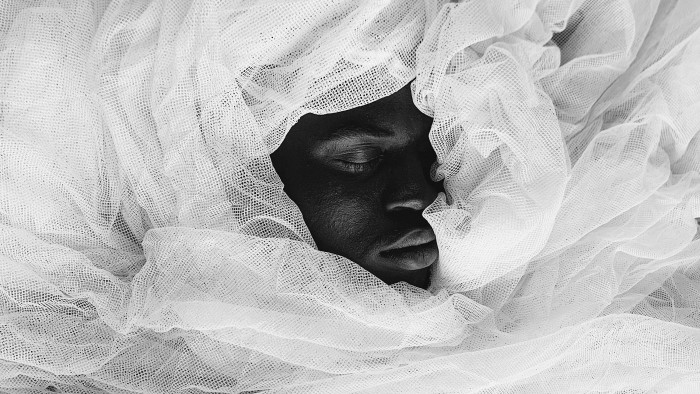
In the leafy suburb of Karen, Nairobi, stands Afrika House, a gallery space for photography and design from across the continent. It is currently hosting an exhibition by Mory, a self-taught Sudanese photographer, curated by Azza Satti and me. It offers a glimpse into Mory’s unique perspective and the distinct gaze through which, as a textile merchant, he sees the world. His work visually expresses complex familial relationships and emotions. I sat down with him at the studio in Nairobi he shares with Sudanese artists who moved to Kenya a few months after war broke out in Sudan on April 15 2023.
Rahiem Shadad Let’s start with a simple question. Your nickname, Mory, where does it come from?
Mory (giggles) My original name is Ammar Abdalla Osman. I’m 28 years old. The name Mory is a nickname my mum gave me when I was young, growing up in Wad Madani in Al-Jazirah state, in Sudan. It stuck among my siblings, and I eventually became very comfortable with it. I decided to adopt it as my artistic name.
RS You were born and raised in Wad Madani, but your family is originally from El-Geneina in West Darfur, correct?
M Yes. My grandfather moved, along with the rest of the family, from West Darfur in the early 20th century to work in farming. They lived in what was known as the Kanabi, the housing built for labourers and farmers. In the 1970s, the University of Al-Jazirah was built on the land where our family lived, so we were relocated to the city of Wad Madani. Before that, my family was mostly made up of farmers. But after my father went to Iraq for college and returned following the Gulf war, we transitioned into trade. He began bringing goods from Libya and Egypt and selling them in the city market.
RS Tell me about your father’s trade. How did you get involved in it?
M My dad started by buying bulk fabric and Kodak camera film from Cairo and selling them in Wad Madani market. The Kodak films were sold to photo studios, which were very common and popular at the time. I used to accompany my dad when he distributed the films to these studios, and I think that was my first exposure to photography.
RS And how old were you? Was that the first time you picked up a camera?
M Not at all! Back then, I just loved being photographed. I would constantly pose in front of the camera, always asking for my photo to be taken. My uncle was a photographer. He was the one who took all our family portraits. Between the age of nine and 13, I would follow him around as he took pictures. Honestly, the family album — his photographs and others — was the main inspiration for my photography journey. I was fascinated by that album. I can still remember it cover-to-cover, visually. I think a lot of my use of colour and composition today is influenced by the photos in that album.
RS At what point did you start creating images yourself?
M I think it was around 2020 that I began taking photos and creating images in an intentional way. In mid-2020, two of my uncles and my grandfather passed away within a very short period of time. Among them was my uncle, the family photographer.
My cousins came to stay with us for the funerals, and I ended up spending a lot of time with them. Taking photos together became a way for us to lighten the mood and distract ourselves from the heaviness of the situation. Every day, we would set up a new scene, and they would pose while I photographed them using my phone and edited the images. During that time and well into 2021, I produced a lot of photographs, mostly featuring my brothers and cousins as subjects.
RS That’s when you started publishing the photos online, on Facebook. I remember noticing them and reaching out to you. I also recall how the distance between me in the capital city of Khartoum and you in Wad Madani [about 200 kilometres away] felt like a real barrier. Tell me about that time, how you started connecting with other photographers and artists, most of whom were based in Khartoum.
M That’s true. I started sharing the photos on Facebook, and because my friends and cousins would repost them, they somehow found their way to artists in Khartoum. That was the first time I actually saw the kind of work other photographers my age were doing. Until then, I had thought that Sudanese photography was mostly limited to events; weddings and such. I didn’t realise there were Sudanese photographers out there who were experimenting like I was.
At the same time, I felt completely disconnected from the photography scene in Khartoum. They were participating in things like photo-walks (walking around the city and taking photos together), workshops and exhibitions, none of which I had access to. In a lot of conversations with them, I’d hear remarks like, “Oh, you’re from Wad Madani,” as if it were somehow unlikely that someone from there could be artistic or experimental. But from another perspective, I felt lucky. In Wad Madani, I was one of a kind, and that actually felt really good.
RS Certainly, there is a clear prejudice towards anyone who isn’t from Khartoum. It stems from the lack of infrastructure, of all kinds, outside the capital city. There are very few platforms for creative expression in other states, and minimal exchange between the capital and other regions. Nonetheless, I’m glad you saw the silver lining in all of this and maintained a positive relationship with those artists.
M Yes, I was really happy to be in touch with them. In fact, it was during those conversations in 2021 that I first learnt about the East African Photography Award, and I decided to apply.
RS And you won!
M [laughs] Yeah! I was honestly very lucky to win first place with my photo “Man With Nobody”. I even received a camera as part of the award.
RS Tell me about that photo, “Man With Nobody”.
M It was taken at a funeral. My friend’s father passed away early in the morning, and my father asked me to go help them at the cemetery to dig the grave. I went with three other guys. We dug the grave, buried the deceased and then returned to the funeral house. I went to drink water from a dispenser in the garden, and as I looked back, I saw this man, a good friend of the deceased, sitting alone with chairs scattered all around him. It looked as if people had just stood up and left, leaving him by himself. To me, it was a visual metaphor of life and death: a quiet narration of how, one day, we’re surrounded by people, and the next, we’re completely alone.
RS Could you tell me more about the relationship between being a textile merchant and being a photographer? How did this trade influence your creativity?
M A lot of things have influenced my creative consciousness. When I was helping my dad in his textile business, the suppliers used to give us these thick catalogues of colours, patterns and fabric samples with every large purchase we made. I used to collect them, and I think they expanded my appreciation of textiles. I started envisioning bed sheets placed vertically or folded in circular shapes rather than laying horizontally over a bed. I also had no equipment at home, and no [access to] photo studios. I had to make do with what I had around me, which were the hundreds of bed sheets and the rolls of fabric. I didn’t realise at first that this was transforming to a visual style of mine until later when I started to reflect on my work as a whole.
RS I’d like to shift the conversation a bit and ask you about your experience during the 2019 revolution in Sudan.
M Around that time, I was mostly at my father’s fabric shop in the market. I joined the protests regularly. Eventually, I was arrested along with other protesters. I spent eight days with seven other guys in a small cell inside one of the National Intelligence detention centres. We were beaten and tortured continuously during those eight days. The treatment was incredibly traumatising.
RS How did they eventually release you?
M On the eighth day, they released us to go home and told us to bring our mothers the next morning, so we did. Once we arrived with our mothers, they forced us to sign statements promising that if we ever protested again, our mothers would be detained instead. It was terrifying. I didn’t go out to protest again until April 6 [the “million-strong” protests that forced out President Omar al-Bashir after 30 years of autocratic rule].
RS Tell me about that day. What gave you the courage to join again?
M I was at the shop in the market. The sheer number of people in the streets and the power of their voices made the shelves in the shop shake. At the time, a lot of photographers were capturing images of the protests. It became the dominant visual theme during that period.
I felt this massive build-up of energy inside me. I wasn’t afraid of NISS [National Intelligence and Security Service] any more. I grabbed my phone and went out into the streets. I took so many photos that day, especially ones capturing the solidarity between the army and the people. As I mentioned earlier, I didn’t really consider myself a photographer until 2020, so the photos I took in 2019 weren’t something I thought much of back then. But they were special to me because of the moment and the meaning behind them.
RS So by 2022, we have Mory the photographer — with a brand-new camera — still helping his father in the family’s fabric trade, travelling between Cairo and Wad Madani. You’re also building an online presence, posting your work and getting noticed. How did the war of 2023 affect you? Where were you when it all started, and what happened?
M I was in Cairo. I left for Wad Madani that morning by bus. I had fabric with me that I was taking back to Sudan. I usually sleep through the journey after the border, until we reach Khartoum, which is the first stop before Wad Madani. But I woke up to find we were at the outskirts of Merowe, about 400km north of Khartoum, stuck alongside dozens of other buses. I had nine missed calls. That’s when I found out that fighting had broken out in Merowe and in Khartoum.
RS You were caught right in between [the fighting].
M Yes. The buses were stuck in the desert, between the two cities. We eventually made it to Omdurman really late, and I ended up stuck there for two days. It wasn’t until the third day that I was able to reach Wad Madani.
RS And how was your family when you finally got to them? How did things unfold after that?
M Within just a few days, several of our relatives began arriving from Khartoum to escape the violence. We ended up with five families living together in our home. I picked up my camera and started photographing again, mainly as a way to process everything, to cope with the chaos surrounding us.
RS Looking at those photos, there’s a sense of joy and liveliness, even though the context was the complete opposite. People’s lives were at a standstill. What I find fascinating is how, through your photographs, you were able to create, or at least highlight, a parallel reality. One where the family and cousins are simply enjoying each other’s company.
M That’s exactly what it was. But it didn’t last long before reality caught up with us. As you know, Egypt stopped issuing visas, and many roads were blocked or barely accessible. I could no longer bring in imports to sell. Money got tight, and I had to figure something out. That’s when I heard about the smugglers who could get people into Egypt through the desert. So I packed up again and left for Cairo.
I left my camera at home with my family because it was too dangerous to travel with one. It could easily get you into trouble. They would’ve assumed I was some kind of intelligence agent. Once in Cairo, I registered with the UN High Commissioner for Refugees and got a refugee certificate. I stayed for a while, trying to figure out my next move.
RS Wad Madani was hit in the middle of December 2023 by the Rapid Support Forces [RSF], who were fighting the army. Were you in Egypt at the time? Where was your family?
M I was still in Cairo. There was a panic and anxiety like no other, as I heard from my family that they had to leave their house. I asked them not to carry my camera with them, as it was dangerous. They moved to Al-Qadarif, south-east of Wad Madani. We had farms there and other relatives. I moved back from Cairo and went straight to Al-Qadarif, to where my family was. It felt like time had rewound. We were farming again to get some income. I made two collections of photos with my phone. One was called Memory Laundry and the other Temporary Homes.
RS My last question is about this exhibition in Nairobi. There are four photos in the exhibition that you shot just a week before it opened. Can you tell us about them?
M These photos are of my brother’s return home. After my family and I spent some time in Al-Qadarif, in February this year, the army regained control of Wad Madani from the RSF. We felt safe enough to go back to our home. The house had been completely looted, and my camera was gone. But I was relieved to find that my late uncle’s photo album had not been taken. My brother joined shortly after. I took the photos of him wrapped in the white net as an expression of the bond we have with each other and the happiness I feel having him around me. The trauma of war can be surpassed when your family is around you.
Rahiem Shadad is a Sudanese curator and art researcher. Mory’s exhibition “Textile Portraiture” is at Afrika House, Nairobi, until July 5. afrika.house
Find out about our latest stories first — follow FT Weekend Magazine on X and FT Weekend on Instagram
Read the full article here