

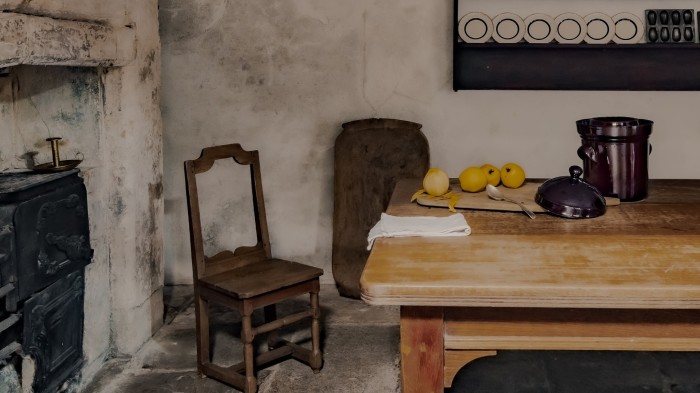
Do you have an air fryer? If the answer is a resounding “no”, you might be part of the backlash gathering momentum against the streamlined, the simplified, the cooking-shy — and convenience food. “We’re in the midst of a sea change,” says Sarah Myerscough, creative director at The New Craftmaker, of the return to the kitchen as “the soul of the home”.
Nowhere is this more keenly felt than among the many who are once again preparing food using centuries-old “slow” processes: fermentation, ageing and preserving. For this cohort, the kitchen pantry has been firmly put back on interiors wishlists, alongside spaces for pickling and preserving. Meanwhile, the pre-industrial tools to meet those needs (which would otherwise have come from antique stores) are returning to the market — sometimes faithful replicas, other times in slick new guises.
Austrian furniture maker Lanserring has embraced the revival with its recently unveiled pickling cabinet and fromagerie cupboard, which can be found in kitchens from Brooklyn and Vienna to the Cotswolds. “We were drawn to the idea of preserving food as a mindful, almost meditative process,” says Lanserring chief executive Bernd Radaschitz. “In a time when everything is so readily available, we wanted to reconnect with preparing and storing food by hand, and without relying on refrigeration.”
The glass-fronted fromagerie cabinet is lined in stone and Himalayan rock salt, which keeps the contents cooler and drier than a wooden cupboard; the pickling cabinet’s open shelving turns jars of preserved foods into display pieces. With a hefty price tag of upwards of £60,000 (depending on finish and materials), they combine historical references with modern detailing and reflect a shift towards kitchen designs that celebrate, rather than hide, ingredients and domestic rituals.
Sweden-based Zakkasine’s hinoki wood food storage cabinets lined in netting (from £249) are modelled on those used in Japan pre-refrigeration. And kitchen maker deVOL has created the Dairy Table, in oak with a marble top (good for working pastry) — inspired by the kitchens at Lanhydrock House in Cornwall (from £9,710).
Antique online marketplace 1stDibs turns up interesting finds — such as a late 19th-century wicker-panelled cheese storage cupboard from Haute-Savoie ($13,600), while the Vintage Fridge Company sources antique insulated wooden ice boxes, reconditioning some with modern fridge motors. They’ve also created their own designs based on early 20th-century Brazilian geladeiras, in hornbeam timber, from £16,950.
“I think we’ve lost some of the hands-on magic that used to be built into everyday life,” says Hannah Neeleman, who sells traditional wooden kitchen tools, enamelware and bread lames (used to score loaves) through her company Ballerina Farm. Now “people want to feel grounded,” she says. A mother of eight, she uses her Instagram account to document her slow way of living at her home in Utah, milking sheep and making cottage cheese and butter. Although the content she creates has been accused of romanticising outdated gender roles, there is a great appetite for it: @ballerinafarm has more than 10mn followers.
1stDibs reports an increase in sales of vintage copper pots and pans, butchers blocks and majolica oyster plates in the past few years. “We have noticed kitchens becoming the setting for both nutritional and emotional sustenance,” says Anthony Barzilay Freund, editorial director at 1stDibs. “Nostalgia for a seemingly simpler time has fuelled this move towards heritage pieces.”
The kitchen of interior designer Patrick Williams of Berdoulat, in an 18th- century building in Bath, “tips its hat to a below stairs atmosphere”, he says of its shiplap-clad walls and freestanding dressers in place of standard kitchen units. “The ubiquitous fitted kitchen is relatively new. Prior to that kitchens would be made up of separate pieces of furniture,” gathered from a range of makers — nothing too co-ordinated.
Williams sources traditional designs from antique shops and contemporary makers for both clients and his shop, which adjoins his home, including wooden egg racks (“a full egg rack is a delight for the eyes”), spice racks, confit jars and creaming bowls designed by Somerset-based ceramicist Matt Pasmore. It plays into “a revival of traditional crafts such as pottery and natural materials, rather than mass-produced items”, says Pasmore.
That said, “I take delight in the packaging of certain brands — like Colman’s, Marmite, Tabasco — and celebrate these classics in the pantry”, says Williams.
“It’s less about nostalgia and more about living well in sync with one’s surroundings,” argues interior designer Elle Kemp of Ridge & Furrow, who is inspired by her grandfather’s workshop. She’s among the designers who have noticed a rise in interest in butter paddles, plate racks and baskets (including a cockle basket by Clare Rivera, inspired by the Penclawdd cockle women from the Gower Peninsula), not as vintage curiosities, but as functional tools.
Kemp is drawn to historic styles because “they were built to last and age into beauty”, she says. In Ridge & Furrow’s own designs — such as a Cotswolds kitchen filled with dark gloss, glass-fronted cabinets, exposed brick and a stone sink — “we leave materials raw, allowing them to age naturally; stains, dents and chips are all part of a living kitchen.”
Merlin Wright, design director at cabinetmaker Plain English, agrees: “Our clients prefer intuitive appliances and joinery that develop character with age and use.” Its designs are “inspired by the ‘below stairs’ joinery of the 18th and 19th centuries, traditional solutions to storage and display”, he says.
“Life moves quickly,” says Neeleman. “There’s something comforting about slowing down and working with your hands. We’re close to our food and land and I think people crave that kind of connection.”
Find out about our latest stories first — follow @ft_houseandhome on Instagram
Read the full article here