

I’m chopping up walnuts to mix with velvety black date syrup and cardamom to make charoset, the sweet, crunchy, sticky spread Jews eat on the first night of Pesach (Passover), which symbolises the cement Jewish slaves used in ancient Egypt. It isn’t just my charoset though; it’s my mother’s, my grandmother’s, my great-grandmother’s and so on, stretching back, probably, to when the first Jews were forcibly deported to Babylon, modern-day Iraq, by Nebuchadnezzar in 597 BCE. If I was Ashkenazi I’d be making it with apples, if I was Egyptian I might use raisins as well as dates, if I was Yemenite I might be adding coriander, cardamom, pepper and sesame seeds, but Iraqis joke that only our charoset is sturdy enough to hold a pyramid together — or at least (because Jews didn’t build the pyramids) a pharaoh’s city. I love it swirled through yoghurt, or just spread on toast.
But it’s Passover, a commemoration of the exodus of Jews from slavery in Egypt, so there is no toast. Only matzah, to remember our ancestors fleeing so fast that they couldn’t let their bread rise. Dry, cardboardy, entirely devoid of flavour, messy — matzah crumbs get everywhere. Moaning about matzah is a tradition in itself. On the festival’s first night, at the seder meal, we are supposed to feel like we ourselves were slaves in Egypt. A recipe for generational trauma, maybe, but when I take my first bite of matzah I do connect with my ancestors who must have sat down to their first meal of freedom, tasted their unrisen bread and groaned. What’s freedom if not the luxury of being safe enough to sit down and criticise your own cooking, and then to pass the grumbling on l’dor vador, from generation to generation? They passed on something else too: creativity driven by constraint. Just as they had to improvise bread they could carry, so Passover’s restrictions have inspired Jews all over the world to wild culinary ingenuity.
Michael Chabon captures some of this in his novel Wonder Boys when his stoned writer anti-hero goes to a Passover seder and admires “the fakery and slyness that went into preparing the food, the way the ubiquitous ‘bread of affliction’ was magically transformed . . . into something manifold and rich”. The best things on Chabon’s fictional Passover table are “tasty little hollow puffs of matzoh-meal artifice, at once crusty and moist, called bagelach”. Or Passover bagels. Which sounds oxymoronic but they are essentially choux buns — and very good.
But Chabon also describes the family gamely forcing down a potato kugel that tastes like “paste”. The OG kugel is lokshen kugel — a casserole of noodles baked in sweet or savoury custard — but at Passover noodles are out, so countless cooks have tinkered with the recipe, using grated potato instead. Or broccoli and cheese; apples and raisins; pineapple and cranberries; spinach and asparagus. The savoury, more peppery kugels were traditionally more common in Lithuania and Russia, while Hungarian and Polish Jews went for sweeter versions, as did American Jews, whose kugel innovations have included using maraschino cherries and topping with smashed cornflakes.
Some Hasidic Jews even credit it with magic powers, saying it grants health, and helps couples to conceive. You can even make it with matzah but I won’t be rushing to do that this Passover (or any other), or to make lasagne with sheets of matzah instead of pasta, or matzah pizza, matzah nachos or matzah tiramisu, called (of course) matzomasu or tiramatzu, but I admire the spirit of adventure of the hungry cooks who invented them.
Like Chabon’s kugel-maker, though, I will turn to potato. Kubba (like kibbeh or kofte but Iraqi) are usually encased in bulgar but at Passover instead we eat kubba poteta or poteta chap, where the spiced minced beef is wrapped in mashed potato bound with egg, then fried. I could eat it any time. I also don’t wait for Passover to make another Iraqi Jewish speciality, masafan (chewy almond macaroons, also known as hajibada), just almonds, sugar, egg whites, cardamom (again) and orange flower water, shaped into stars, a slivered pistachio sunk into each one, and baked until pale gold. Cherished or hated, the recipes roll round again each year, greeted with nostalgia and oh God, not that again, along with a vague suspicion that we only like them because we are suffering from Stockholm syndrome, imprisoned by Passover’s rules.
The resourcefulness and creativity of the Passover repertoire gives the lie to the idea that there is no such thing as Jewish food, that Jews just cooked the cuisine of wherever we lived. Some communities, like mine, spent thousands of years cooking and eating in one place, and my many-times-great-grandmothers would absolutely scorn the suggestion that they didn’t contribute to a single dish. Especially when they had to remix recipes to work around the laws of kashrut, shabbat and, most maddening and stringent of all, Passover, which doesn’t just outlaw bread and noodles but anything leavened or fermented. No pasta. No beer. No biscuits or cakes unless they are made in accordance with the rules. No porridge. No whiskey.
Passover is also where the Jewish world diverges; as an Iraqi Jew, I follow the Sephardi traditions developed by rabbis in medieval Spain and Portugal. Which means, as the first boy I ever kissed said, “You get to eat rice!” His family came from Europe so followed the Ashkenazi tradition, avoiding not just rice but beans, pulses, corn and seeds. No wonder he was aggrieved. Because we can, Sephardi Jews go big on rice. We grind it for the shells of deep-fried kubba halab (which literally means Aleppo kubba so who knows what journeys it has made), and for kubba shwandar, we simmer kubba coated in rice and pounded meat in sauce with beetroot that stains them ruby red. We stud rice with broad beans and dill; I make double so I can fry an egg over the leftovers. Some communities (including mine) traditionally hit each other with green branches at Passover and wish each other “santak khathra!” (Judeo-Iraqi Arabic for “have a green year!”), which might be why so many Passover recipes are so verdant, from Iraqi mfarka (a dish of onions, eggs and greens) to Persian kuku sabzi, frittatas emerald with spinach, leeks, spring onions, parsley and dill.
I first tried the iconic Ashkenazi dish matzo brei at an artists’ colony in New Hampshire, made by a homesick novelist. Literally matzah porridge in Yiddish, it’s chunks of matzah mixed with beaten egg and milk then fried. Passover French toast. I’ve always found the other Ashkenazi classic, gefilte fish — cold poached fish balls — a bit spooky and alien, and predictably prefer the Sephardic version where the balls are rolled in matzo meal and fried. But I love that in medieval eastern Europe, gefilte was also popular with Christians during Lent. I imagine these home cooks, who were usually divided by ferocious antisemitism, sharing recipes because they wanted something delicious under duress — even if what they landed on was deboned pike.
The scattering of Jews all over the world, and the different rules, makes the range of recipes dazzling. Why so many? Passover only lasts eight days (seven in Israel). You’d think we could just eat matzah and be done with it. But no. Go online or open Claudia Roden’s masterpiece, The Book of Jewish Food, crammed with 800-odd recipes and stories collected from Jewish communities across the globe, and you can find: Danish apple and almond macaroons; Moroccan lamb tagines with prunes or dates; eastern European chremslach or bubeleh, pancakes made of matzo meal and flavoured with cinnamon, raisins and brandy; matzo meal fritters, fried and dipped into honeyed, lemony syrup, called sfereet in Algeria and friteches in Tunisia.
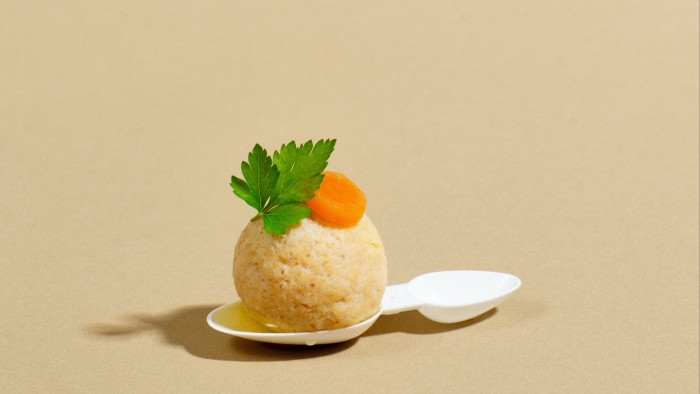
Tunisian Jews also make m’soki, a beef or lamb stew spiked with harissa and packed with fistfuls of fresh herbs. Balkan Jews make kifteke de prasa, patties made of leeks, beef or chicken, and, yes, matzo meal and eggs. And Jews all over the Sephardic world make minas, pies made with strata of softened matzah sheets, the top layer glazed with egg, and, perhaps, egg and spinach, or lamb and leeks. Georgian Jews put egg-and-walnut dumplings in their chicken soups instead of noodles, while eastern European Jews make matzo balls called kneidlach. The Black American food writer Michael Twitty serves kneidlach in a tangy horseradish and lemon West African yassa sauce usually used for chicken.
Many recipes taste of epic, difficult, hopeful journeys. Take the cakes, which all require a lot of eggs. Really, an implausible quantity of eggs. When the Inquisition sent Spanish Jews fleeing to Turkey, their moist, puddingy orange and almond cakes morphed into tishpishti, switching the almonds for walnuts and drenching the cake, hot, in a syrup of sugar, cinnamon, lemon juice and rosewater. More Inquisition refugees brought fish and chips to these islands and even more wound up in Central America trading cacao, inspiring many, many nut-and-chocolate cakes. Roden traces a recipe for torta di mandorle e cioccolata back to the Jewish ghetto in Rome, a community that also had the brainwave of frying artichokes that in Italy are still known as carciofi alla Giudia (Jewish-style artichokes). My own family’s food is defined by the journeys we have made. My father went to Israel in 1951 as part of the mass airlift of Iraqi Jews, and moved to London in the 1960s. My mother was stuck in Iraq — at one point literally in prison — and made it over here in 1971.
As the old joke goes, you can boil all Jewish festivals down to the formula “They tried to kill us. We survived. Let’s eat.” It’s not funny really, that rush from existential terror to stuffing your face, with no clue about how to survive if (my neurotic heart says when) the danger comes again. But recently I’ve started thinking “let’s eat” is the survival strategy. Food is what literally sustains you and “let’s” means you have to eat with family or friends, to resist the darkness collectively, to pass on generational healing instead of trauma. Or at least — let’s not be too optimistic here! — along with trauma.
Maybe Passover’s culinary creativity is another crucial coping mechanism, perhaps even a coping and hoping mechanism, a reminder that you can find silver linings in tough times, that you can imagine your way out of narrowness and unfreedom to pleasure, to nurture and, yes, if you must, to matzomasu.
Samantha Ellis is the author of “Chopping Onions on My Heart: On Losing and Preserving Culture”, published by Chatto & Windus
Find out about our latest stories first — follow FT Weekend Magazine on X and FT Weekend on Instagram
Read the full article here