

Unlock the Editor’s Digest for free
Roula Khalaf, Editor of the FT, selects her favourite stories in this weekly newsletter.
Across the latter part of her career, American composer Pauline Oliveros developed the term “deep listening” to describe a deliberate, heightened attention to sound that we can cultivate to help us connect more deeply with others, with nature and — perhaps most importantly — with ourselves. We are beings shaped by sound, she reasoned. It envelopes our bodies, even passes through us as vibrations. Sound is how we first communicate our needs as babies, and hearing is thought to be the last sense we lose before we die. For all this, we pay the auditory realm remarkably little attention — people consistently rank vision as by far their most important sense.
In an age when the loudest voices usually win, where the blaring noises of urban life compete so forcefully for our attention that we seal ourselves away in AirPod bubbles, to take a note from Oliveros and truly stay quiet, focusing just on listening, might be considered a radical act.
This idea is at the forefront of the Barbican’s new summer exhibition Feel the Sound, where the first installation recalls Oliveros’s deep listening principles. The 12 silver speakers of Miyu Hosoi’s “Observatory Station” line the entrance, playing an ever-shifting tapestry of field recordings from dozens of locations across the world. You might catch birdsong, a train rattling by or indistinct chatter from a restaurant in California, Cameroon or Shanghai. These are intimate windows into the lives of others, communicated not through what they see, but what they hear.
Each of the exhibition’s 11 installations invites visitors, often playfully, to meditate on the role of sound in their lives. Entering through a black portal that simulates the texture of a speaker cone, you first encounter Evan Ifekoya’s “Resonant Frequencies”. A rust-coloured bench beneath a canopy of hanging gourds encloses a pool of water whose rippling surface makes visible the bass vibrations of the accompanying ambient soundscape. An artist described as a “dream architect” might provoke scepticism, but feeling the deep waves of bass in your bones and belly connects you to the undeniable physicality of sound.
This same idea is picked up in Jan St Werner’s “Vibraceptional Plate”, a composition made only of vibrations experienced while standing on a rumbling platform. Both works remind us that listening is conducted with the entire body, that our atoms vibrate in tandem with the world around us, and nod to the interconnectedness of all things.
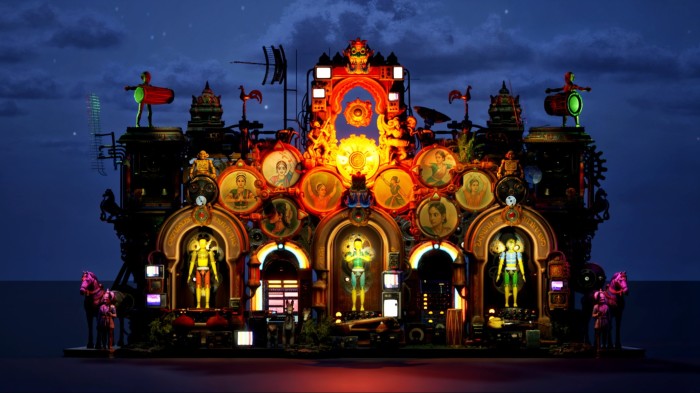
Some of the most memorable works here invite visitors to join in the music-making themselves. The interactive wall installation “Resonance Continuum”, by the collective Elsewhere in India, is a giddy lark that invites visitors to perform different poses from classical Indian dance to trigger musical instruments in an evolving soundtrack. Further on, the exhibition’s standout is “UN/BOUND” by Trans Voices, Ilā and Monom, which takes the form of an ethereal choral suite playing loudly in a dark room. Visitors can contribute using microphones that smartly tune your voice so that your warblings become an organic part of the wider soundtrack. As well as the undeniable pleasure of making music with others, there is something powerful about letting your voice melt into a greater harmony.
The focus here is squarely on sound as a felt experience rather than a scientific phenomenon, yet several pieces invoke challenging questions about the role of sound in contemporary life. “Sensing Streams” represents the electromagnetic waves that are unseen but always filling the air around us, pairing the late Japanese composer Ryuichi Sakamoto’s itchy, jangling soundscape with Daito Manabe’s austere but beautiful geometric visualisations. “Holly+” is a project by the future-facing musician and theorist Holly Herndon, who created a synthetic instrument of her own voice which anyone can use. Here it is tooled for a rendition of Dolly Parton’s “Jolene”, the chorus about a lover being stolen away wryly referencing concerns over creative authorship in the age of AI, as if to say: “I’m begging of you, please don’t take my IP.”
Feel the Sound also incorporates the Barbican’s car park in an exhibition for the first time, capitalising on the space’s industrial aesthetic and reverberant acoustics. Walking into “Reflections of Being”, an audiovisual piece by electronic musician Max Cooper, feels like entering a rave as coruscating synths and deep bass are paired with flashing images of cities, crowds and what looks like molecular biology — the whole tapestry of humanity morphing and warping before your eyes. There is a grandiose concept behind the project which is not wholly convincing, but when the soundtrack soars — nakedly emotional, unabashedly epic — it is difficult to remain unmoved by the power of music.
The exhibition contains a variety of diverting installations, but the scattershot breadth of the works means it lacks a clear point of view. Some of the pieces feel gimmicky, such as instruments that can be played using magnets, pedals or phone torches, and a particularly mystifying contraption that involves pulling a hanging orb to activate instruments that also somehow respond to a culture of fermenting kombucha with a microphone inside — an unlikely musical collaborator. The show opts to prioritise sensation over deep insight, but this makes sense within the context of the Barbican’s broader push to attract new demographics to its events. Feel the Sound is the centrepiece of a season that includes the history of London’s pirate radio scene and the acid house VR documentary In Pursuit of Repetitive Beats.
Perhaps there are no profound revelations here about the role of sound in our lives, but this is an entertaining, joyful and occasionally arresting show. The final installation in the car park is “Joyride” by Temporary Pleasure, in which four salvaged cars have their boots filled with speakers pointed towards a central, implied dancefloor. They pump out a soundtrack of stylish club music, the cars’ brake lights illuminating in perfect synchrony, closing the exhibition by emphasising how easily sound can bring people together, facilitating human connections and dancefloor transcendence as bodies become conduits for the beat. Then you emerge blinking into the Barbican courtyard and hear the burbling water of the brutalist fountains, the murmuring of conversation, a stray sneeze. Every sound takes on a little more meaning. It might not be deep listening, but it’s certainly a little deeper.
To August 31, barbican.org.uk
Read the full article here