

Unlock the Editor’s Digest for free
Roula Khalaf, Editor of the FT, selects her favourite stories in this weekly newsletter.
“Pattern can be lost on chairs or curtains, but the headboard is a canvas,” says Kit Kemp. “It’s where you can experiment.” For the designer and founder of Firmdale Hotels, the embellished, supersized bedstead has become a leitmotif of her interiors. The higher the ceiling, the taller the headboard. Upholstered in linen or hand-dyed fabric, appliquéd or embroidered with a whimsical moon or heraldic beast, “it becomes performative, a decoy focal point,” she says.
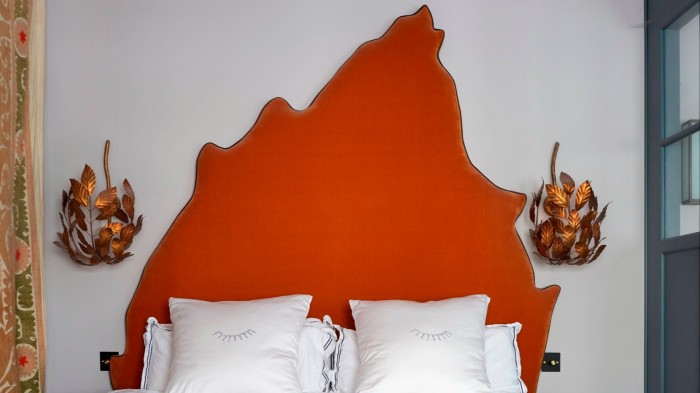
Bold designs are making a return to design-conscious bedrooms — from the sculptural, red velvet flame of a headboard that interior designer Rachel Chudley dreamt up for a client’s New York home, to artist Charlotte Colbert’s surreal wrought-iron versions: a mix of Salvador Dalí and Alice in Wonderland.
The headboard has not always been a wallflower. History abounds with extravagant and enchanting examples. Beauty magnate Helena Rubinstein held meetings in her bed, backed by illuminated Lucite. Art patron Peggy Guggenheim slumbered under an Alexander Calder wall-scape of silver fish and plant life. And while fashion designer Pierre Cardin took his sci-fi aesthetic to his bed with a chrome-trimmed surround, Mae West reclined on a gilded bed shaped like a swan.
Elisabetta Bolzan aims to recapture that spirit of creative largesse. The founder of the eponymous Italian furniture maker recently launched a collection of bedheads by prominent creatives. There’s one by Italian designer Martino Gamper — a triptych-like design, with hinged side panels of elm and walnut evoking what he calls “a threshold between sleep and wakefulness”; another, by Iranian-French architect India Mahdavi, is a poetic rectangle of velvet topped with a ceramic cylinder whose vividly coloured sections are inspired by rosary beads. All are conversation starters.
“Italy has a long tradition of beautiful bed making,” says Bolzan. Postwar mass production changed things. “Designs became standardised and simple. We want to escape those restraints: to take risks, have fun.”
The family-run business began in her parent’s garage in 1990. Bolzan made the wooden frames; her mother, a tailor, did the upholstery. Now they collaborate with local artisans — leather-workers, weavers, joiners — on pieces for architects and interior designers. The new bedheads echo that craft-led approach; starting at around €6,500, this is the headboard as collectible design rather than a piece of upholstery.
The timing feels right, says Bolzan. In our sleep-obsessed age those with deep enough pockets can spend thousands in pursuit of Hypnos’s embrace — from handmade mattresses to cashmere-filled duvets. The headboard is an aesthetic addition to the bedroom as sanctuary.
“It doesn’t have to be a monolithic slab,” says textile designer Christine Van Der Hurd. “It’s where you should begin when you design a room — adding layers around it.” She fell for the “romance of beds” at an early age. Her father was an antiques dealer and her parents’ bed — a scrolled neo-Venetian design adorned with whimsical painted flowers — looms large in her imagination. So, too, does Van Der Hurd’s own art deco, silver-leaf bed, which she bought from a New York antiques dealer. An artwork in itself, the flamboyant contours are decorated with a painting of a cubist-esque nude.
For the art-collecting owners of a Brooklyn brownstone, Van Der Hurd designed a bedroom in which both the bedhead and the fabric-lined walls are embroidered in an intricate pattern of abstracted floral motifs. The silk stitches appear to drift across the surfaces, enveloping the room with mesmerising detail.
The Elizabethans excelled at this kind of boudoir opulence. In the 1500s, advances in upholstery led to increasingly sophisticated designs lined in damask and festooned with silk trimmings. The towering headboard designs signalled wealth and status.
These “beds with ego” were the catalyst for textile artist Natasha Hulse’s one-off headboards. “There’s scope to personalise a design in a way you can’t do with a table — or armchair,” she says. Her medium is appliqué; each cut-out motif is delicately hand painted, customised to capture the owner’s “narrative” — be it a favourite view or treasured animal. “There’s something symbolic and sacred about having a garden of flowers watching over you,” she says. “I think of the headboards as guarding people in their sleep.”
For Chudley, discovering the flamboyant velvet-lined beds at Hardwick Hall in Derbyshire led to her “tester with a twist” at her own London home. The headboard, clad in a geometric velvet, is a punchy contrast to the panels of “chintzy Victorian-inspired” floral fabric draped across the ceiling and walls. The combination has a postmodern feel — both familiar and unexpected — which makes Chudley’s work so recognisable. “I love drama and narrative,” she says. “Creative bedheads really play into this.”
Artist and filmmaker Charlotte Colbert takes things into the realm of the surreal with her new collection of London-made wrought-iron beds. The finial-topped Victorian-style bedsteads incorporate the playful motifs — eyes, lips, hearts, drawn from myths and fairy tales — which characterise her metal sculptures. Colbert, who is fascinated by Jungian theories of the subconscious, describes them as “portals to night travelling” — and a riposte to the “banality of so much modern design”. Beds to dream in — and about.
Find out about our latest stories first — follow @ft_houseandhome on Instagram
Read the full article here