

Unlock the Editor’s Digest for free
Roula Khalaf, Editor of the FT, selects her favourite stories in this weekly newsletter.
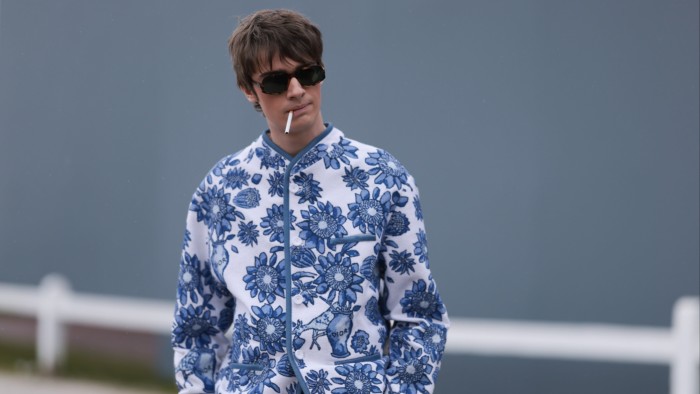
Florals for spring. On workwear. Worn by men. Maybe not groundbreaking, but the visual tension makes for something pretty nice. And when you squint at a dark blue abstracted peony print on a classic French labourer’s jacket from Liberty, aren’t you just looking at a twist on camouflage?
A new 14-piece Paul Smith collaboration with denim brand Lee includes a matching indigo jacquard pair of tapered trousers and collarless chore jacket, covered with pansies (£180 for the trousers, £250 for the jacket, paulsmith.com). The pattern appears to have been worn away entirely in certain patches, but doesn’t read as faux, or pre-distressed. It’s strong but dark, reminiscent of Warhol’s more sombre silkscreen series, and offset with brass buttons.
You could wear the look gardening, or to work behind the bar at St John, or to dinner at the same restaurant. It’s modernist rather than William Morris. “Many people know Paul Smith for our use of colour and print,” says the designer. “Using a print of British pansies felt removed from the world of workwear. Each floral piece has a film-like quality, almost like a negative. And they will develop and age as they are worn, just like their classic denim relatives.”
Petals on menswear were used for decades as something subversive (the flower power of the late ’60s), or ironic. They would appear in suit linings or on ties — as if too potent to be seen fully blown, in bloom. One might be reminded of Oscar Wilde’s green carnation buttonholes, which began as Parisian street code for gay men to recognise one another in the 1890s, but that’s not what makes florals on men in any way arresting. It’s nuanced. It’s less about phobias around sexual orientation, more about notions of masculinity. As with sex and gender, the two things are distinct.
Florals weren’t always seen as risky for men, although they were rarely embraced. “They weren’t gendered as feminine within fashion until the 19th century,” explains historian and curator Amy De La Haye, author of The Rose in Fashion: Ravishing. “But they were never popular for male occupational dress. And today’s vogue for flower patterns in workwear draws on that tension. They aren’t very ‘flowery’, they are in muted colours redolent of military uniform.”
At Bode, Etro and Dries Van Noten, florals have dominated for years and on the whole have been unabashedly “flowery”. But they have become the starting point for a shift to workwear. For the current season, also his last collection at his own label, Van Noten sent out typically floaty silk-satin cargo trousers and silk-twill short-sleeved shirts, but also action-oriented padded organza jackets with a high-tech sheen on the florals. At Chateau Orlando (the clothing and homewares label led by FT columnist Luke Edward Hall) this season, a snowdrop emblem appears not only on a knitted polo cardigan (£247, chateauorlando.com) but also, more surprisingly, on the bicep of a double-breasted denim blazer (£566, chateauorlando.com).
At Japanese label Kapital, men’s shirts include trad Hawaiian styles with wide-open camp collar (£410, mrporter.com). That specific kind of casual shirt, along with the high-fashion decadence of Dries, has always been an opportunity for men to shift into spring and summer holiday mode.
And there’s a clear line from them to modern workwear florals. Edinburgh-based menswear designer Kestin Hare has been collecting vintage Hawaiian shirts for years. “I picked up some amazing ones from trawling the Rose Bowl flea market in LA recently,” he says. “The Kestin brand is known for prints and many of our customers like to collect new versions every season. For this spring, we depicted some rare wildflowers from the Flow Country in Sutherland. I’d never seen some of these before I started researching the area. I always love finding out new things about my home country.”
The Kestin Ormiston carpenter jacket comes in a pleasingly textured chenille fabric (£269, kestin.co). “It’s the combination of texture and pattern that makes it most interesting,” says Hare. His florals are graphically strong but rendered in the kind of dark tones you get with Madder silk (which has its roots, pardon the pun, in the natural red dye of the plant of the same name, and rose to popularity in the 17th century, when it dominated industrial textile production in Norwich). For spring, there’s a light olive and a navy version of the Ormiston. Both look muted but rich. It’s an earthy opulence.
Other British brands thrive on workwear florals. Our Legacy’s Mount cargo pants and Uniform jackets come in what they describe as a Spotting Rose print (£400 for the trousers, £440 for the jacket, ourlegacy.com). There’s enough spacing in the illustration to make it look like desert camouflage, in contrasting greens and a colour reminiscent of bloodstained cotton. War of the roses, if you will. Meanwhile, the Chore jacket at Liberty has been coming in different florals from the brand’s print archive since 2023.
There’s something about a Liberty version of anything that always feels fresh. The current season’s Jungle Voyage Chore jacket uses a version of the mid-19th century Adelphi Voyage print, depicting a lush, Rousseau-like tropical rainforest (£295, liberty.co.uk). The Promenade Dance Chore jacket adapts the Liberty Peony Promenade print, originally produced for silk scarves in the 1960s (£295, liberty.co.uk). The 2025 twist is still obviously a floral, but the pattern has been zoomed in to the point that it truly transforms into pure camouflage. A dark red version of Maud’s Posy, an art nouveau-style print first rendered in the 1980s, is back in store from June.
One of the beauties of floral workwear is that it’s so easy to wear. It’s as simple as opting for all black and trying to vanish, but so much more interesting. It adds spirit to an outfit, without making you stand out like a sore green thumb. It’s fancy, but only slightly. It has a light touch of English eccentricity, and crucially, unlike many menswear trends, flatters men who look old enough to have inherited an allotment.
Follow us on Instagram and sign up for Fashion Matters, your weekly newsletter about the fashion industry
Read the full article here