

Unlock the Editor’s Digest for free
Roula Khalaf, Editor of the FT, selects her favourite stories in this weekly newsletter.
In Fox, the latest novel by Joyce Carol Oates, the prolific octogenarian author places a predator in a henhouse and lets the feathers fly. Her titular protagonist, Francis Harlan Fox, is an English teacher in an elite private boarding school in New Jersey. In his late thirties (apparently), charming (by design), a poet (he insists), Fox turns out to be as much a fabrication as the Edgar Allan Poe stories with which he enthrals his prepubescent pupils.
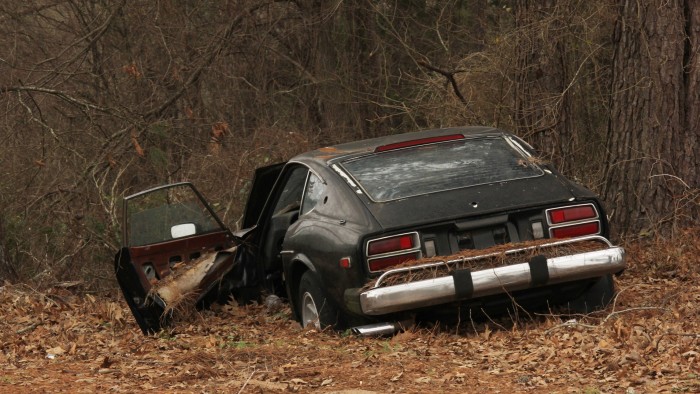
The novel opens in winter 2013 with a dog discovering a human tongue in the wetlands of South Jersey. Two days later bodily remains are found next to the wreck of a car in a nearby ravine. The vehicle is registered to Fox — a much-admired new faculty member at Langhorne Academy in the small town of Wieland — but the body takes longer to identify: there has been considerable interference from animals.
Dental records reveal that Francis Fox is in fact 40-something Frank Farrell, who a decade earlier narrowly avoided charges of child abuse while teaching in another school. A sharp lawyer and a name change wiped his slate clean. But in Wieland, detective Horace Zwender discovers that Fox has groomed several girls at Langhorne, turning what was thought to be an accidental death or suicide into a homicide case with a long list of suspects.
Fox, conjured up in flashbacks, only half materialises as a character. He’s Freddy Krueger in preppy shirts, a smooth-talking bogeyman. While Oates details his methodology, his psychology remains opaque. Fox simply refuses to accept that his actions are crimes: “How is it the fault of the flammable material that the match ignites it? It is not.”
Far more tangible is detective Zwender, a hot-headed Buddhist who is as likely to throw a punch as he is pause in reflection. Prone to observations such as “charisma is just another word for bullshit”, he is aided by officer Odom, who has a “sulky mouth” and a forehead that “oozes sweat like the tears of a mollusc”. Both are well-honed figures, “from South Jersey families in which police officers, prison guards, and individuals with criminal records are frequent”. Fox’s victims are similarly believable in their misplaced adoration of their teacher, confusion about the twisted teacher-pupil relationship and slide towards trauma.
Oates explores many of her regular themes, not least the obfuscating mythology permeating American popular history. Her previous books have delved into murky theories about Marilyn Monroe, Jeffrey Dahmer and Ted Kennedy. Fox includes a curious subplot about a local family’s involvement in the Hindenburg disaster.
Oates views the US through a gothic prism, forming images as striking as they are disturbing. Even roadkill has its elegance: “Often in South Jersey you see at the side of country roads the curved rib cage of an animal, skull and large bones remaining,” she writes. “Startling beauty in the grace of a white-tailed deer even in death.”
But for all of its impressive flourishes — the pungent atmosphere, the Hitchcock-worthy bit-part players — Fox is hampered by two fundamental problems. At 650 pages, the novel is twice as long as it needs to be. It’s possible that at this point in Oates’s career — with more than 50 novels and numerous story collections to her name — the cap stays on the editor’s red pen. But the repetition of phrases, clues and red herrings tires. As do the superfluous narrative detours: we are given, at length, the “electric-alert” perspective of the terrier chewing away at Fox’s “human-meat” tongue.
The second problem is the story’s prurient delivery. Oates likes to shock. Her last novel, Butcher — about a surgeon in a 19th-century asylum — caused Stephen King to warn readers that it wasn’t for the faint of heart. Here, Oates lingers on the grooming and abuse of the girls to an unnecessary degree. If her intent is to discomfort the reader, she succeeds.
With moments of effective and chilling drama, Fox fits into the sub-genre of “dark academia” sparked by Donna Tartt’s The Secret History some three decades ago. It’s a milieu Oates understands: she has taught at Princeton and Berkeley for most of her adult life. In her sour depiction of Langhorne Academy, the author revels in the petty jealousies, self-satisfied charlatans and arcane value systems loitering in the quads, classrooms and trustee meetings. She even allows herself a meta cameo as a creative writing professor. Perhaps the wiliest fox is Oates herself.
Fox by Joyce Carol Oates, 4th Estate £18.99/Hogarth $32, 672 pages
Join our online book group on Facebook at FT Books Café and follow FT Weekend on Instagram, Bluesky and X
Read the full article here