
Garsington Opera opens its summer festival with distinctively different productions — review

Unlock the Editor’s Digest for free
Roula Khalaf, Editor of the FT, selects her favourite stories in this weekly newsletter.
For the past 14 years, since it was ousted from its original site, Garsington Opera has been based at the Getty estate at Wormsley in Buckinghamshire. Nestled in the Chiltern Hills, with formal gardens and a full-scale cricket pitch, it has proved the ideal venue for an upmarket summer opera festival.
This year Garsington Opera really feels at home. Garsington Studios, the festival’s new cultural hub, has enjoyed its first full season of operations. Commercial events and the education programme are under way and a winter season of concerts will be announced soon. All four of this summer’s operas — new productions of Tchaikovsky’s The Queen of Spades, Donizetti’s L’elisir d’amore and Handel’s Rodelinda, plus a revival of Beethoven’s Fidelio — are being rehearsed there.
The Tchaikovsky and Donizetti, which are up first, give Garsington audiences a very distinct choice. For The Queen of Spades, surely one of the greatest of romantic operas, director Jack Furness has opted out of realism. Giant mirrors in golden frames are moved around the stage, their reflections suggesting hallucinations in a troubled mind. Idyllic pictures of Russian imperial life, including the pastoral intermezzo “The Faithful Shepherdess”, slide in and out of view.
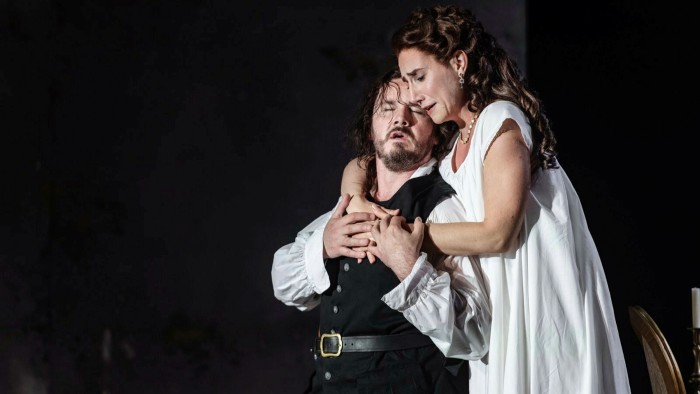
Within this framework Tchaikovsky’s brooding, melancholy masterpiece about an obsessive gambler comes chillingly to life. For once, it is easy to feel the intense connection that draws Lisa fatefully into Herman’s orbit and by the end of the love duet — Tchaikovsky turns up the heat to white-hot passion — he is fairly ripping the clothes off her. How subtly, too, the eerie scene between Herman and the old Countess plays out, as we sense the diabolical bond of the winning card trick that will lead them both to their deaths.
The haunting strings that pervade that scene sink deep into the consciousness and conductor Douglas Boyd, Garsington Opera’s artistic director, captures their nervy anxiety to perfection. Having the Philharmonia Orchestra at Garsington has been a quantum leap, paying dividends in a big romantic score like The Queen of Spades.
A very decent cast is led by Aaron Cawley, who has the vocal heft for Herman, though a lack of flexibility in the voice led to some uncomfortable moments. Laura Wilde is well cast as Lisa, at once lyrical and burgeoning with dramatic intensity. Roderick Williams sang with subtlety as Prince Yeletsky; Stephanie Wake-Edwards was a vivid Polina; and it was good to see Diana Montague back on the stage as the aged Countess, holding the audience, as well as Herman, spellbound. The choruses, adults and children alike, were on fine form. Even the weather played its part, suddenly flooding the theatre with a blaze of evening sunshine at the moment when Catherine the Great makes her imperial entrance.
★★★★☆
The production of L’elisir d’amore lies at the opposite pole. The wide-angle, picture-postcard set of an Italian piazza, filled with pots of flowers, shows what Garsington can create in its studios and sets the scene for a charming comedy of real-life naturalness.
All director Christopher Luscombe misses are those touches of individuality that would make it funnier, sharper, more touching. Richard Burkhard makes a suave Dulcamara, though the quack doctor might have a bit more edge to him. Madison Leonard is a pleasing, not at all spiteful Adina, though the voice is missing an Italianate gleam, and Carles Pachon makes a sturdy Belcore. The star of the evening, though, is the well-sung, bright-eyed Nemorino of Oleksiy Palchykov, a bubbly young fellow who deserves to walk off with the opera. The Philharmonia Orchestra plays and Chloe Rooke conducts a sparkling performance.
★★★☆☆
‘The Queen of Spades’ to July 4, ‘L’elisir d’amore’ to July 21, garsingtonopera.org
Read the full article here