

Fifty-five years after it started and with a strong claim to be the world’s foremost music festival, Glastonbury is unfussed by its contradictions. Complaints that the countercultural spirit of old has been betrayed by mainstream acts and wealthy festival-goers are akin to mosquitoes buzzing around an elephant.
The sprawling site in the green and pleasant hills of Somerset contains multitudes: 210,000 to be precise. Among them, in separate parts of a backstage bar on a sunny Thursday evening — not in conversation, alas — were Samantha Cameron, wife of former Conservative UK prime minister David Cameron, and the rappers from Kneecap. The Irish provocateurs’ participation at the festival had been condemned by the current occupant of Number 10, Keir Starmer as “not appropriate” following a court appearance by one of them, Mo Chara, on a terrorism charge. The PM’s objections were brushed aside as easily as the ones others would make about the presence of Tory grandees at Glastonbury.
Kneecap’s set, scheduled for Saturday afternoon, was the most anticipated of the festival’s three day line-up, overshadowing the headliners, The 1975, Neil Young and Olivia Rodrigo. More on that later — but first there was the sight of a surprise act, Lorde, having an identity crisis in the Woodsies tent as the festival got under way on Friday morning.
Confusion about the meaning of life is not uncommon at music festivals, as another of this year’s unannounced acts, Pulp, observed in their classic anthem of rural raving, “Sorted for E’s and Wizz”. But Lorde’s breakdown — or “breakdown” — took place at 11.30am, in contrast to the chemically fuelled nocturnal disorientation of Pulp’s 1995 song.
The New Zealander’s appearance was an ill-kept secret. Queues for the 12,000-capacity tent had formed an hour and a half beforehand, baked by the warm sun that has beaten down over this year’s festival. Wearing an all-white ensemble of T-shirt and cargo pants, a star’s sartorial flex in the dust and grime, she played her self-conflicted new album Virgin in full. The music brooded and convulsed as she sang about ego death and rebirth — all intense looks, dramatically intoned vocals and wild flurries of dancing. “I’m an actress,” she sang at one point, and true: this was a striking display of theatrics.
Compared with some of Glastonbury’s surprise acts, where fevered speculation about the impending arrival of an A-lister is quashed by the unremarkable appearance of a mid-market indie band, Lorde was the real deal. But the sense of occasion that she brought to the opening of the festival was not matched by the rest of Friday. The sun, guarantor of good times, was the day’s main star.
On the Pyramid stage, the festival’s biggest performing space with a maximum crowd capacity of 120,000, Irish singer CMAT put on an entertaining early-afternoon show. Clearly relishing the chance to perform before a large audience, endearingly so, she and her band played quirky indie-pop with Irish fiddle and country steel guitar that shaded at times into being a little too quirky.
Another surprise act turned up in the afternoon: Lewis Capaldi, also on the Pyramid stage, playing his first gig in two years after a break for his mental health. I missed the mass-market Scottish belter, however, having chosen to take in Faye Webster’s understated songs at the Park stage high up on the edge of the site. The US singer-songwriter murmured at the microphone while the music burbled in a mellow indie way.
“What’s up, Glaston-berry?” she asked mildly at one point, employing the lilting American pronunciation. A much more stentorian version of the same rang out at the West Holts stage. It was 1990s girl group En Vogue treating Glaston-berry to highly honed renditions of hits such as “Free Your Mind”. Alanis Morissette was another nostalgic draw, performing to a large crowd at the Pyramid Stage. She too sang powerfully — one of the great rock vocalists, a Gen X Janis Joplin — but the likes of “You Oughta Know” sounded stodgier than their recorded versions.
Friday’s headliners were The 1975. The UK band played a slick set of songs that transplanted rock’s disruptive energy into polished synth-pop and pop-funk. They were led by the artfully dishevelled Matty Healy, who swigged from a pint of stout, smoked lots of cigarettes and was full of nervous tics such as rubbing his head. His self-conscious approach to being a frontman didn’t quite work in the setting of the Pyramid stage. Reiterations of how overwhelmed he was by the import of the event made him seem more preoccupied with Glastonbury’s meaning for The 1975 than their show’s meaning for the audience.
At one point, Healy spoke of avoiding politics in favour of love and friendship. This milksop phrasemaking was overturned on Saturday, when the festival really came alive. Politics came to the fore. “Free Palestine” was the rallying cry, uttered by UK punk-rap duo Bob Vylan in a storming early-afternoon set on the West Holts stage, during which they upped the stakes with a highly provocative chant of “Death to the IDF”. (Protests duly followed from politicians and the Israeli embassy.)
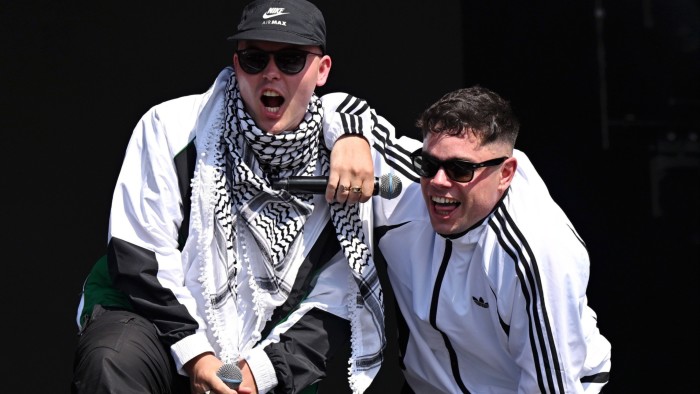
They were followed by Kneecap on the same stage. DJ Próvaí made no allowance for the heat in his customary Irish tricolour balaclava. Nor did the keffiyeh scarf that Mo Chara had wrapped around his neck. He was charged earlier this month for expressing support for Hizbollah, a proscribed organisation in the UK. Many Palestinian flags waved as the trio tore through their Irish-English bilingual songs. The stage, with a capacity of 30,000, had been closed to prevent overcrowding. The music was interspersed with pro-Palestine chants and crude anti-Keir Starmer ones — a karmic reversal of the Corbyn-mania that gripped the festival when former Labour party leader Jeremy Corbyn visited in 2017.
Amid the gunpowder-like odour of smoke flares being let off in the audience, their blistering set ended with a frenzied response to new song “The Recap”. Its impact showed how much succour Kneecap have drawn from the overdone hostility of British officialdom. It has had the effect of turning a group that used to have a cartoonish aspect into a honed rap-battle outfit whose impact is almost reminiscent of Public Enemy circa 1989.
Spattered by fake blood sprayed by an activist (showing a typical ability to alienate people from their cause), I went to the Pyramid stage for another highlight — a surprise show by the reunited Pulp. Jarvis Cocker led the band with dry wit and impassioned yelps. He and his bandmates were in irresistible form. The closing number, “Common People”, the best dissection of class in British rock, had the feel of an alternative national anthem amid the waving flags, flares and singalongs.
Pulp first performed opening number “Sorted for E’s and Wizz” as stand-ins for the Stone Roses in 1995. On the Other Stage, grime figurehead Skepta did the same for The Deftones, rendered unavailable through illness. A short but boisterous set of UK rap anthems such as “Shutdown” was greeted as an unexpected treat by an up-for-it Saturday night crowd.
The same wasn’t true of the comparatively sparse audience at the Pyramid stage for its headliner, Neil Young. He opened well with a solo number, “Sugar Mountain”, performed on acoustic guitar and harmonica. But then he was joined by his band the Chrome Hearts, with whom he proceeded to play sludgy rock in the style of his better known backing band Crazy Horse. The 79-year-old still has his celebrated voice, a fluting instrument that can rise into sharper focus, and his guitar soloing remains fierce. However, his habit of playing in a huddle with his bandmates was disengaging and the atmosphere grew flatter.
“Rock and roll will never die,” he sang during “Hey Hey, My My (Into the Black)”. But it seemed in a pretty parlous condition at that point in time — so I headed to the Other Stage for Charli XCX’s much more energetic set, played before an equally responsive audience. If there was a contradiction in finding the spirit of Glastonbury in a full-throttle show by a pop star singing with backing tracks instead of the rock great on the Pyramid stage, then it was impossible to discern.
To June 29, glastonburyfestivals.co.uk
Read the full article here